

Eyes on Earth
View Sequence overviewStudents will:
- describe changes in the size and direction of shadows during a day.
- describe apparent movement of the Sun across the sky each day.
observe light and shaded sides of objects (themselves) in sunlight.
Students will represent their understanding as they:
- discuss observations of light and shadows.
- draw a labelled diagram of their own shadow.
In this lesson, assessment is summative.
Students working at the achievement standard (science inquiry) should:
- be able to make and record observations, including informal measurements of their shadow throughout the day.
- be able to recognise patterns of the sun’s apparent movement across the sky.
- Students could do this by drawing images and writing/describing what happened to their shadows during the day.
Whole class
Class science journal (digital or hard-copy)
Demonstration copy of the Moving shadows investigation planner Resource sheet
Torch, or other source of light
Note: The outdoor shadow-tracing activity in this lesson will be more challenging on a cloudy or rainy day, but it should still be done as the physical investigation is important for the students to observe the patterns.
Each group
Chalk, masking tape or other resources that can be used to create outlines of students’ shadows at different time during the day
Optional: Paper large enough to draw a series of students’ shadows across the day
Digital device for taking photographs
Each student
Individual science journal (digital or hard-copy)
Moving shadows investigation planner Resource sheet
Lesson
The Inquire phase allows students to cycle progressively and with increasing complexity through the key science ideas related to the core concepts. Each Inquire cycle is divided into three teaching and learning routines that allow students to systematically build their knowledge and skills in science and incorporate this into their current understanding of the world.
When designing a teaching sequence, it is important to consider the knowledge and skills that students will need in the final Act phase. Consider what the students already know and identify the steps that need to be taken to reach the level required. How could you facilitate students’ understanding at each step? What investigations could be designed to build the skills at each step?
Read more about using the LIA FrameworkRe-orient
Recall the previous lesson, focusing on key facts about planet Earth.
Review students’ learning by asking true/false questions. Students should give a reason for their answer based on the evidence collected in the previous lesson. Questions might include:
- Earth is shaped like a sphere (ball). TRUE/FALSE
- What evidence from last lesson makes you think this?
- More than half of Earth's surface is covered with water. TRUE/FALSE
- What evidence from last lesson makes you think this?
- Earth is the only planet in our solar system that we know of that can support life. TRUE/FALSE
- What evidence from last lesson makes you think this?
- From space, Earth looks mostly brown because of all the land and dirt. TRUE/FALSE
- What evidence from last lesson makes you think this?
The Inquire phase allows students to cycle progressively and with increasing complexity through the key science ideas related to the core concepts. Each Inquire cycle is divided into three teaching and learning routines that allow students to systematically build their knowledge and skills in science and incorporate this into their current understanding of the world.
When designing a teaching sequence, it is important to consider the knowledge and skills that students will need in the final Act phase. Consider what the students already know and identify the steps that need to be taken to reach the level required. How could you facilitate students’ understanding at each step? What investigations could be designed to build the skills at each step?
Read more about using the LIA FrameworkIdentifying and constructing questions is the creative driver of the inquiry process. It allows students to explore what they know and how they know it. During the Inquire phase of the LIA Framework, the Question routine allows for past activities to be reviewed and to set the scene for the investigation that students will undertake. The use of effective questioning techniques can influence students’ view and interpretation of upcoming content, open them to exploration and link to their current interests and science capital.
When designing a teaching sequence, it is important to spend some time considering the mindset of students at the start of each Inquire phase. What do you want students to be thinking about, what do they already know and what is the best way for them to approach the task? What might tap into their curiosity?
Read more about using the LIA FrameworkShadows at play
Begin by explaining that students are going to be learning about the Sun by tracking the movement of the shadows it creates rather than tracking the Sun itself. By doing this we can learn about the Sun in a safe manner. Continue by explaining to students that it is not safe to look directly at the Sun as doing so can cause permanent, irreversible eye damage.
Ask students to describe what a shadow is and identify what they think they know about shadows, if they can see shadows when they are outside, and what causes them.
On a sunny morning or afternoon, take students outside for a game of ‘shadow tag’. Avoid midday as the sun will be overhead and shadows not long enough for the game to be effective.
Students play shadow tag in pairs. One student is ‘it’ and they try to tag their partner’s shadow by stepping on it. The partner becomes ‘it’ after being tagged.
After every pair of students has had a few turns, discuss with students what they noticed about their shadows at this time of day.
- Does your shadow move in the same direction as you do?
- Are you and your shadow joined together?
- What happens to your shadow if you jump in the air?
- How can you make your shadow smaller or larger?
- Where is the Sun in relation to your shadow?
- What do you think causes a shadow?
- Do you think your shadow will look different at another time of the day?
Optional: Take students outside to play shadow tag on a cloudy morning. Discuss students’ observations.
Pose the question: Do shadows stay the same throughout the day? If not, how do they change?
Shadows
What should students understand about shadows and the movement of the sun at this stage?
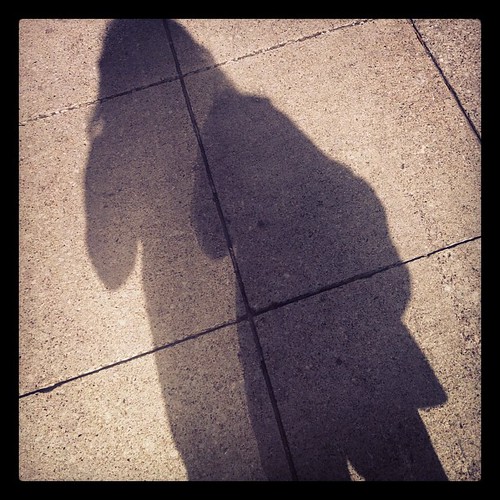
Shadows are formed when the path of light from a source is blocked by an object. In this instance the source of light is the sun, and the object blocking the light is the students’ bodies.
Whilst students do not formally learn about light and shadows until Year 5, or the causes of day and night (in detail) until Year 6, they will have made experiential observations of these phenomena during their daily activities, and will likely be aware that when in the sun (or even another light source) their bodies can cast a shadow, and that this shadow moves with them.
Students may have questions, and limited understanding, about how and why these shadows change over the course of the day.
By investigating shadows, students can identify patterns about the positions and movements of the Sun without looking directly at it, which is a safety issue.
The shape of a shadow is affected by:
- the shape of the object blocking the light.
- how close the object is to the light source.
- the position of the light source relative to the object, for example, whether the light source is above or at the same level as the object.
These last two factors come into play as the sun ‘moves across the sky’ (as students may describe it) throughout the day.
In reality, although the Sun appears to move across the sky from east to west during the day, almost all of the Sun’s apparent motion across the sky comes from the rotation of the Earth. It is the spinning of the Earth on its axis that causes the shadows to move and creates the impression of the Sun moving across the sky.
At this stage of development, it is not necessary to correct students’ use of this type of language (i.e. ‘the sun moves’), as the focus is on observing the patterns—that the same things happen every day at a similar time. However, it is also important that we do not inadvertently reinforce these alternative concepts with the language we use in the classroom. Alternative phrases to use include: The direction of the sunlight shifts/moves during the day or The Sun and Earth move so the shadows move.
More information about how shadows are cast
When the position of the light source is right above the object, the object will cast a short shadow on the ground. As the light source moves downwards, the object will cast a longer shadow. This is why when the Sun is directly overhead, people and objects cast very small, short shadows. In the morning and afternoon, however, when the Sun is low on the horizon, they cast very long shadows. As the position of the Sun in the sky changes from east in the morning to west in the afternoon, the direction of shadows changes. The change in the position of a shadow throughout the day is what allows shadows to be used when telling the time using sundials.
Shadows are formed when the path of light from a source is blocked by an object. In this instance the source of light is the sun, and the object blocking the light is the students’ bodies.
Whilst students do not formally learn about light and shadows until Year 5, or the causes of day and night (in detail) until Year 6, they will have made experiential observations of these phenomena during their daily activities, and will likely be aware that when in the sun (or even another light source) their bodies can cast a shadow, and that this shadow moves with them.
Students may have questions, and limited understanding, about how and why these shadows change over the course of the day.
By investigating shadows, students can identify patterns about the positions and movements of the Sun without looking directly at it, which is a safety issue.
The shape of a shadow is affected by:
- the shape of the object blocking the light.
- how close the object is to the light source.
- the position of the light source relative to the object, for example, whether the light source is above or at the same level as the object.
These last two factors come into play as the sun ‘moves across the sky’ (as students may describe it) throughout the day.
In reality, although the Sun appears to move across the sky from east to west during the day, almost all of the Sun’s apparent motion across the sky comes from the rotation of the Earth. It is the spinning of the Earth on its axis that causes the shadows to move and creates the impression of the Sun moving across the sky.
At this stage of development, it is not necessary to correct students’ use of this type of language (i.e. ‘the sun moves’), as the focus is on observing the patterns—that the same things happen every day at a similar time. However, it is also important that we do not inadvertently reinforce these alternative concepts with the language we use in the classroom. Alternative phrases to use include: The direction of the sunlight shifts/moves during the day or The Sun and Earth move so the shadows move.
More information about how shadows are cast
When the position of the light source is right above the object, the object will cast a short shadow on the ground. As the light source moves downwards, the object will cast a longer shadow. This is why when the Sun is directly overhead, people and objects cast very small, short shadows. In the morning and afternoon, however, when the Sun is low on the horizon, they cast very long shadows. As the position of the Sun in the sky changes from east in the morning to west in the afternoon, the direction of shadows changes. The change in the position of a shadow throughout the day is what allows shadows to be used when telling the time using sundials.
Vocabulary spotlight—the position of the Sun
Why is it important to take care when talking about the ‘movement’ of the Sun (and stars)?
Care has been taken in this lesson (and in Lesson 5 where students explore stars) to use phrases such as ‘apparent movement’ and ‘changing position’ when talking about the Sun and stars. This is done to avoid reinforcing any alternative conceptions students may hold about the relative position and movements of the Sun, Earth, Moon, stars and planets.
It is unlikely that students will have an understanding of our Sun-centred solar system at this stage of development, and they will not formally learn about this until Year 6. They may use phrases such as "the Sun (or stars) moves across the sky", as that is what they understand from their Earth-centred experiences.
However, the Sun and the stars do not move—rather it is the Earth that is rotating around the Sun whilst revolving on its axis, and the Moon that is rotating around the Earth.
By using terms such as ‘apparent movement’ and describing the position of the Sun and stars we can avoid confusing students or inadvertently reinforcing their alternative conceptions. However, it is not necessary to correct students at this stage, if they do use phrases such as "the Sun (or stars) moves across the sky".
Care has been taken in this lesson (and in Lesson 5 where students explore stars) to use phrases such as ‘apparent movement’ and ‘changing position’ when talking about the Sun and stars. This is done to avoid reinforcing any alternative conceptions students may hold about the relative position and movements of the Sun, Earth, Moon, stars and planets.
It is unlikely that students will have an understanding of our Sun-centred solar system at this stage of development, and they will not formally learn about this until Year 6. They may use phrases such as "the Sun (or stars) moves across the sky", as that is what they understand from their Earth-centred experiences.
However, the Sun and the stars do not move—rather it is the Earth that is rotating around the Sun whilst revolving on its axis, and the Moon that is rotating around the Earth.
By using terms such as ‘apparent movement’ and describing the position of the Sun and stars we can avoid confusing students or inadvertently reinforcing their alternative conceptions. However, it is not necessary to correct students at this stage, if they do use phrases such as "the Sun (or stars) moves across the sky".
The Inquire phase allows students to cycle progressively and with increasing complexity through the key science ideas related to the core concepts. Each Inquire cycle is divided into three teaching and learning routines that allow students to systematically build their knowledge and skills in science and incorporate this into their current understanding of the world.
When designing a teaching sequence, it is important to consider the knowledge and skills that students will need in the final Act phase. Consider what the students already know and identify the steps that need to be taken to reach the level required. How could you facilitate students’ understanding at each step? What investigations could be designed to build the skills at each step?
Read more about using the LIA FrameworkThe Investigate routine provides students with an opportunity to explore the key ideas of science, to plan and conduct an investigation, and to gather and record data. The investigations are designed to systematically develop content knowledge and skills through increasingly complex processes of structured inquiry, guided inquiry and open inquiry approaches. Students are encouraged to process data to identify trends and patterns and link them to the real-world context of the teaching sequence.
When designing a teaching sequence, consider the diagnostic assessment (Launch phase) that identified the alternative conceptions that students held. Are there activities that challenge these ideas and provide openings for discussion? What content knowledge and skills do students need to be able to complete the final (Act phase) task? How could you systematically build these through the investigation routines? Are there opportunities to build students’ understanding and skills in the science inquiry processes through the successive investigations?
Read more about using the LIA FrameworkPatterns in the sky
Establish (by modelling using a torch or other light source) that shadows are cast in the opposite direction to where the light is coming from.
Using a demonstration copy of the Moving shadows investigation planner Resource sheet record the questions students are looking to answer through the investigation:
- What happens to the length and direction of a human shadow during the day?
- When are shadows at their longest and shortest?
Explain that students will work in teams, with one student selected as the ‘object’ that will be casting a shadow, and that their shadow will be traced around at regular intervals throughout the day to see what happens to it.
Students make predictions about what will happen to their shadow throughout the day. Record predictions either as a class or individually.
Discuss and model how students will complete their investigation planner, identifying what they will:
- change: for this investigation, the time of day will change.
- measure/observe: record the length and direction of the shadow by drawing around the shadow.
- keep the same: the same person, the person’s position on the playground (mark the location of their feet so they can go back to the same place).
Highlight fair test principles by discussing why it is important for one student (only) to be selected as the ‘object’ casting the shadow, and why it is important for them to stand in the same place each time their shadow was traced.
Brainstorm solutions for how teams might ensure the ‘object’ student stands in exactly the same place each time, such as drawing around their feet with chalk or marking the position with masking tape.
Select the solution most suitable for your context and model for students how they might carry this out carefully and accurately.
It might also be necessary to model for students how to carefully trace around the object’s shadow. Consider using different coloured chalk, recording the time the outline was drawn, or using a single large piece of paper throughout the day to maintain records (paper will need to be firmly affixed to the ground to ensure it does not move during the day).
Allow teams the opportunity to complete the investigation, marking the position of the object’s shadow at regular intervals throughout the day (for examples at 10 a.m., 11 a.m., 12 p.m., 1 p.m. and 2 p.m.), recording the time each shadow was traced alongside it.
After the final shadow has been traced, teams should take a photograph showing the movement of the shadow across the day. They could also do this at each interval, but it is not necessary if the shadows have been traced clearly.
Optional: It would be ideal for students to repeat this investigation on a subsequent day, so that a pattern can be established. However, if that is not possible you might conduct a discussion with students to establish that similar movement of shadows will occur each day.
Aboriginal and Torres Strait Islander Histories and Cultures
How might I bring a First Nations perspective to this lesson?
First Nations’ Australians have been using the Sun’s observable movements across the sky to tell the time and mark events for a very long time. There are many stories told to help explain the creation and movements of the Sun. Many of these also relate to specific times of the year, such as the migration and breeding of animals, and the growth or ripening of specific plants. Features of the landscape have even been used or created to mark the passing of time.
Before sharing First Nations traditional knowledge with students, your first contact should be First Nations education officers, community groups, or elders. They will be able to guide you in sharing local knowledge in an appropriate manner.
There are also many published resources that you can share, including:
- The story of Sun woman Walu, from the Yolngu traditions of Arnhem Land in the far north of Australia.
- The stone arrangement Wurdi Youang, in Victoria, marks the equinoxes and solstices.
First Nations’ Australians have been using the Sun’s observable movements across the sky to tell the time and mark events for a very long time. There are many stories told to help explain the creation and movements of the Sun. Many of these also relate to specific times of the year, such as the migration and breeding of animals, and the growth or ripening of specific plants. Features of the landscape have even been used or created to mark the passing of time.
Before sharing First Nations traditional knowledge with students, your first contact should be First Nations education officers, community groups, or elders. They will be able to guide you in sharing local knowledge in an appropriate manner.
There are also many published resources that you can share, including:
- The story of Sun woman Walu, from the Yolngu traditions of Arnhem Land in the far north of Australia.
- The stone arrangement Wurdi Youang, in Victoria, marks the equinoxes and solstices.
The Inquire phase allows students to cycle progressively and with increasing complexity through the key science ideas related to the core concepts. Each Inquire cycle is divided into three teaching and learning routines that allow students to systematically build their knowledge and skills in science and incorporate this into their current understanding of the world.
When designing a teaching sequence, it is important to consider the knowledge and skills that students will need in the final Act phase. Consider what the students already know and identify the steps that need to be taken to reach the level required. How could you facilitate students’ understanding at each step? What investigations could be designed to build the skills at each step?
Read more about using the LIA FrameworkFollowing an investigation, the Integrate routine provides time and space for data to be evaluated and insights to be synthesized. It reveals new insights, consolidates and refines representations, generalises context and broadens students’ perspectives. It allows student thinking to become visible and opens formative feedback opportunities. It may also lead to further questions being asked, allowing the Inquire phase to start again.
When designing a teaching sequence, consider the diagnostic assessment that was undertaken during the Launch phase. Consider if alternative conceptions could be used as a jumping off point to discussions. How could students represent their learning in a way that would support formative feedback opportunities? Could small summative assessment occur at different stages in the teaching sequence?
Read more about using the LIA FrameworkRecognising the patterns
In this Integrate step, guide students to link their experiences in the investigation to the science concept being explored—in this instance, that the Sun is in different positions in the sky throughout the day, and that this forms a pattern, creating shadows that can be used to tell the time. Through questioning and discussion, students should come to a consensus that:
|
Teams share and compare records of their human shadow observations, referring back to the investigation questions:
- What happens to the length and direction of a human shadow during the day?
- When are shadows at their longest and shortest?
- What happened to the shadow over the course of the day?
- When was the shadow the shortest? When was it the longest?
- Using the data we have collected, what time/s of day do you think it might be when you would have the smallest shadow?
- What time/s of day do you think it might be when we have the longest shadow? Why do you think that?
- How does your data compare to other teams’ data? Is it the same? Different? Do you notice any patterns?
- What does the change in shadows tell you about the position of the sun (the source of light) during the day?
- Why did the direction of the shadow change during the day?
- Will you get the same results if you repeat the experiment tomorrow or the day after?
- Or, if students repeated the investigation the following day: Did we get the same/similar results when we repeated the investigation on a different day? Why do you think that is?
- What was challenging, or could have been challenging, about conducting this investigation? How could it be improved?
- Keeping in mind that a shadow is formed in the opposite direction that light is coming from, what does our investigation tell us about the position of the sun in the sky during the day?
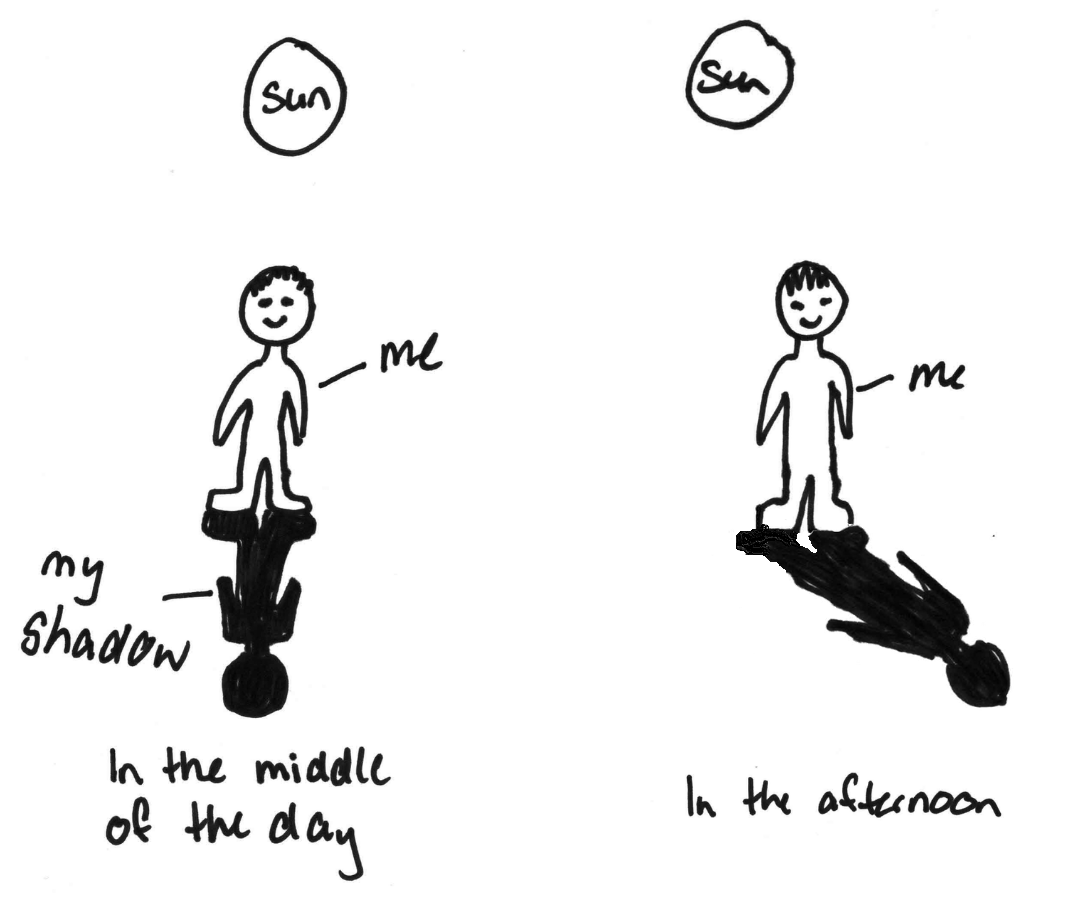
Students draw a diagram showing themselves, the position of their shadow, and the position of the Sun at different times of the day.
Optional: Discuss sundials, and how they have been used in the past to keep track of time. Discuss how the object in this activity became a type of human sundial. Also discuss why sundials are no longer used as the main method of time keeping. If showing images/videos of sundials, ensure you show one that has been designed for the southern hemisphere. See the embedded professional learning on Sundials below for more information.
Reflect on the lesson
You might:
- add words and images to the class word wall.
- re-examine the intended learning goals for the lesson and consider how they were achieved.
- discuss how students were thinking and working like scientists during the lesson. Focus on the activities where students are noticing/observing, and also ‘drawing‘, linking this back to the scientific skills of recording data.
Sundials
How does a sundial work, and how do they differ between the hemispheres?
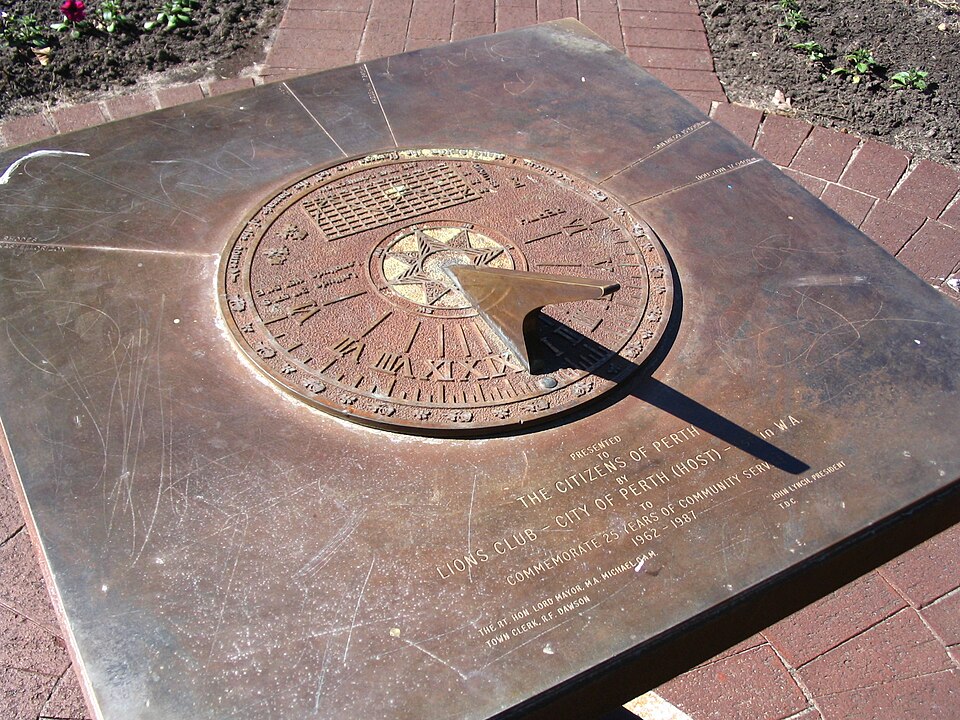
A sundial works by casting a shadow from a pole, T-bar or ‘gnomon’ onto a marked surface to show the time. As the sun changes position in the sky, the shadows cast by the pole, T-bar or gnomon change direction as well, thus pointing towards a different marked time.
The key difference between sundials in the northern and southern hemispheres is caused by the Sun’s apparent path across the sky.
In the northern hemisphere:
- the Sun appears in the southern part of the sky at midday.
- the gnomon points toward true north (toward the North Celestial Pole, near Polaris).
- the shadows move clockwise throughout the day on a standard horizontal sundial.
In the southern hemisphere:
- the Sun appears in the northern part of the sky at midday.
- the gnomon points toward true south (toward the South Celestial Pole).
- the shadow moves counterclockwise on a standard horizontal sundial.
This means that a sundial in the southern hemisphere is essentially “reversed” compared to one in the northern hemisphere, because the Sun travels through the opposite half of the sky.
A sundial works by casting a shadow from a pole, T-bar or ‘gnomon’ onto a marked surface to show the time. As the sun changes position in the sky, the shadows cast by the pole, T-bar or gnomon change direction as well, thus pointing towards a different marked time.
The key difference between sundials in the northern and southern hemispheres is caused by the Sun’s apparent path across the sky.
In the northern hemisphere:
- the Sun appears in the southern part of the sky at midday.
- the gnomon points toward true north (toward the North Celestial Pole, near Polaris).
- the shadows move clockwise throughout the day on a standard horizontal sundial.
In the southern hemisphere:
- the Sun appears in the northern part of the sky at midday.
- the gnomon points toward true south (toward the South Celestial Pole).
- the shadow moves counterclockwise on a standard horizontal sundial.
This means that a sundial in the southern hemisphere is essentially “reversed” compared to one in the northern hemisphere, because the Sun travels through the opposite half of the sky.