

'Eyes on Earth' IS ONE OF OUR NEW TEACHING SEQUENCES FOR V9
- On the 'Sequence overview' tab you'll find all the lessons in this sequence and curriculum alignment.
- The 'Our design decisions' tab shows how key scientific ideas develop over the sequence, and shows how the sequence addresses curriculum achievement standards.
- The 'Preparing for this sequence' tab guides you through important information and considerations for this sequence.
- Have you taught this sequence? Use the Feedback button to let us know how it went!
Launch
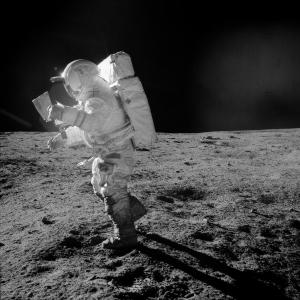
Mission 1 • An astronaut’s life
Students are introduced to Earth as our shared home planet and explore how we can observe features and changes in the sky. In this context, they take on the role of junior astronauts, creating a record of their observations about Earth.

Inquire
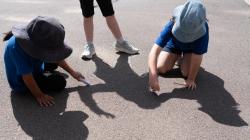
Mission 2 • Observing Earth’s unique features
Students observe and identify Earth’s unique characteristics as a planet in the solar system.
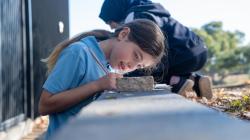
Mission 3 • Observing the Sun’s movement via shadows
Students explore ideas, collect evidence, keep records and discuss observations of the apparent movement of the Sun across the sky during the day.
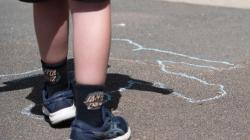
Mission 4 • Moon watch
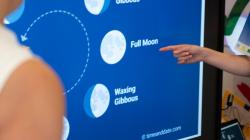
Students are introduced to Earth’s Moon, a natural satellite. Students learn how scientists must make regular observations to help them identify patterns and make predictions, then use their own observations to make Moon wheels to predict the appearance of the Moon.
Mission 5 • Star gazing
Students observe and identify their own star patterns and follow the movements of known constellations in the sky.

Mission 6 • Our planetary neighbours
Students identify the celestial objects that are around Earth.

Act
Mission 7 • Bringing the data together
Students make a ‘golden record’ to share what they have learned about Earth during their missions.

The Australian Academy of Science supports and encourages broad use of its material. Unless indicated below, copyright material available on this website is licensed under a Creative Commons Attribution-NonCommercial-ShareAlike 4.0 International (CC BY-NC-SA 4.0) licence.
Curriculum and syllabus alignment
Year 2
By the end of Year 2 students identify celestial objects and describe patterns they observe in the sky. They describe how people use science in their daily lives and how people use patterns to make scientific predictions.
Students pose questions to explore observed patterns or relationships and make predictions based on experience. They suggest steps to be followed in an investigation and follow safe procedures to make and record observations. They use provided tables and organisers to sort and order data and represent patterns in data. With guidance, they compare their observations with those of others, identify whether their investigation was fair and identify further questions. They use everyday and scientific vocabulary to communicate observations, findings and ideas.
Science as a human endeavour
Describe how people use science in their daily lives, including using patterns to make scientific predictions
Science understanding
Recognise Earth is a planet in the solar system and identify patterns in the changing position of the sun, moon, planets and stars in the sky
Science inquiry
Pose questions to explore observed simple patterns and relationships and make predictions based on experiences
Sort and order data and information and represent patterns, including with provided tables and visual or physical models
Compare observations with predictions and others observations, consider if investigations are fair and identify further questions with guidance
Write and create texts to communicate observations, findings and ideas, using everyday and scientific vocabulary
Australian curriculum content links
| Science understanding core concept: Earth is part of an astronomical system; interactions between Earth and celestial bodies influence the Earth system. |
| Sub-strand | Content descriptor | AC code | Achievement standard | How the sequence addresses this content |
| SHE: Use and influence of science | Describe how people use science in their daily lives, including using patterns to make scientific predictions. | AC9S2H01 | Describe how people use science in their daily lives and how people use patterns to make scientific predictions. | Consider how technological advancements such as satellites allow us to make repeated observations of the Earth. (Lessons 1-2 and 4-6) |
| SU: Earth and space sciences | Recognise Earth is a planet in the solar system and identify patterns in the changing position of the Sun, Moon, planets and stars in the sky. | AC9S2U01 | Identify celestial objects and describe patterns they observe in the sky. | Observe and identify patterns in the changing position of the sun across the sky. (Lesson 3) Observe and identify patterns in the apparent changing appearance of the moon over time. (Lesson 4) Observe patterns of stars in the sky using online digital platforms. (Lesson 5) |
| SI: Questioning and predicting | Pose questions to explore observed simple patterns and relationships and make predictions based on experiences. | AC9S2I01 | Pose questions to explore observed patterns or relationships and make predictions based on experience. | Pose questions to underpin their exploration of Earth and its place in the solar system. (Lesson 1) |
| SI: Planning and conducting | Suggest and follow safe procedures to investigate questions and test predictions | AC9S2I02 | They suggest steps to be followed in an investigation and follow safe procedures to make and record observations. | Follow safe procedure to investigate the size and direction of shadows, not looking directly at the sun. (Lesson 3) |
| SI: Planning and conducting | Make and record observations, including informal measurements, using digital tools as appropriate. | AC9S2I03 | Suggest steps to be followed in an investigation and follow safe procedures to make and record observations. | Make and record observations of shadow size and direction, including informal measurements, using photos and drawing around the shadows using chalk. (Lesson 3) Make observations of planet Earth using a range of digital tools to answer questions. (Lessons 1-2 and 4-6) Make and record observations of the appearance of the moon over a month. (Lesson 4) |
| SI: Processing, modelling and analysing | Sort and order data and information and represent patterns, including with provided tables and visual or physical models. | AC9S2I04 | Use provided tables and organisers to sort and order data and represent patterns in data. | Use secondary data to investigate the apparent movement of celestial bodies, identifying patterns created by these apparent movements. (Lessons 3-5) |
| SI: Evaluating | Compare observations with predictions and others’ observations, consider if investigations are fair and identify further questions with guidance. | AC9S2I05 | With guidance, compare observations with those of others, identify whether their investigation was fair and identify further questions. | Use their own observations alongside those of others to learn about Earth. (Lessons 2-6) Identify further questions related to observing the appearance of the moon over a month. (Lesson 4) |
| SI: Communicating | Write and create texts to communicate observations, findings and ideas, using everyday and scientific vocabulary. | AC9S2I06 | Use everyday and scientific vocabulary to communicate observations, findings and ideas. | Create and refine representations to communicate their observations of Earth, sharing their findings and key vocabulary about their home planet to an audience. (Lesson 7) |
Science journals
Create a class science journal, either in hard-copy or digitally. You might:
- use/create a large scrap book or flip chart.
- use poster/butchers’ paper so learning can be displayed in sequence on the wall.
- create a digital journal using your platform/technology of choice.
- any combination of the above.
Plan for students’ creation of an individual science journal, either in hard-copy or digitally. They might:
- use an exercise book, scrap book or flip chart to record their thinking and gather resource sheets together.
- use a folder to store and collate resource sheets, diagrams, photographs etc.
- use a digital folder to store work samples, images and videos.
- any combination of the above.
See Using a science journal throughout inquiry for more detailed information on the importance of science journals.
General preparation
- Read through the teaching sequence.
- Note any adaptations you would like to make to suit your school and students’ context.
- Prepare demonstration copies of Resource sheets as required.
- Collect the resources required for the sequence.
Safety considerations when teaching this sequence
In Lesson 3 of this sequence students examine the movements of the Sun by tracking it indirectly via shadows.
Begin the lesson by discussing the dangers of looking directly at the Sun. Looking directly at the sun can cause permanent, irreversible eye damage.
Remind students of this safety measure as the sequence progresses when appropriate.

'Eyes on Earth' IS ONE OF OUR NEW TEACHING SEQUENCES FOR V9
- On the 'Sequence overview' tab you'll find all the lessons in this sequence and curriculum alignment.
- The 'Our design decisions' tab shows how key scientific ideas develop over the sequence, and shows how the sequence addresses curriculum achievement standards.
- The 'Preparing for this sequence' tab guides you through important information and considerations for this sequence.
- Have you taught this sequence? Use the Feedback button to let us know how it went!