

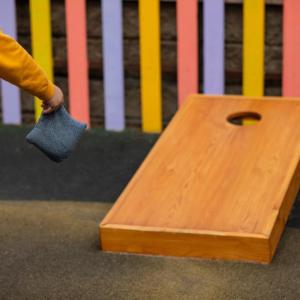
'Forces are fun' IS A NEW V9 SEQUENCE.
- On the 'Sequence overview' tab you'll find all the lessons in this sequence and curriculum alignment.
- The 'Our design decisions' tab shows how key scientific ideas develop over the sequence, and shows how the sequence addresses curriculum achievement standards.
- The 'Preparing for this sequence' tab guides you through important information and considerations for this sequence.
- Have you taught this sequence? Use the Feedback button to let us know how it went!
Launch
Lesson 1 • Fun with forces
Students are introduced to the content and context of the sequence—exploring push and pull forces—by participating in a series of activities designed to elicit their prior knowledge and explore these forces in action.


Inquire
Lesson 2 • Describing motion
Students identify everyday actions in the classroom that require push and pull forces, and use their experience to define what push and pull forces are.
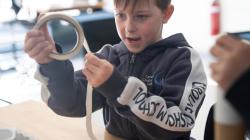
Lesson 3 • Pushes and pulls can cause motion
Students explore how and when pushes and pulls cause the motion of objects.

Lesson 4 • Changing direction
Students investigate how push and pull forces can make an object change direction.
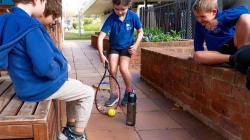
Lesson 5 • Changing shape
Students investigate how push and pull forces can cause objects to change shape/form.
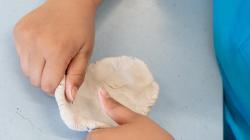
Lesson 6 • Pushing it further
Students explore how the strength of a push force can affect how far or fast an object moves.
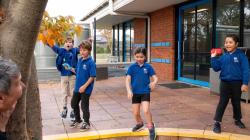
Lesson 7 • Pulling light and heavy objects
Students investigate how mass affects the motion of objects when they are pulled.
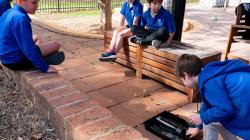
Act
Lesson 8 • Designing an activity
Students apply their learning about push and pull forces to design an activity that utilises these forces in different ways.

The Australian Academy of Science supports and encourages broad use of its material. Unless indicated below, copyright material available on this website is licensed under a Creative Commons Attribution-NonCommercial-ShareAlike 4.0 International (CC BY-NC-SA 4.0) licence.
Curriculum and syllabus alignment
Year 1
By the end of Year 1 students describe how different pushes and pulls change the motion and shape of objects. They describe situations where they use science in their daily lives and identify examples of people making scientific predictions.
Students pose questions to explore observations and make predictions based on experiences. They follow safe procedures to make and record observations. They use provided tables and organisers to sort and order data and information and, with guidance, represent patterns. With guidance, they compare observations with predictions and identify further questions. They use everyday vocabulary to communicate observations, findings and ideas.
Science as a human endeavour
Describe how people use science in their daily lives, including using patterns to make scientific predictions
Science understanding
Describe pushes and pulls in terms of strength and direction and predict the effect of these forces on objects' motion and shape
Science inquiry
Pose questions to explore observed simple patterns and relationships and make predictions based on experiences
Sort and order data and information and represent patterns, including with provided tables and visual or physical models
Compare observations with predictions and others observations, consider if investigations are fair and identify further questions with guidance
Write and create texts to communicate observations, findings and ideas, using everyday and scientific vocabulary
Australian curriculum content links
| Science understanding core concept: Forces affect the motion and behaviour of objects. |
| Sub-strand | Content descriptor | AC code | Achievement standard | Elaboration/application |
| SHE: Use and influence of science | Describe how people use science in their daily lives, including using patterns to make scientific predictions. | AC9S1H01 | Describe situations where they use science in their daily lives and identify examples of people making scientific predictions. | Identify how they use push and pull forces to complete daily tasks. (Lesson 6) Identify patterns to support them to draw scientific conclusions about the effect of the strength of a push or pull force. (Lesson 6) |
| SU: Physical sciences | Describe pushes and pulls in terms of strength and direction and predict the effect of these forces on objects’ motion and shape. | AC9S1U03 | Describe how different pushes and pulls change the motion and shape of objects. | Identify and utilise push and pull forces (Lessons 1-8), including to change an object’s direction (Lessons 3, 4) or shape (Lesson 5), with varying magnitudes. (Lesson 6). |
| SI: Questioning and predicting | Pose questions to explore observed simple patterns and relationships and make predictions based on experiences. | AC9S1I01 | Pose questions to explore observations and make predictions based on experiences. | Make predictions about the effects of push and pull forces. (Lesson 3-7) |
| SI: Planning and conducting | Suggest and follow safe procedures to investigate questions and test predictions. | AC9S1I02 | Follow safe procedures to make and record observations. | Explore the scientific method of trial and error. (Lesson 6) Contribute to the planning of fair test investigations. (Lesson 7) |
| SI: Planning and conducting | Make and record observations, including informal measurements, using digital tools as appropriate. | AC9S1I03 | Follow safe procedures to make and record observations. | Make and record observations of the impact on push and pull forces on the movement of people and objects. (Lessons 1-8) Participate safely in activities that explore push and pull forces. (Lessons 1-8) |
| SI: Processing, modelling and analysing | Sort and order data and information and represent patterns, including with provided tables and visual or physical models. | AC9S1I04 | Use provided tables and organisers to sort and order data and information and, with guidance, represent patterns. | Create labelled diagrams that use arrows to show the direction and magnitude of push and pull forces. (Lessons 3-8) |
| SI: Evaluating | Compare observations with predictions and others’ observations, consider if investigations are fair and identify further questions with guidance. | AC9S1I05 | With guidance, compare observations with predictions and identify further questions. | Discuss findings and reach consensus about the effects of push and pull forces. (Lessons 2-7) |
| SI: Communicating | Write and create texts to communicate observations, findings and ideas, using everyday and scientific vocabulary. | AC9S1I06 | Use everyday vocabulary to communicate observations, findings and ideas. | Verbally share observations, ideas and understanding about the effects of push and pull forces. (Lessons 1-8) Design, and participate in, hands-on activities that require the use of push and pull forces. (Lessons 1-8) |
Science journals
Create a class science journal, either in hard-copy or digitally. You might:
- use/create a large scrap book or flip chart.
- use poster/butchers’ paper so learning can be displayed in sequence on the wall.
- create a digital journal using your platform/technology of choice.
- any combination of the above.
Plan for students’ creation of an individual science journal, either in hard-copy or digitally. They might:
- use an exercise book, scrap book or flip chart to record their thinking and gather resource sheets together.
- use a folder to store and collate resource sheets, diagrams, photographs etc.
- use a digital folder to store work samples, images and videos.
- any combination of the above.
See Using a science journal throughout inquiry for more detailed information on the importance of science journals.
General preparation
- Read through the teaching sequence.
- Review the kind of equipment that you have available in your school and plan the obstacles/challenges you will create for the first lesson, and any other lessons where options have been presented (Lessons 3, 4, 6, 7).
- Note any adaptations you would like to make to suit your school and students’ context.
- Prepare demonstration copies of Resource sheets as required.
- Collect the resources required for the sequence.
Taking and printing photographs
In the sequence students are expected to represent push and pull forces with arrows, to show where the force occurs, its direction and magnitude.
One way of doing this is by asking students to draw a picture including force arrows. Another way is to ask them to annotate a photograph with force arrows.
Using photographs is effective because students are able to refer back to their direct experiences when making their annotations.
Determine a method for taking and printing photos that is suitable for the resources you have and students’ needs. You might:
- print a selection of photos immediately after taking them. Many digital devices are able to connect directly to printer over a wi-fi network.
- take photos and print them at a later time. In most lessons it is viable to complete the Investigate routine (where photos are generally taken) and then return to the Integrate routine at a later time. Alternatively, allow time at the beginning of each science lesson for students to annotate photos taken in the previous lesson.
You may choose to take/annotate photos at the beginning of the sequence, and progress to students drawing their own diagrams later in the sequence once they are more experienced at recognising where the force arrows should go.
Making playdough for Lesson 5
Consider if you would prefer to make homemade playdough for Lesson 5. Alternatively, students could make their own playdough. Take care to ensure it has cooled down sufficiently before allowing students to knead it.
Recipe for homemade playdough
2 tbs cooking oil
4 tbs cream of tartar
2 cups plain flour
Food colouring
2 cups cold water
(Stove top) Mix all ingredients in a saucepan and stir continuously over medium heat for 3-5 minutes, until the mixture is combined and not sticky. Allow to cool. Knead until smooth.
(Microwave) Mix all ingredients in a large microwave-safe bowl. Microwave for 2 minutes. Stir well. Microwave for 1 minute 30 seconds. Stir well. Microwave for 30 seconds. The mixture should be combined and not sticky. Allow to cool. Knead until smooth.

'Forces are fun' IS A NEW V9 SEQUENCE.
- On the 'Sequence overview' tab you'll find all the lessons in this sequence and curriculum alignment.
- The 'Our design decisions' tab shows how key scientific ideas develop over the sequence, and shows how the sequence addresses curriculum achievement standards.
- The 'Preparing for this sequence' tab guides you through important information and considerations for this sequence.
- Have you taught this sequence? Use the Feedback button to let us know how it went!