


'Access all areas' IS ONE OF OUR NEW TEACHING SEQUENCES FOR V9
- On the 'Sequence overview' tab you'll find all the lessons in this sequence and curriculum alignment.
- The 'Our design decisions' tab shows how key scientific ideas develop over the sequence, and shows how the sequence addresses curriculum achievement standards.
- The 'Preparing for this sequence' tab guides you through important information and considerations for this sequence.
- Have you taught this sequence? Use the Feedback button to let us know how it went!
Launch
Lesson 1 • Portable packages
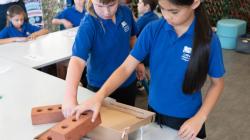
Students connect to the content and context of the sequence by transporting a package, which must always stay in contact with the ground, across different surfaces. They describe how the object moved and record their observations using prior knowledge about forces.

Inquire
Lesson 2 • Feeling friction
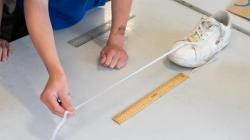
Students explore friction by investigating the amount of force required to pull a shoe across a surface.
Lesson 3 • Gravity’s grasp
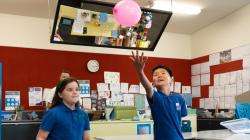
Students explore how the force of gravity pulls things towards the Earth, and how objects with more mass require more force to move.
Lesson 4 • Magnetic movement
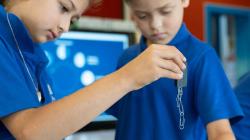
Students measure magnetic strength by determining how far apart a magnet and magnetic material can be before the magnetic force is too weak to cause movement.
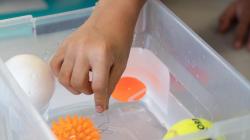
Lesson 5 • Floating free
Students observe how liquids exert an upward force that enables objects to float. They then test how different raft shapes affect buoyancy by measuring how much weight each raft can hold before sinking.
Lesson 6 • Reliable rollers
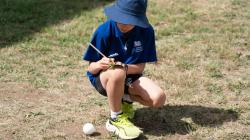
Students explore toy rollers made and played with by First Nations children in inland Australia, and investigate how they can be changed to suit specific conditions.
Act
Lesson 7 • Access allowed
Students consolidate their learning by designing an accessibility solution that facilitates access to difficult terrain by using and/or overcoming forces. They represent what they know about forces by drawing a labelled/annotated diagram of their accessibility solution.

The Australian Academy of Science supports and encourages broad use of its material. Unless indicated below, copyright material available on this website is licensed under a Creative Commons Attribution-NonCommercial-ShareAlike 4.0 International (CC BY-NC-SA 4.0) licence.
Curriculum and syllabus alignment
Year 4
By the end of Year 4 students identify forces acting on objects and describe their effect. They explain the role of data in science inquiry. They identify solutions based on scientific explanations and describe the needs these meet.
Students pose questions to identify patterns and relationships and make predictions based on observations. They plan investigations using planning scaffolds, identify key elements of fair tests and describe how they conduct investigations safely. They use simple procedures to make accurate formal measurements. They construct representations to organise data and information and identify patterns and relationships. They compare their findings with those of others, assess the fairness of their investigation, identify further questions for investigation and draw conclusions. They communicate ideas and findings for an identified audience and purpose, including using scientific vocabulary when appropriate.
Science as a human endeavour
Science understanding
Identify how forces can be exerted by one object on another and investigate the effect of frictional, gravitational and magnetic forces on the motion of objects
Science inquiry
Pose questions to explore observed patterns and relationships and make predictions based on observations
Use provided scaffolds to plan and conduct investigations to answer questions or test predictions, including identifying the elements of fair tests, and considering the safe use of materials and equipment
Follow procedures to make and record observations, including making formal measurements using familiar scaled instruments and using digital tools as appropriate
Construct and use representations, including tables, simple column graphs and visual or physical models, to organise data and information, show simple relationships and identify patterns
Compare findings with those of others, consider if investigations were fair, identify questions for further investigation and draw conclusions
Write and create texts to communicate findings and ideas for identified purposes and audiences, using scientific vocabulary and digital tools as appropriate
Australian curriculum content links
| Science understanding core concept: Forces affect the motion and behaviour of objects. |
| Sub-strand | Content descriptor | AC code | Achievement standard | How the sequence addresses this content |
| SHE: Nature and development of science | Examine how people use data to develop scientific explanations. | AC9S4H01 | Explain the role of data in science inquiry. | Draw on data/evidence from investigations to explain the design of their mobility vehicle to meet the need of moving an object more easily across a challenging terrain. (Lesson 7) |
| SHE: Use and influence of science | Consider how people use scientific explanations to meet a need or solve a problem. | AC9S4H02 | Identify solutions based on scientific explanations and describe the needs these meet. | Use understanding of forces to inform the design of an accessibility solution for challenging terrain. (Lesson 7) |
| SU: Physical sciences | Identify how forces can be exerted by one object on another and investigate the effect of frictional, gravitational and magnetic forces on the motion of objects. | AC9S4U03 | Identify forces acting on objects and describe their effect. | Identify how forces can be exerted by one object on another and investigate the effect of frictional forces on the motion of an object. (Lesson 2) Identify how forces can be exerted by one object on another and investigate the effect of gravitational forces on the motion of an object. (Lesson 3) Identify how forces can be exerted by one object on another and investigate the effect of magnetic forces on the motion of an object. (Lesson 4) |
| SI: Questioning and predicting | Pose questions to explore observed patterns and relationships and make predictions based on observations. | AC9S4101 | Pose questions to identify patterns and relationships and make predictions based on observations. | Construct investigation questions to identify force at work (Lessons 2-5) and how they can improve the motion of their toy rollers. (Lesson 6) |
| SI: Planning and conducting | Use provided scaffolds to plan and conduct investigations to answer questions or test predictions, including identifying the elements of fair tests, and considering the safe use of materials and equipment. | AC9S4I02 | Plan investigations using planning scaffolds, identify key elements of fair tests and describe how they conduct investigations safely. | Use an investigation scaffold to design a fair test to identify forces at work. (Lessons 2-6) |
| SI: Planning and conducting | Follow procedures to make and record observations, including making formal measurements using familiar scaled instruments and using digital tools as appropriate. | AC9S4I03 | Use simple procedures to make accurate formal measurements. | Record observations and informal and formal measurements of force including making formal measurements. (Lessons 2-6) Consider the accuracy of informal measurements, and devices used for measuring force and how these can be improved. (Lessons 3-4) |
| SI: Processing, modelling and analysing | Construct and use representations, including tables, simple column graphs and visual or physical models, to organise data and information, show simple relationships and identify patterns. | AC9S4I04 | Construct representations to organise data and information and identify patterns and relationships. | Record data in simple tables. (Lessons 2-6 ) Represent data using force arrow diagrams and graphs where appropriate. (Lessons 2-7) |
| SI: Evaluating | Compare findings with those of others, consider if investigations were fair, identify questions for further investigation and draw conclusions. | AC9S4I05 | Compare findings with those of others, assess the fairness of the investigation, identify further questions for investigation and draw conclusions. | Draw conclusions about the magnitude of forces based on informal observations and formal measurements. (Lessons 2-7) Summarise and compare results of investigations. (Lessons 2-7) |
| SI: Communicating | Write and create texts to communicate findings and ideas for identified purposes and audiences, using scientific vocabulary and digital tools as appropriate. | AC9S4I06 | Communicate ideas and findings for an identified audience and purpose, including using scientific vocabulary when appropriate. | Design an accessibility solution to meet a community need. Communicate the design using force arrow diagrams. Evaluate own designs and those of others according to specific criteria. (Lessons 2 - 7) |
Science journals
Create a class science journal, either in hard-copy or digitally. You might:
- use/create a large scrap book or flip chart.
- use poster/butchers’ paper so learning can be displayed in sequence on the wall.
- create a digital journal using your platform/technology of choice.
- any combination of the above.
Plan for students’ creation of an individual science journal, either in hard-copy or digitally. They might:
- use an exercise book, scrap book or flip chart to record their thinking and gather resource sheets together.
- use a folder to store and collate resource sheets, diagrams, photographs etc.
- use a digital folder to store work samples, images and videos.
- any combination of the above.
See Using a science journal throughout inquiry for more detailed information on the importance of science journals.
General preparation
- Read through the teaching sequence.
- Note any adaptations you would like to make to suit your school’s and students’ context.
- Prepare demonstration copies of Resource sheets as required.
Selecting a specific context
At the end of the sequence, students will apply what they have learned about forces and how forces move objects to design an accessibility solution for people with diverse needs, such as wheelchair users, families with infants, or individuals with limited mobility.
Students will be required to design a solution for a specific context. Selecting a locally specific context will enable students to have a stronger personal connection to the task. Look for areas of unique natural beauty, usefulness or community significance in your area that may be challenging to access in general or in specific weather conditions. Some suggestions include:
- a local beach.
- a local park with steep gradients, stone pathways and loose rocks.
- a local area of wetland with soft, muddy ground.
Alternatively, you might allow students to select a location of their own choosing that they believe presents an accessibility challenge for a specific group.
The materials required for each lesson are listed on the lesson's page.

'Access all areas' IS ONE OF OUR NEW TEACHING SEQUENCES FOR V9
- On the 'Sequence overview' tab you'll find all the lessons in this sequence and curriculum alignment.
- The 'Our design decisions' tab shows how key scientific ideas develop over the sequence, and shows how the sequence addresses curriculum achievement standards.
- The 'Preparing for this sequence' tab guides you through important information and considerations for this sequence.
- Have you taught this sequence? Use the Feedback button to let us know how it went!