

Access all areas
View Sequence overviewStudents will:
- investigate how a toy roller moves across terrain.
- record data to show how the toy roller moved.
Students will represent their understanding as they:
- pose questions to identify the relationship between one variable and the way a toy roller moves.
- plan and conduct an investigation of the effect of one variable on the movement and speed of an object.
- construct an investigation question for a fair test investigation.
In this lesson, assessment is summative
Students working at the achievement standard (science inquiry) should:
- be able to use provided scaffolds to plan and investigate to answer questions or test predictions, including identifying the elements of fair tests, and considering the safe use of materials and equipment.
Refer to the Australian Curriculum content links on the Our design decisions tab for further information.
Class science journal (digital or hard-copy)
1 x toy roller for demonstration purposes. These can be constructed in the following ways:
- using tin cans and lengths of craft wire as shown on the Museums Victoria website. Take care to use tins that do not have sharp edges (e.g. baby formula tins).
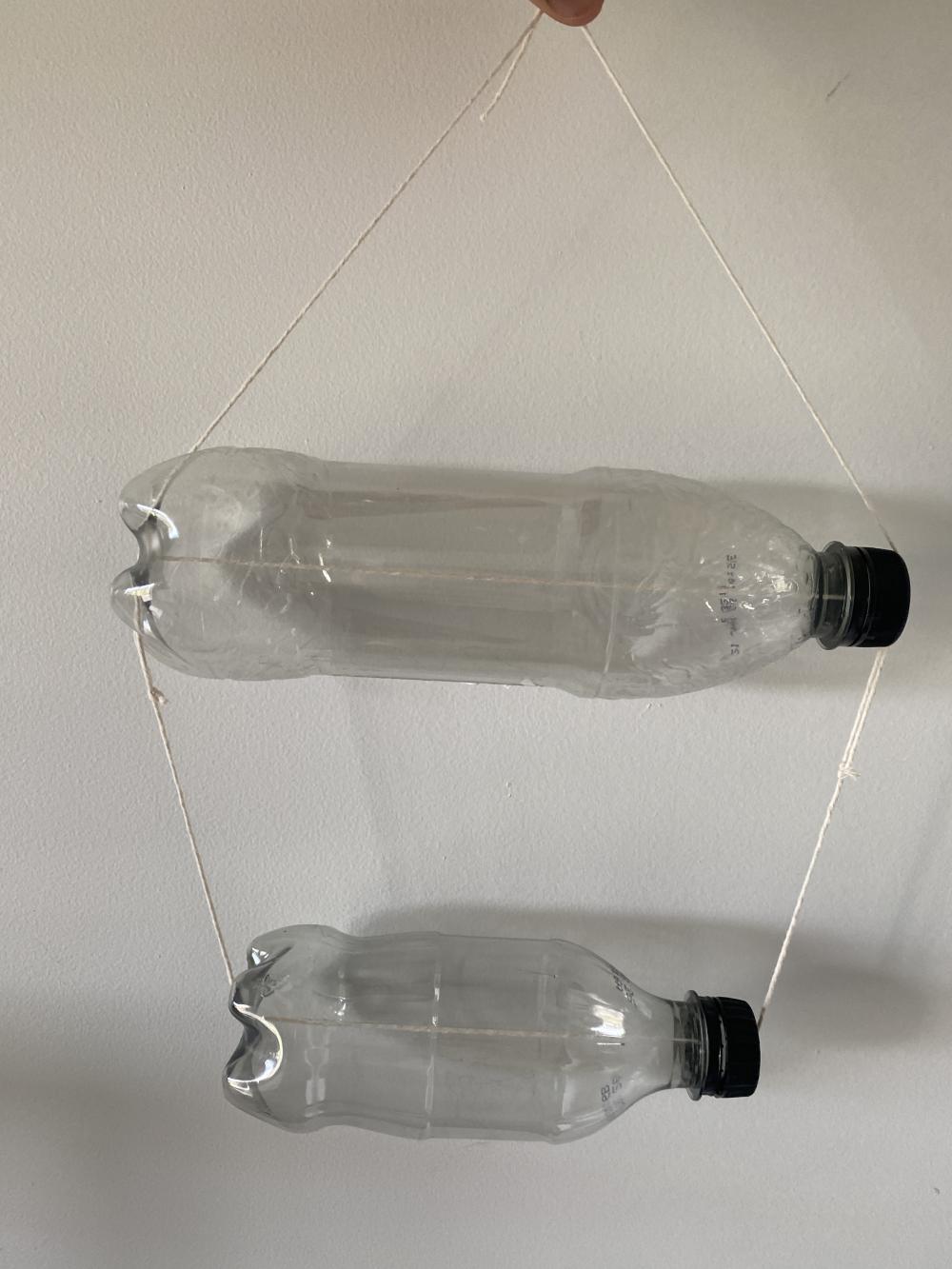
- using empty spherical drink containers and string as in the image below.
- using various other materials, as long as the basic design of the roller is followed:
- 2 cylindrical objects, one shorter (and thinner if possible) than the other.
- An axle runs through the smaller cylindrical object and connects (via loops or hooks) to an axle running through the larger cylindrical object.
- Both ends of the axle of the larger object are joined together or connected to form a handle.
Demonstration copy of the Variables grid Resource sheet
Optional: some simple toys, such as self-propelled cars, doll prams, toy lawnmowers, pool toys, or toy pets on leads.
A variety of materials to construct a toy roller, as described above
A variety of materials that students might use to vary something about their toy roller, for example:
- different materials to use for the axle, e.g. string and modelling wire.
- sand and water to fill the containers and change their mass.
- cylindrical objects of different sizes.
Individual science journal (digital or hard-copy)
Toy roller investigation planner Resource sheet
Lesson
Re-orient
Remind the students of the forces that have been investigated so far:
- friction
- gravity
- magnetism
- upthrust/buoyancy
Discuss how there are often many forces interacting when an object moves. This is what makes designing and building things that move really complex engineering!
Recall some of the investigations students have engaged in over the course of this sequence and the forces they have witnessed, such as opposing push and pull forces during the shoe investigation and pushing forces, friction and gravity when keeping the balloon afloat.
Optional: Examine some simple toys and consider the forces involved that make them work. Ideas might include self-propelled cars, doll prams, toy lawnmowers, pool toys, or toy pets on leads.
The Inquire phase allows students to cycle progressively and with increasing complexity through the key science ideas related to the core concepts. Each Inquire cycle is divided into three teaching and learning routines that allow students to systematically build their knowledge and skills in science and incorporate this into their current understanding of the world.
When designing a teaching sequence, it is important to consider the knowledge and skills that students will need in the final Act phase. Consider what the students already know and identify the steps that need to be taken to reach the level required. How could you facilitate students’ understanding at each step? What investigations could be designed to build the skills at each step?
Read more about using the LIA FrameworkIdentifying and constructing questions is the creative driver of the inquiry process. It allows students to explore what they know and how they know it. During the Inquire phase of the LIA Framework, the Question routine allows for past activities to be reviewed and to set the scene for the investigation that students will undertake. The use of effective questioning techniques can influence students’ view and interpretation of upcoming content, open them to exploration and link to their current interests and science capital.
When designing a teaching sequence, it is important to spend some time considering the mindset of students at the start of each Inquire phase. What do you want students to be thinking about, what do they already know and what is the best way for them to approach the task? What might tap into their curiosity?
Read more about using the LIA FrameworkRolling along
Show students tin rollers from the Australian Children’s Folklore Collection, Museums Victoria. Read the page for details about how First Nations children used tin cans to create tin rollers and how they played with them.
Optional: With input from the students, construct a force arrow diagram showing the forces involved when the tin rollers are raced. Use a single arrow to represent each force, adjusting the length for the size of the force and the arrowhead to show the direction of the force.
List the names of other push or pull-along toys that children still play with today.
Show students the sample toy roller that you have prepared and demonstrate how it works.
Ask students how they think might change the design of the toy rollers to meet different needs, for example to slow them down or increase their stability when rolling over bumpy terrain.
Discuss why this information might be useful when designing their accessibility solutions (including making rolling vehicles more safe for users, or able to move over difficult terrain).
Explain that this is sometimes what engineers do: they try to design things to work better than the versions that already exist, or to better meet different people’s needs.
Pose the question: How can we make a toy roller move more slowly/stably over a chosen terrain?
The Inquire phase allows students to cycle progressively and with increasing complexity through the key science ideas related to the core concepts. Each Inquire cycle is divided into three teaching and learning routines that allow students to systematically build their knowledge and skills in science and incorporate this into their current understanding of the world.
When designing a teaching sequence, it is important to consider the knowledge and skills that students will need in the final Act phase. Consider what the students already know and identify the steps that need to be taken to reach the level required. How could you facilitate students’ understanding at each step? What investigations could be designed to build the skills at each step?
Read more about using the LIA FrameworkThe Investigate routine provides students with an opportunity to explore the key ideas of science, to plan and conduct an investigation, and to gather and record data. The investigations are designed to systematically develop content knowledge and skills through increasingly complex processes of structured inquiry, guided inquiry and open inquiry approaches. Students are encouraged to process data to identify trends and patterns and link them to the real-world context of the teaching sequence.
When designing a teaching sequence, consider the diagnostic assessment (Launch phase) that identified the alternative conceptions that students held. Are there activities that challenge these ideas and provide openings for discussion? What content knowledge and skills do students need to be able to complete the final (Act phase) task? How could you systematically build these through the investigation routines? Are there opportunities to build students’ understanding and skills in the science inquiry processes through the successive investigations?
Read more about using the LIA FrameworkHow can we change the toy roller?
Use a variables grid to brainstorm What things might affect how slowly/stably the toy roller moves?
What you measure should be placed in the centre of the grid and marked with an M. In this case you may choose to measure the time it takes for the toy roller to move over a specific distance, or you might use the push and pull spring meters/Newton meters to measure the force required to pull the toy rollers. Other variables might include: the surface the toy roller is used on, the type of string/axle used, the size of the containers used, the mass of the containers, the surface area of the containers, if there’s anything inside the containers (besides air), how much is inside the containers.
Use the scaffold to determine the investigable questions that students will answer: What happens to __________ when we change __________?
If students are experienced in these types of investigations, teams may test a variable of their choice. This makes managing the investigation more complicated, but it can result in a wider variety of data to analyse. Alternatively, teams might also answer the same investigable question. This can allow students to compare data across teams and consider variations in results and why they might have occurred. Select the approach that is most appropriate for your students and context.
Teams use the Toy roller investigation planner Resource sheet to plan and carry out their investigation, including building their toy rollers with guidance as needed, recording observations and data, and evaluating their investigations.
Support teams to determine the data they will record according to their investigable question. For example, if they are going to change the type of string/axle used, help them determine the different types of equipment available and list them on the data table provided. If they are going to change the mass of the containers, support them in determining what they will fill the toy roller's containers with, in what increments, and how they will measure those increments.
You might also need to provide support and scaffolding when teams represent their data on a column graph.
The Inquire phase allows students to cycle progressively and with increasing complexity through the key science ideas related to the core concepts. Each Inquire cycle is divided into three teaching and learning routines that allow students to systematically build their knowledge and skills in science and incorporate this into their current understanding of the world.
When designing a teaching sequence, it is important to consider the knowledge and skills that students will need in the final Act phase. Consider what the students already know and identify the steps that need to be taken to reach the level required. How could you facilitate students’ understanding at each step? What investigations could be designed to build the skills at each step?
Read more about using the LIA FrameworkFollowing an investigation, the Integrate routine provides time and space for data to be evaluated and insights to be synthesized. It reveals new insights, consolidates and refines representations, generalises context and broadens students’ perspectives. It allows student thinking to become visible and opens formative feedback opportunities. It may also lead to further questions being asked, allowing the Inquire phase to start again.
When designing a teaching sequence, consider the diagnostic assessment that was undertaken during the Launch phase. Consider if alternative conceptions could be used as a jumping off point to discussions. How could students represent their learning in a way that would support formative feedback opportunities? Could small summative assessment occur at different stages in the teaching sequence?
Read more about using the LIA FrameworkWhat did we find?
In this Integrate step, guide students to link their experiences in the investigation to the science concept being explored—in this instance, that design choices can impact the forces at play in rolling objects. Through questioning and discussion, students should come to a consensus that:
|
Teams share the results of their investigations, including any graphs or other representations (such as force arrow diagrams) they have made of their observations and data, any claims they have made, or improvements they would make to the investigations. Encourage other teams to use the science question starters to further the discussion.
Discuss some of the design changes that have occurred over time in moving vehicles and toys that have made them more efficient and/or effective.
Some examples are given below.
Making things go faster
- Bicycle design: Engineers noticed that sitting upright on a bike creates wind resistance that slows you down. So they tweaked racing bikes to let riders lean forward in a streamlined position, helping them cut through the air more easily and go faster.
- Toy car wheels: Engineers discovered that smooth, round wheels roll much better than bumpy or wobbly ones. They also found that making wheels from hard plastic instead of soft materials reduces friction, so the car rolls farther.
Making things move more smoothly
- Skateboard bearings: Engineers added tiny metal balls inside the wheels. These ball bearings help the wheels spin freely with less friction, making the skateboard glide smoothly instead of feeling jerky or slow.
- Playground slides: Engineers learned that using smooth, polished materials and creating a gentle curve (instead of sharp angles) helps children slide down more smoothly and safely.
Making things easier to control
- Scooter handlebars: Engineers tweaked the height and width of handlebars to make scooters easier to steer. They also added rubber grips so hands don’t slip when turning.
- Remote control cars: Engineers adjusted the size and position of wheels. Bigger back wheels help the car grip better when turning, while smaller front wheels make it easier to steer quickly.
Discuss how students will be using some of these design principles when designing (and possibly building) their mobility vehicle during the Act phase.
Reflect on the lesson
You might:
- add to the class word wall any vocabulary related to forces.
- re-examine the intended learning goals for the lesson and consider how they were achieved.
- discuss how students were thinking and working like scientists during the lesson. Focus on observation and testing.