

Access all areas
View Sequence overviewStudents will:
- explore the upward force of buoyancy through a floating and sinking investigation.
- investigate the relationship between the shape of a vessel and the weight it can carry before it sinks.
Students will represent their understand as they:
- use force diagrams to explain the concept of buoyancy.
In this lesson, assessment is formative.
Feedback might focus on:
- students’ ability to use provided scaffolds to plan and conduct investigations to answer questions or test predictions, including identifying the elements of fair tests, and considering the safe use of materials and equipment.
OR:
In this lesson, assessment is summative.
Students working at the achievement standard (science inquiry) should:
- be able to compare findings with those of others, consider if investigations were fair, identify questions for further investigation and draw conclusions from data.
Refer to the Australian Curriculum content links on the Our design decisions tab for further information.
Class science journal (digital or hard-copy)
Demonstration copy of the Observations in water Resource sheet
Demonstration copy of the Nature’s rafts Resource sheet
Demonstration copy of the Variables grid Resource sheet
Optional: Demonstration copy of the Floating shapes investigation planner Resource sheet
A large container filled with water
A variety of materials that will sink or float, including:
- at least one air-filled ball, such as a basketball
- items that are made of the same material, but are shaped differently, such as a metal tray and a pair of scissors/plastic plate and plastic fork
- at least one weighted ball, such as a heavy medicine ball
- small metal weight
- orange fruit
2 x foil sheets, as close to the same length/width as possible
Weights for students to place on their rafts. These must be all the same item and the same size, for example: dominoes, uni-fix cubes, marbles.
Individual science journal (digital or hard-copy)
Observations in water Resource Sheet
Floating shapes investigation planner Resource sheet
Lesson
Re-orient
Revise the forces that students have learnt about so far (friction, gravity and magnetism) and whether they are considered contact or non-contact forces.
The Inquire phase allows students to cycle progressively and with increasing complexity through the key science ideas related to the core concepts. Each Inquire cycle is divided into three teaching and learning routines that allow students to systematically build their knowledge and skills in science and incorporate this into their current understanding of the world.
When designing a teaching sequence, it is important to consider the knowledge and skills that students will need in the final Act phase. Consider what the students already know and identify the steps that need to be taken to reach the level required. How could you facilitate students’ understanding at each step? What investigations could be designed to build the skills at each step?
Read more about using the LIA FrameworkIdentifying and constructing questions is the creative driver of the inquiry process. It allows students to explore what they know and how they know it. During the Inquire phase of the LIA Framework, the Question routine allows for past activities to be reviewed and to set the scene for the investigation that students will undertake. The use of effective questioning techniques can influence students’ view and interpretation of upcoming content, open them to exploration and link to their current interests and science capital.
When designing a teaching sequence, it is important to spend some time considering the mindset of students at the start of each Inquire phase. What do you want students to be thinking about, what do they already know and what is the best way for them to approach the task? What might tap into their curiosity?
Read more about using the LIA FrameworkExperiences with water
Discuss students’ experiences with water, such as playing in a pool, swimming or having a bath.
Pose the question: What happens to different objects when placed on/in water?
Alternative conceptions
What alternative conceptions might students have about floating and sinking, and how does this lesson address them?
Many students have non-scientific ideas about sinking and floating, believing that objects sink because they are big/heavy and float because they are small/light. This is because they have not recognised that whether an object sinks or floats is determined by two factors: the weight of the object and the upwards force of buoyancy, or the balance between push and pull forces.
In this lesson, students test materials of various sizes, shapes and weights in order to develop their understanding that size, mass, or weight are not the only determining factors in whether something sinks or floats. Every time an object is placed in water, it displaces or moves water out of the way. This is called Archimedes’ principle. If the density of the displaced water (determined by the mass divided by the volume) is greater than the density of the object, then the object will be pushed up and will float. If the density of the displaced water is less than the density of the object, then the object will sink.
An example of this is an orange fruit. When a whole orange (with a thick peel) is placed in water, it will float. This is because the density of the orange is less than the displaced water. If the peel is removed, the volume of the orange will decrease, but the mass will remain almost the same. The density (mass ÷ volume) of the orange has increased, and the peeled orange will sink.
In this lesson, students will be examining how increasing the flat bottom surface of a raft (increasing its potential volume) allows it to carry more mass.
Many students have non-scientific ideas about sinking and floating, believing that objects sink because they are big/heavy and float because they are small/light. This is because they have not recognised that whether an object sinks or floats is determined by two factors: the weight of the object and the upwards force of buoyancy, or the balance between push and pull forces.
In this lesson, students test materials of various sizes, shapes and weights in order to develop their understanding that size, mass, or weight are not the only determining factors in whether something sinks or floats. Every time an object is placed in water, it displaces or moves water out of the way. This is called Archimedes’ principle. If the density of the displaced water (determined by the mass divided by the volume) is greater than the density of the object, then the object will be pushed up and will float. If the density of the displaced water is less than the density of the object, then the object will sink.
An example of this is an orange fruit. When a whole orange (with a thick peel) is placed in water, it will float. This is because the density of the orange is less than the displaced water. If the peel is removed, the volume of the orange will decrease, but the mass will remain almost the same. The density (mass ÷ volume) of the orange has increased, and the peeled orange will sink.
In this lesson, students will be examining how increasing the flat bottom surface of a raft (increasing its potential volume) allows it to carry more mass.
The Inquire phase allows students to cycle progressively and with increasing complexity through the key science ideas related to the core concepts. Each Inquire cycle is divided into three teaching and learning routines that allow students to systematically build their knowledge and skills in science and incorporate this into their current understanding of the world.
When designing a teaching sequence, it is important to consider the knowledge and skills that students will need in the final Act phase. Consider what the students already know and identify the steps that need to be taken to reach the level required. How could you facilitate students’ understanding at each step? What investigations could be designed to build the skills at each step?
Read more about using the LIA FrameworkThe Investigate routine provides students with an opportunity to explore the key ideas of science, to plan and conduct an investigation, and to gather and record data. The investigations are designed to systematically develop content knowledge and skills through increasingly complex processes of structured inquiry, guided inquiry and open inquiry approaches. Students are encouraged to process data to identify trends and patterns and link them to the real-world context of the teaching sequence.
When designing a teaching sequence, consider the diagnostic assessment (Launch phase) that identified the alternative conceptions that students held. Are there activities that challenge these ideas and provide openings for discussion? What content knowledge and skills do students need to be able to complete the final (Act phase) task? How could you systematically build these through the investigation routines? Are there opportunities to build students’ understanding and skills in the science inquiry processes through the successive investigations?
Read more about using the LIA FrameworkFloat or sink?
Show students the variety of objects they will be investigating to see what happens when they are placed on/in the water.
Using the demonstration copy of the Observations in water Resource sheet, tally students’ predictions on whether they think each object will float or sink. Include some of the students’ reasoning for their choices.
Set up large containers of water in an appropriate place in the school, such as in a wet area or outdoors. If required, discuss safety rules with students including being careful around any spills, notifying an adult if a spill occurs, not splashing water.
In teams, students test if each object floats or sinks. Ask them to push any items that do float under the water, and observe what happens—do they float back to the surface, or stay submerged?
The Inquire phase allows students to cycle progressively and with increasing complexity through the key science ideas related to the core concepts. Each Inquire cycle is divided into three teaching and learning routines that allow students to systematically build their knowledge and skills in science and incorporate this into their current understanding of the world.
When designing a teaching sequence, it is important to consider the knowledge and skills that students will need in the final Act phase. Consider what the students already know and identify the steps that need to be taken to reach the level required. How could you facilitate students’ understanding at each step? What investigations could be designed to build the skills at each step?
Read more about using the LIA FrameworkIdentifying and constructing questions is the creative driver of the inquiry process. It allows students to explore what they know and how they know it. During the Inquire phase of the LIA Framework, the Question routine allows for past activities to be reviewed and to set the scene for the investigation that students will undertake. The use of effective questioning techniques can influence students’ view and interpretation of upcoming content, open them to exploration and link to their current interests and science capital.
When designing a teaching sequence, it is important to spend some time considering the mindset of students at the start of each Inquire phase. What do you want students to be thinking about, what do they already know and what is the best way for them to approach the task? What might tap into their curiosity?
Read more about using the LIA FrameworkFollowing an investigation, the Integrate routine provides time and space for data to be evaluated and insights to be synthesized. It reveals new insights, consolidates and refines representations, generalises context and broadens students’ perspectives. It allows student thinking to become visible and opens formative feedback opportunities. It may also lead to further questions being asked, allowing the Inquire phase to start again.
When designing a teaching sequence, consider the diagnostic assessment that was undertaken during the Launch phase. Consider if alternative conceptions could be used as a jumping off point to discussions. How could students represent their learning in a way that would support formative feedback opportunities? Could small summative assessment occur at different stages in the teaching sequence?
Read more about using the LIA FrameworkOur observations
In this Integrate step, guide students to link their experiences in the investigation to the science concept being explored—in this instance, the force of buoyancy. Through questioning and discussion, students should come to a consensus that:
|
Record teams’ observations about each item on the demonstration copy of the Observations in water Resource sheet and compare the observations to the predictions recorded as a class. Make notes on what students observed and felt, particularly for any objects that floated and were pushed under the water.
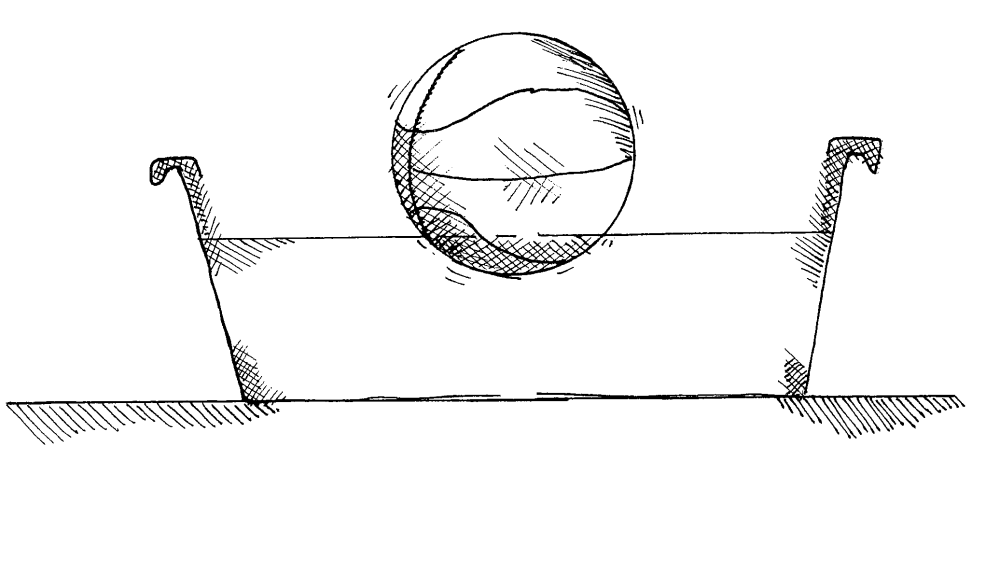
With input from students, draw a diagram showing an air-filled ball floating on water (see the image below for a sample of what this might look like). Discuss with students where an arrow might be placed to show the forces acting in the situation. Remind them of what they felt and observed when they pushed the air-filled ball into the water, and any other objects that floated back to the top after being submerged: in this instance, the students used a downward pushing force to submerge the ball into the water, but when they removed that pushing force, the upwards pushing force of the water was too strong for the ball to remain submerged. When the ball is not being pushed into the water, gravity is still acting upon it and pulling it down, but the force of gravity is not enough to overcome the upward push of the water.
Discuss which objects floated, which sank, and any that may have initially floated but stayed submerged after being pushed into the water. Ask students why they think these objects initially floated but didn’t come back to the surface like the air-filled ball did.
Introduce the term ‘upthrust’: the pushing force of water on an object that has been submersed in it. Explain that objects float when the upward pushing force is greater than the force of gravity, and they don’t float when the pull of gravity is greater than the upthrust.
Examine the shapes of the objects that floated, looking for any patterns. Note that objects that had a larger volume and a wide base, but weren’t heavy (large mass), tended to float.
Ask students what they think would happen if you started to add more weight to the floating object. Would it still float?
Pose the question: Does the shape of something affect how heavy it can be before it sinks?
The Inquire phase allows students to cycle progressively and with increasing complexity through the key science ideas related to the core concepts. Each Inquire cycle is divided into three teaching and learning routines that allow students to systematically build their knowledge and skills in science and incorporate this into their current understanding of the world.
When designing a teaching sequence, it is important to consider the knowledge and skills that students will need in the final Act phase. Consider what the students already know and identify the steps that need to be taken to reach the level required. How could you facilitate students’ understanding at each step? What investigations could be designed to build the skills at each step?
Read more about using the LIA FrameworkThe Investigate routine provides students with an opportunity to explore the key ideas of science, to plan and conduct an investigation, and to gather and record data. The investigations are designed to systematically develop content knowledge and skills through increasingly complex processes of structured inquiry, guided inquiry and open inquiry approaches. Students are encouraged to process data to identify trends and patterns and link them to the real-world context of the teaching sequence.
When designing a teaching sequence, consider the diagnostic assessment (Launch phase) that identified the alternative conceptions that students held. Are there activities that challenge these ideas and provide openings for discussion? What content knowledge and skills do students need to be able to complete the final (Act phase) task? How could you systematically build these through the investigation routines? Are there opportunities to build students’ understanding and skills in the science inquiry processes through the successive investigations?
Read more about using the LIA FrameworkWhat shape is a raft?
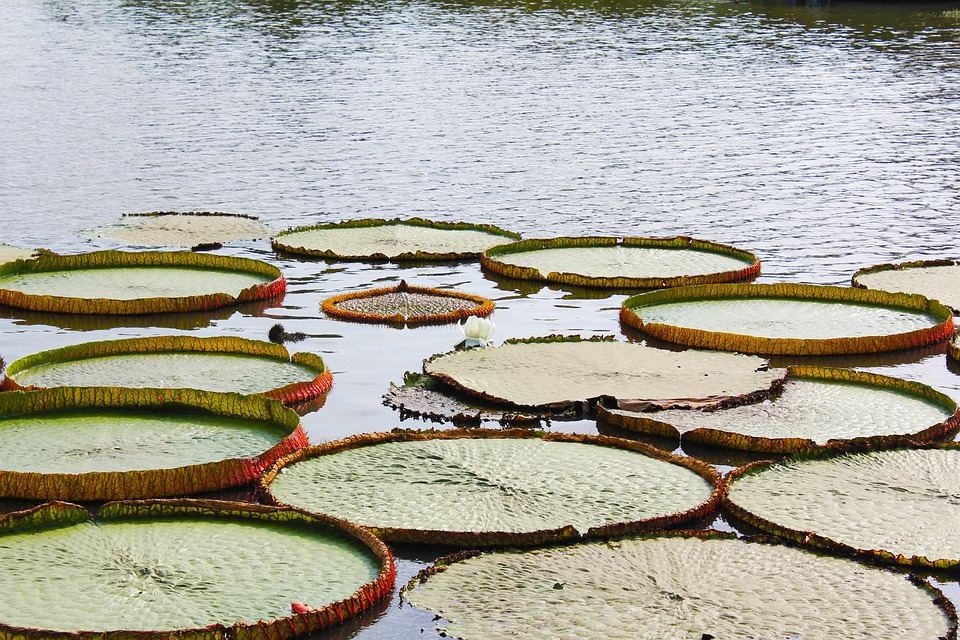
Using the demonstration copy of the Nature’s rafts Resource sheet, examine the images of the lilypad and the water lily. Compare and contrast the shapes of each, asking students to consider which they think would hold the most weight before sinking in the water.
Pose the broad question: What things might affect how much weight a shape can hold before it sinks?
Use the Variables grid Resource sheet to brainstorm the potential variables, marking what will be measured (the amount of weight held) and what will be changed (the shape of the floating vessel) before adding other variables to the remaining cells. These might include the weight of the vessel, how much weight is added each time, the volume of water it’s floating in.
Determine the question for investigation: What happens to how much weight a raft can hold when we change the shape of the raft?
Explain to students that each team will receive two identical pieces of foil with which to design and make their rafts, and that they must use the whole piece (without cutting or tearing any foil off) to design their rafts to ensure both are the same weight/mass. These will then be floated on water, with weight added in increments, to measure how much weight each raft can fold before it sinks.
Allow time for students in collaborative teams to plan their investigation using the Floating shapes investigation planner Resource sheet, including designing and making the shape of their rafts. After the rafts have been made teams can carry out their investigations, recording on a data table how much weight was added to each before it sank.
The Inquire phase allows students to cycle progressively and with increasing complexity through the key science ideas related to the core concepts. Each Inquire cycle is divided into three teaching and learning routines that allow students to systematically build their knowledge and skills in science and incorporate this into their current understanding of the world.
When designing a teaching sequence, it is important to consider the knowledge and skills that students will need in the final Act phase. Consider what the students already know and identify the steps that need to be taken to reach the level required. How could you facilitate students’ understanding at each step? What investigations could be designed to build the skills at each step?
Read more about using the LIA FrameworkFollowing an investigation, the Integrate routine provides time and space for data to be evaluated and insights to be synthesized. It reveals new insights, consolidates and refines representations, generalises context and broadens students’ perspectives. It allows student thinking to become visible and opens formative feedback opportunities. It may also lead to further questions being asked, allowing the Inquire phase to start again.
When designing a teaching sequence, consider the diagnostic assessment that was undertaken during the Launch phase. Consider if alternative conceptions could be used as a jumping off point to discussions. How could students represent their learning in a way that would support formative feedback opportunities? Could small summative assessment occur at different stages in the teaching sequence?
Read more about using the LIA FrameworkWhat did we find?
In this Integrate step, guide students to link their experiences in the investigation to the science concept being explored—in this instance, the force of buoyancy. Through questioning and discussion, students should come to a consensus that:
|
Share teams’ investigation results, including the designs of their rafts and how many objects were added before each sunk.
- How were your rafts the same? How did they differ?
- All of the rafts had the same mass/weight, because the original pieces of foil provided were the same size.
- Were both of your rafts able to hold the same amount of weight before they sank?
- How much weight could each raft hold?
- Why do you think this happened?
- What did your force arrow diagrams look like?
- Considering we know that to overcome one force, the opposing force has to be stronger, what could you claim about why things float or sink?
Discuss how having a flatter base surface with short sides allowed a raft to hold more weight. The flat surface displaces more water, therefore increasing the upthrust force on the raft. When the upthrust force is larger than the pull of gravity, then the raft stays floating.
Optional: Compare the volume of a flat piece of foil (no volume) to the larger volume of a flat-bottom raft shape with small side panels. This will emphasise that volume is important in the upthrust buoyancy force.
Reflect on the lesson
You might:
- brainstorm how buoyant/floating objects could be used in students' accessibility solution.
- add to the class word wall of vocabulary related to buoyancy
- re-examine the intended learning goals for the lesson and consider how they were achieved.
- discuss how students were thinking and working like scientists during the lesson. Focus on accuracy and if students think they would get the same results if they repeated the investigation.