

Access all areas
View Sequence overviewStudents will:
- explore gravity’s effect on an object.
- accurately measure and record the force required to move objects of different mass.
- identify that gravity is acting on all objects all the time.
Students will represent their understanding as they:
- use oral and visual language to represent their understanding of gravity.
- record observations and measurements.
- represent findings using force arrow diagrams.
In this lesson, assessment is formative.
Feedback might focus on:
- the accuracy of students' recorded measurements.
- the comparisons they draw between their findings and the of others.
- how fairly they conducted their investigations.
- the conclusions they drew from these investigations.
Class science journal (digital or hard-copy)
2 x pieces of A4 paper
1 x inflated balloon
A variety of objects collected from around the classroom
One of the following two options for measuring force:
Option 1
A homemade force meter, either prepared for groups before the lesson or constructed with groups during the lesson. See How to construct a homemade force meter Resource sheet for directions. Materials required:
- A length of thick cardboard
- Scissors
- Sticky tape
- Blu-tac
- Elastic bands or springs
- 2 x paper clips
- Plastic bag, resealable bag or paper cup
- 50g weights
Alternatively, see How to make a force meter (Newton meter) (2:26) or Science for Kids and Tweens: How to Make a Newton Meter (6:30).
Option 2
1 x push and pull spring meter or Newton meter. These can be purchased from educational resource suppliers or specialty stores.
Individual science journal (digital or hard-copy)
Moving with force investigation planner Resource sheet
Lesson
Re-orient
Use the class science journal to review learning from the previous lesson about friction, including how a force occurs when two objects interact, and how friction occurs when two objects touch (in contact).
Discuss how friction only occurs when two surfaces are in contact.
The Inquire phase allows students to cycle progressively and with increasing complexity through the key science ideas related to the core concepts. Each Inquire cycle is divided into three teaching and learning routines that allow students to systematically build their knowledge and skills in science and incorporate this into their current understanding of the world.
When designing a teaching sequence, it is important to consider the knowledge and skills that students will need in the final Act phase. Consider what the students already know and identify the steps that need to be taken to reach the level required. How could you facilitate students’ understanding at each step? What investigations could be designed to build the skills at each step?
Read more about using the LIA FrameworkIdentifying and constructing questions is the creative driver of the inquiry process. It allows students to explore what they know and how they know it. During the Inquire phase of the LIA Framework, the Question routine allows for past activities to be reviewed and to set the scene for the investigation that students will undertake. The use of effective questioning techniques can influence students’ view and interpretation of upcoming content, open them to exploration and link to their current interests and science capital.
When designing a teaching sequence, it is important to spend some time considering the mindset of students at the start of each Inquire phase. What do you want students to be thinking about, what do they already know and what is the best way for them to approach the task? What might tap into their curiosity?
Read more about using the LIA FrameworkThe Investigate routine provides students with an opportunity to explore the key ideas of science, to plan and conduct an investigation, and to gather and record data. The investigations are designed to systematically develop content knowledge and skills through increasingly complex processes of structured inquiry, guided inquiry and open inquiry approaches. Students are encouraged to process data to identify trends and patterns and link them to the real-world context of the teaching sequence.
When designing a teaching sequence, consider the diagnostic assessment (Launch phase) that identified the alternative conceptions that students held. Are there activities that challenge these ideas and provide openings for discussion? What content knowledge and skills do students need to be able to complete the final (Act phase) task? How could you systematically build these through the investigation routines? Are there opportunities to build students’ understanding and skills in the science inquiry processes through the successive investigations?
Read more about using the LIA FrameworkWhat goes up?
Pose the question: What do we have to do to keep a balloon in the air and not let it hit the ground?
Explain to students that, as a class or in small groups, they will be investigating forces by playing a game. The aim of the game is to keep an inflated balloon in the air and not let it hit the ground.
Before play begins, ask students what they might have to do to keep the balloon in the air, and to predict what will happen if they don’t do anything.
Allow students time to play the game, encouraging them to notice the movement of the balloon when it is:
- hit by the hand.
- moving up after leaving the hand.
- temporarily stopped at the top of its flight.
- moving downwards.
Alternative conceptions
What alternative conceptions might students hold about gravity, and how does this lesson address them?
Many students have non-scientific ideas about gravity. They may think that gravity acts only on falling objects.
A book sitting on a table is pulled down by gravity, and the table pushes back up against the book. The book does not move because these two forces are balanced—there is no net force acting on the book.
Similarly, if a person is standing still and not moving, there are still two forces acting on the person: a downward gravitational pull force and an upward push force from the ground (normal force). As these forces are balanced, there is no movement.
Students might think that an object of greater mass will fall, or roll downhill, faster than an object of less mass because gravity pulls it more strongly. The object of greater mass does experience a greater pull force, however, it also requires a greater force in order to move. This means, for example, that a heavy (large mass) medicine ball and a lighter (same size and less mass) basketball have the same acceleration when falling. This can be demonstrated by dropping both identically sized balls from shoulder height simultaneously—both will hit the ground at the same time.
Objects with different shapes might be slowed more noticeably by other forces, such as air resistance: a feather and a lead ball fall at exactly the same rate in a vacuum (if there is no air), but on Earth, the lead ball will hit the ground first as it experiences less air resistance.
Students might think that the strength (magnitude) of an applied force is proportional to the movement of an object, that is, a strong push will always make an object move a long distance. However, some strong forces do not result in any movement at all. For example, you might push a large granite boulder and not move it at all. The boulder has a strong gravitational pull towards the Earth, and an equally large push back from the surface it is on, so even though large forces are acting on the object, there is no motion.
In this lesson, students explore gravity in familiar situations by trying to keep an object in the air or dropping things to the ground. They also measure the force of gravity required to move objects.
Many students have non-scientific ideas about gravity. They may think that gravity acts only on falling objects.
A book sitting on a table is pulled down by gravity, and the table pushes back up against the book. The book does not move because these two forces are balanced—there is no net force acting on the book.
Similarly, if a person is standing still and not moving, there are still two forces acting on the person: a downward gravitational pull force and an upward push force from the ground (normal force). As these forces are balanced, there is no movement.
Students might think that an object of greater mass will fall, or roll downhill, faster than an object of less mass because gravity pulls it more strongly. The object of greater mass does experience a greater pull force, however, it also requires a greater force in order to move. This means, for example, that a heavy (large mass) medicine ball and a lighter (same size and less mass) basketball have the same acceleration when falling. This can be demonstrated by dropping both identically sized balls from shoulder height simultaneously—both will hit the ground at the same time.
Objects with different shapes might be slowed more noticeably by other forces, such as air resistance: a feather and a lead ball fall at exactly the same rate in a vacuum (if there is no air), but on Earth, the lead ball will hit the ground first as it experiences less air resistance.
Students might think that the strength (magnitude) of an applied force is proportional to the movement of an object, that is, a strong push will always make an object move a long distance. However, some strong forces do not result in any movement at all. For example, you might push a large granite boulder and not move it at all. The boulder has a strong gravitational pull towards the Earth, and an equally large push back from the surface it is on, so even though large forces are acting on the object, there is no motion.
In this lesson, students explore gravity in familiar situations by trying to keep an object in the air or dropping things to the ground. They also measure the force of gravity required to move objects.
The Inquire phase allows students to cycle progressively and with increasing complexity through the key science ideas related to the core concepts. Each Inquire cycle is divided into three teaching and learning routines that allow students to systematically build their knowledge and skills in science and incorporate this into their current understanding of the world.
When designing a teaching sequence, it is important to consider the knowledge and skills that students will need in the final Act phase. Consider what the students already know and identify the steps that need to be taken to reach the level required. How could you facilitate students’ understanding at each step? What investigations could be designed to build the skills at each step?
Read more about using the LIA FrameworkFollowing an investigation, the Integrate routine provides time and space for data to be evaluated and insights to be synthesized. It reveals new insights, consolidates and refines representations, generalises context and broadens students’ perspectives. It allows student thinking to become visible and opens formative feedback opportunities. It may also lead to further questions being asked, allowing the Inquire phase to start again.
When designing a teaching sequence, consider the diagnostic assessment that was undertaken during the Launch phase. Consider if alternative conceptions could be used as a jumping off point to discussions. How could students represent their learning in a way that would support formative feedback opportunities? Could small summative assessment occur at different stages in the teaching sequence?
Read more about using the LIA FrameworkMust come down
In this Integrate step, guide students to link their experiences during the game to the science concept being explored—in this instance, that objects cannot remain suspended in the air indefinitely because of the pull of gravity. Through questioning and discussion, students should come to a consensus that:
|
Discuss with students what happened during their game.
- How did you get to the balloon into the air?
- Did it stay in the air?
- What happened to it?
- What was the balloon touching during the game? Was it touching anything besides your bodies?
With students’ input, draw a force arrow diagram showing how the balloons were pushed into the air, and what happened to them afterwards. See below for an example.
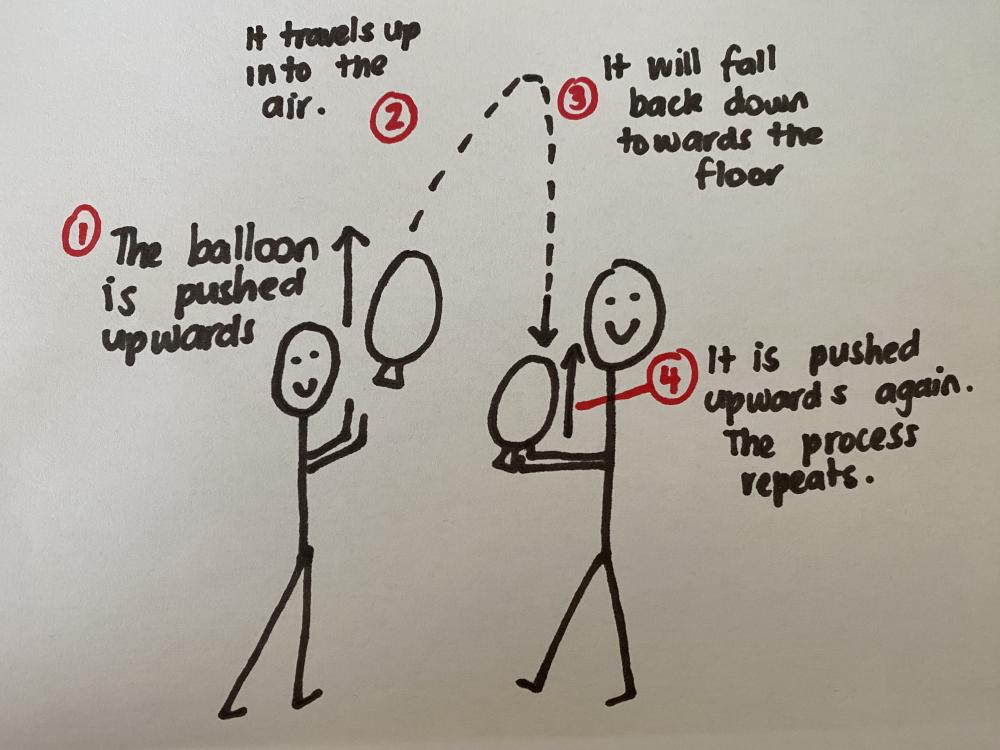
Next, ask students why they think the balloon always falls back down towards the ground eventually, and that this can only be interrupted by another push into the air.
Students might think that the air pushes the balloon back towards the ground. To demonstrate the difference between the ‘force of the air’ and the force of gravity, ask students to hold their arms out and wave them about in different directions, both at a normal speed, and quickly with force. Ask them to describe what they felt—they should describe feeling the air being displaced by the force of their arms. Liken this to the resistance/friction they noticed when pulling the shoes last lesson. Explain that what students are feeling is air resistance, or wind resistance, a type of friction that happens when we push or pull something through the air.
Demonstrate that students can still feel air resistance when they push their arms up through the air, as well as pull them back down. Explain that they are actually making ‘contact’ with the air, just as their shoes had to make contact with the surface of the floor/ground in the previous investigation.
Ask students what else might have been making the balloon fall back towards the ground. If students do not identify the term ‘gravity’ themselves, introduce the term, and ask students what they know about it. Define the term—a force that pulls things towards the centre of the Earth—and add it to the class word wall, glossary or science journal.
Ask students if they can see gravity, or feel it. Explain that, unlike friction, which is a contact force that involves things touching each other, gravity is a non-contact force. We cannot see gravity, or feel it, but we see its effects.
- How do we know that gravity exists?
- What effects of gravity can we see or experience?
- What does the balloon activity tell us about gravity?
- What might happen if there were no gravity?
Add the same size arrow pointing downwards to each balloon in your force arrow diagram. This represents the pull of gravity that is experienced by the balloon at each stage. Label the new arrow in the diagram as ‘gravity’.
Pushing up
When does the push force on the balloon stop?
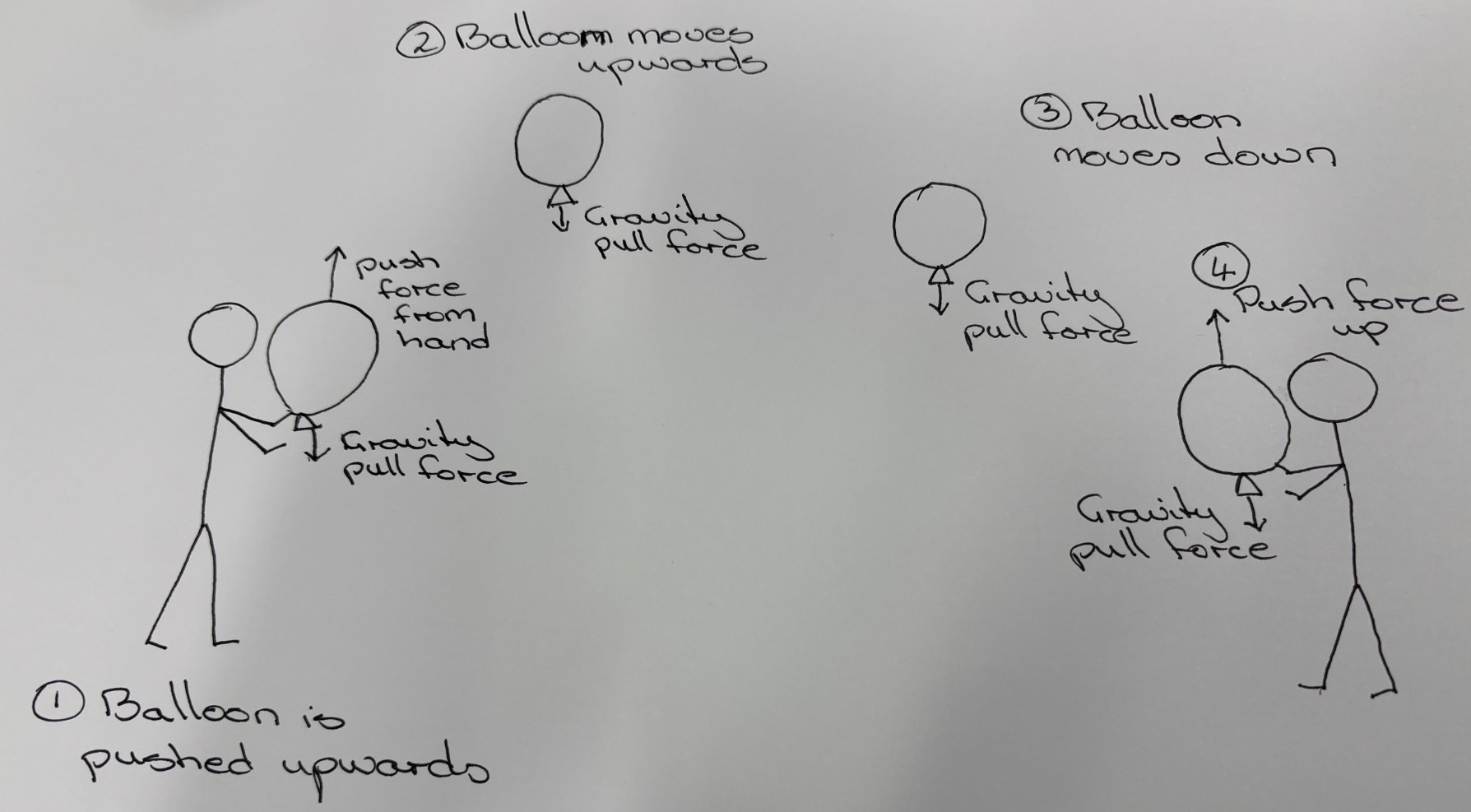
When throwing a ball or pushing up a balloon, a common alternative conception is that the push force continues to act on the ball or balloon when it leaves the hand. Instead, the push force is exerted by the hand only when in contact. Once an object is no longer in contact, the push force no longer applies.
In contrast, the pull force of gravity continues to apply at the same magnitude and direction at all times. An arrow with the same length and direction can be used to represent this in a force diagram, as in the diagram above.
When throwing a ball or pushing up a balloon, a common alternative conception is that the push force continues to act on the ball or balloon when it leaves the hand. Instead, the push force is exerted by the hand only when in contact. Once an object is no longer in contact, the push force no longer applies.
In contrast, the pull force of gravity continues to apply at the same magnitude and direction at all times. An arrow with the same length and direction can be used to represent this in a force diagram, as in the diagram above.
The Inquire phase allows students to cycle progressively and with increasing complexity through the key science ideas related to the core concepts. Each Inquire cycle is divided into three teaching and learning routines that allow students to systematically build their knowledge and skills in science and incorporate this into their current understanding of the world.
When designing a teaching sequence, it is important to consider the knowledge and skills that students will need in the final Act phase. Consider what the students already know and identify the steps that need to be taken to reach the level required. How could you facilitate students’ understanding at each step? What investigations could be designed to build the skills at each step?
Read more about using the LIA FrameworkIdentifying and constructing questions is the creative driver of the inquiry process. It allows students to explore what they know and how they know it. During the Inquire phase of the LIA Framework, the Question routine allows for past activities to be reviewed and to set the scene for the investigation that students will undertake. The use of effective questioning techniques can influence students’ view and interpretation of upcoming content, open them to exploration and link to their current interests and science capital.
When designing a teaching sequence, it is important to spend some time considering the mindset of students at the start of each Inquire phase. What do you want students to be thinking about, what do they already know and what is the best way for them to approach the task? What might tap into their curiosity?
Read more about using the LIA FrameworkFalling for you
Show students a sheet of A4 paper and ask them to predict how long it will take gravity to pull it to the floor.
Drop the paper and encourage students to count the seconds it takes to reach the floor.
Show students two identical sheets of A4 paper. Ask students to predict how long it will take gravity to pull both pieces of paper to the floor.
Screw one piece of paper into a small ball, and compare it to the other piece of paper.
Pose the questions: How have I changed the paper? How would you describe the shape and size of the two pieces of paper?
Discuss how the weight or mass of the paper has not changed (nothing has been added or taken away). The only thing that has changed is the shape of the paper.
Ask students to predict how long it will take gravity to pull both pieces of paper to the floor.
Drop the paper and identify that the ball of paper took less time to reach the floor. Discuss how the ball of paper had less air resistance than the flat paper.
Pose the question: Is the force of gravity the same on all objects?
The Inquire phase allows students to cycle progressively and with increasing complexity through the key science ideas related to the core concepts. Each Inquire cycle is divided into three teaching and learning routines that allow students to systematically build their knowledge and skills in science and incorporate this into their current understanding of the world.
When designing a teaching sequence, it is important to consider the knowledge and skills that students will need in the final Act phase. Consider what the students already know and identify the steps that need to be taken to reach the level required. How could you facilitate students’ understanding at each step? What investigations could be designed to build the skills at each step?
Read more about using the LIA FrameworkThe Investigate routine provides students with an opportunity to explore the key ideas of science, to plan and conduct an investigation, and to gather and record data. The investigations are designed to systematically develop content knowledge and skills through increasingly complex processes of structured inquiry, guided inquiry and open inquiry approaches. Students are encouraged to process data to identify trends and patterns and link them to the real-world context of the teaching sequence.
When designing a teaching sequence, consider the diagnostic assessment (Launch phase) that identified the alternative conceptions that students held. Are there activities that challenge these ideas and provide openings for discussion? What content knowledge and skills do students need to be able to complete the final (Act phase) task? How could you systematically build these through the investigation routines? Are there opportunities to build students’ understanding and skills in the science inquiry processes through the successive investigations?
Read more about using the LIA FrameworkMoving forces
To complete this investigation teams will require a device to measure force—push and pull spring meters, Newton meters, or homemade force meters. See the Materials list above for more information.
Explain to students that to measure force, we use a force meter. Force meters measure in units called Newtons (N). On Earth, 1 Newton is approximately the same as 100 grams of weight.
Model how to measure the pull force of Earth’s gravity by hanging an object from the force meter. Show how students can read and record the number shown on the scale.
Compare this measurement to the amount of force needed to lift an object off a surface. Attach the item to the force meter whilst it sits on a surface, making sure the elastic band/spring has no tension on it. Then lift the item off the surface. The measurement should be taken when the object is just lifting off the surface. If the object is accelerating up, the force may be slightly larger.
Note: The elastic band/spring should stretch the same amount using both methods, and the purpose of doing both is to show students that the same amount of force pulling down on an object is the same as is required to keep it suspended in the air.
If the force meter is sensitive enough, measure both sheets of A4 paper that you dropped in the previous step.
Ask teams to select five objects from around the classroom. They will use their meters to compare the amount of pull due to gravity on these objects. Remind them that the object will need to be attached to their measuring device, so they need to select accordingly.
Ask students to place their objects in order from the object they think will require the least force to lift the object that will require the most force.
Measure the force needed to lift an object from a surface (as just demonstrated).
Using the Moving with force investigation planner Resource sheet, teams plan and carry out their investigation, recording their result, drawing a force arrow diagram, and making a claim about which objects will require more force to move.
The Inquire phase allows students to cycle progressively and with increasing complexity through the key science ideas related to the core concepts. Each Inquire cycle is divided into three teaching and learning routines that allow students to systematically build their knowledge and skills in science and incorporate this into their current understanding of the world.
When designing a teaching sequence, it is important to consider the knowledge and skills that students will need in the final Act phase. Consider what the students already know and identify the steps that need to be taken to reach the level required. How could you facilitate students’ understanding at each step? What investigations could be designed to build the skills at each step?
Read more about using the LIA FrameworkFollowing an investigation, the Integrate routine provides time and space for data to be evaluated and insights to be synthesized. It reveals new insights, consolidates and refines representations, generalises context and broadens students’ perspectives. It allows student thinking to become visible and opens formative feedback opportunities. It may also lead to further questions being asked, allowing the Inquire phase to start again.
When designing a teaching sequence, consider the diagnostic assessment that was undertaken during the Launch phase. Consider if alternative conceptions could be used as a jumping off point to discussions. How could students represent their learning in a way that would support formative feedback opportunities? Could small summative assessment occur at different stages in the teaching sequence?
Read more about using the LIA FrameworkWhat did we find?
In this Integrate step, guide students to link their experiences in the investigation to the science concept being explored—in this instance, that the more mass an object has, the stronger the pull of gravity is. Through questioning and discussion, students should come to a consensus that:
|
Teams share their investigation data with the class. Compare the objects that needed the least or most force. Identify that the size of an object did not always indicate that more force was needed.
- How did you make your predictions about which objects were going to need the most force, and which ones would need the least?
- What object needed the most force to lift it from a surface?
- Did this match your prediction?
- How do you know?
- Did you identify any patterns?
- For example, objects that felt heavy stretched the rubber band/spring further.
- What claim did you make to answer your investigable question?
- How did your evidence support your claim?
Ask students if forces are represented with arrows in their diagrams, and how they might represent a stronger or larger force.
Explain that the size of a force (whether it is stronger/weaker, larger/smaller) is referred to as its ‘magnitude’, and that the larger the magnitude of the force, the longer the arrow should be.
Demonstrate this using the measuring tool to show that the spring or rubber band stretches further, and how this is represented in the diagram by a longer arrow.
Allow students time to make adjustments to their force arrow diagrams drawn as part of their investigation.
Come to a consensus about a list of key scientific findings from the lesson and record them in the class science journal. See the list at the beginning of this step for guidance on what these key findings might be. Students might not use the most accurate, scientific language when summarising their key findings. This is acceptable at this stage of the sequence. Encourage students to use the terms already explicitly introduced, such as gravity and magnitude.
Discuss how what was learned in this lesson might help inform the students’ design of their accessibility solutions at the end of the sequence, considering weight/mass of part of their design and the users, and how to overcome the forces of gravity if applicable.
Reflect on the lesson
You might:
- discuss students’ experiences of gravity and choices they might make because of it. For example, considering the mass of the materials they select and how gravity might affect those choices.
- add to the class word wall any vocabulary related to gravity and magnitude.
- re-examine the intended learning goals for the lesson and consider how they were achieved.