

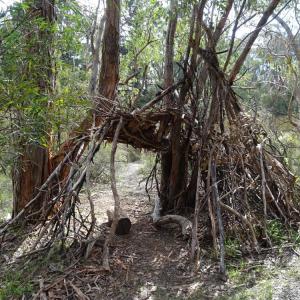
'Shelter in a storm' IS A NEW V9 SEQUENCE BASED ON OUR V8 SEQUENCE 'What's it made of?'
- On the 'Sequence overview' tab you'll find all the lessons in this sequence and curriculum alignment.
- The 'Our design decisions' tab shows how key scientific ideas develop over the sequence, and shows how the sequence addresses curriculum achievement standards.
- The 'Preparing for this sequence' tab guides you through important information and considerations for this sequence.
- Have you taught this sequence? Use the Feedback button to let us know how it went!
Launch
Lesson 1 • What is shelter and why do we need it?
Students explore the observable properties of materials by investigating the purpose and features of shelters and the materials used to construct them.

Inquire
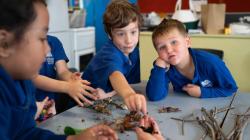
Lesson 2 • What is used to make shelters?
Students explore materials by sorting the objects collected during Lesson 1 and identifying what they are made from. They consider what materials are used to build shelters and begin to consider how shelters can be impacted by weather.
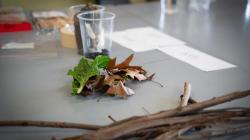
Lesson 3 • Stiff or bendy?
Students explore the properties of materials by determining if a material is bendy or stiff. They consider how and why stiff and bendy materials can be used when building a shelter.
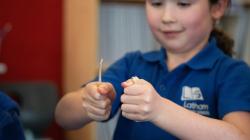
Lesson 4 • Which frame material is best?
Students build and test a simple shelter frame to determine which construction material best achieves the required criteria.
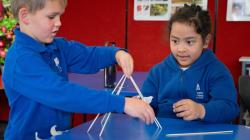
Lesson 5 • Can it be torn?
Students explore the properties of materials by determining if a material can be torn. They consider how and why this property is relevant when building a shelter.

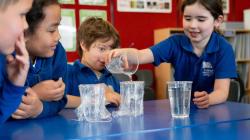
Lesson 6 • Will it let water in?
Students investigate if materials are waterproof by looking at a familiar shelter—an umbrella. They consider how and why waterproofing is relevant when building a shelter.
Act
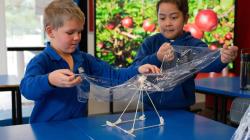
Lesson 7 • Designing a shelter
Students apply their learning about materials to build a shelter that can keep a toy dry and safe in the rain/a storm.
The Australian Academy of Science supports and encourages broad use of its material. Unless indicated below, copyright material available on this website is licensed under a Creative Commons Attribution-NonCommercial-ShareAlike 4.0 International (CC BY-NC-SA 4.0) licence.
Curriculum and syllabus alignment
Foundation
By the end of Foundation students describe the observable properties of the materials that make up objects. They identify examples of people using observation and questioning to learn about the natural world.
Students pose questions and make predictions based on their experiences. They engage in investigations and make observations safely. With guidance, they represent observations and identify patterns. With guidance, they compare their observations with their predictions. They share questions, predictions, observations and ideas about their experiences with others.
Science as a human endeavour
Explore the ways people make and use observations and questions to learn about the natural world
Science understanding
Recognise that objects can be composed of different materials and describe the observable properties of those materials
Science inquiry
Pose questions and make predictions based on experiences
Engage in investigations safely and make observations using their senses
Represent observations in provided templates and identify patterns with guidance
Compare observations with predictions with guidance
Share questions, predictions, observations and ideas with others
Australian curriculum content links
| Science understanding core concept: The chemical and physical properties of substances are determined by their structure at a range of scales. |
| Sub-strand | Content descriptor | AC code | Achievement standard | How the sequence addresses this content |
| SHE: Use and influence of science | Explore the ways people make and use observations and questions to learn about the natural world. | AC9SFH01 | Students describe how shelters are used by humans and other animals and that their choice of materials influences shelter properties. | Observe and discuss shelters used by people, animals and plants during a school shelter hunt (Lesson 1). Explore how different materials are used to make shelters in The Three Little Pigs or The Three Little Javelinas (Lesson 2). Investigate the observable properties of materials used in real objects (Lessons 3-6). Investigate the umbrella as a familiar shelter object, exploring its parts and materials (Lesson 6). |
| SU: Chemical sciences | Recognise that objects can be composed of different materials and describe the observable properties of those materials. | AC9SFU03 | Students identify a range of objects and the materials they are made from. They describe the properties of some materials and explain how these properties influence how the material can be used. | Identify that shelters are made from materials and sort found objects by material type (plastic, metal, paper, rock/stone, fabric, wood) (Lesson 2). Investigate single-material objects and describe their properties using the words “stiff” and “bendy” (Lesson 3). Investigate umbrella parts and identify the materials used in each part (handle, frame, cover) (Lesson 6). Test and compare materials for waterproofness (Lesson 6). Build and test shelter frames from different materials, such as pipe cleaners, sticks and skewers, and compare how the materials behave (Lesson 4). Choose and test a cover material for a shelter; explain why the chosen material is suitable (Lesson 6-7). |
| SI: Questioning and predicting | Pose questions and make predictions based on experiences. | AC9SFI01 | Students pose and answer questions and make predictions about materials, their properties, and their designed shelters. | Pose questions about shelters and materials in the class science journal at the start of the unit (Lesson 1). Predict which materials might be useful for different shelter parts (base, frame, cover) (Lessons 3-6). Predict which material will keep water out before conducting the waterproof test (Lesson 6). Predict whether their shelter frame will stand by itself and stay upright in wind before testing (Lesson 4). Predict whether their chosen cover material will keep the toy dry before the rain test (Lesson 6-7). |
| SI: Planning and conducting | Engage in investigations safely and make observations using their senses. | AC9SFI02 | Students participate in testing the properties of materials and the designed shelters. | Participate in a school shelter hunt, observing and collecting found objects safely (Lesson 1). Sort found objects by material, making observations about properties (Lesson 2). Test materials for stiffness and bendiness using safe handling techniques (Lesson 3). With support, conduct a fair waterproof test, applying equal drops of water to material samples (Lesson 6). With support, build and test shelter frames in wind using an electric fan (Lesson 4). With support, test assembled shelters (frame + cover) in wind and rain (Lessons 4, 6). |
| SI: Processing, modelling and analysing | Represent observations in provided templates and identify patterns with guidance. | AC9SFI03 | Students record their observations of material and shelter testing through drawings and provided templates. | Record sorted objects in individual science journals using drawings and material labels (Lesson 2). Record stiff/bendy results on the Testing materials Resource sheet (Lesson 3). Record predictions and observations from the waterproof tests (Lesson 6). Record frame test results (fit, self-supporting, wind stability) (Lesson 4). Record cover choice, prediction and observations (Lesson 7). |
| SI: Evaluating | Compare observations with predictions with guidance. | AC9SFI04 | Students compare their predictions and observations of material and shelter testing. | Compare observations from the shelter hunt with initial ideas about what a shelter is (Lesson 1). Compare material sorting results with predictions about which materials might be best for shelters (Lessons 2-6). Compare predictions about waterproofness with observations from the waterproof test (Lesson 6). Compare predictions about frame stability with results of the wind test; identify what worked and what needs to change (Lesson 4). Compare predictions about cover waterproofness with observations from the rain test; identify problems and suggest improvements. (Lesson 6). Evaluate final shelter designs using evidence from combined wind and rain testing (Lesson 7). |
| SI: Communicating | Share questions, predictions, observations and ideas with others. | AC9SFI05 | Students share what they learned from testing materials and shelters to explain how their shelter design worked or did not work. | Contribute to class discussions and the class science journal throughout the unit (Lessons 1-7). Use material property language (stiff, bendy, hard, soft, waterproof, absorbent) when sharing observations (Lessons 2-7). Share observations and ideas during group and whole-class discussions about shelter frame and cover testing (Lessons 6-7). Communicate to a selected audience (classmates, parents or visitors) during a gallery walk or science fair, explaining shelter design choices using unit vocabulary (Lesson 7). |
Science journals
Create a class science journal, either in hard-copy or digitally. You might:
- use or create a large scrap book or flip chart.
- use posters or butcher's paper so that learning can be displayed in sequence on the wall.
- create a digital journal using your platform or technology of choice.
- use any combination of the above options.
Plan for students to create individual science journals, either in hard-copy or digitally. They might:
- use an exercise book, scrap book or flip chart to record their thinking and gather resource sheets tigetger.
- use a folder to store and collate resource sheets, diagrams, photographs and other materials.
- use a digital folder to store work samples, images and videos.
- use any combination of the above options.
See Using a science journal throughout inquiry for more detailed information on the importance of science journals.
General preparation
- Read through the teaching sequence.
- Note any adaptations you would like to make to suit your school context and students’ needs.
- Prepare demonstration copies of Resource sheets as required.
- Collect the resources required for the sequence.
Selecting a focus story for the sequence
In this sequence, students explore materials in the context of those used to build strong, suitable shelters.
To spark their interest, students read the familiar story of The Three Little Pigs. Alternatively, use an Australian-based version, such as The Three Little Bush Pigs by Paul Dallimore or The Three Little Aussie Pigs by Renee Conoulty.
You might also use the south-west USA/Mexican-based Three Little Javelinas by Susan Lowell.
Selecting two focus characters for the sequence
In this sequence, you will introduce students to two characters for whom they will use their learning to build a waterproof and windproof shelter.
These characters might be the two pigs who built unsuccessful shelters in the original story (or the alternative story you read) or two different characters that will appeal to the students in your class.

'Shelter in a storm' IS A NEW V9 SEQUENCE BASED ON OUR V8 SEQUENCE 'What's it made of?'
- On the 'Sequence overview' tab you'll find all the lessons in this sequence and curriculum alignment.
- The 'Our design decisions' tab shows how key scientific ideas develop over the sequence, and shows how the sequence addresses curriculum achievement standards.
- The 'Preparing for this sequence' tab guides you through important information and considerations for this sequence.
- Have you taught this sequence? Use the Feedback button to let us know how it went!