

Shelter in a storm
View Sequence overviewStudents will:
- identify the parts of an umbrella.
- describe the materials from which umbrella parts are made.
- test and compare materials for waterproofness.
- explain that materials are chosen for a purpose.
Students will represent their understanding as they:
- label parts of an umbrella.
- predict which material will keep water out.
- observe and record what happens in a simple “rain test”.
- discuss whether predictions matched observations.
In this lesson, assessment is formative.
Feedback might focus on students’ ability to:
- identify key parts of an umbrella or parasol.
- name materials used in different umbrella parts.
- predict which material will keep water out.
- participate in a fair test and describe the outcome.
Whole class
Class science journal
Umbrella
Word wall
Demonstration copy of Waterproof or not? Resource sheet
Each group
Small flat pieces of materials, all approximately the same size and thickness, such as plastic, paper towel, fabric and metal etc.
Water droppers or pipettes
Each student
Individual science journal
Small paper umbrella, as often used to decorate drinks, with the rubber band removed so they can be opened easily
Waterproof or not? Resource sheet
Lesson
The Inquire phase allows students to cycle progressively and with increasing complexity through the key science ideas related to the core concepts. Each Inquire cycle is divided into three teaching and learning routines that allow students to systematically build their knowledge and skills in science and incorporate this into their current understanding of the world.
When designing a teaching sequence, it is important to consider the knowledge and skills that students will need in the final Act phase. Consider what the students already know and identify the steps that need to be taken to reach the level required. How could you facilitate students’ understanding at each step? What investigations could be designed to build the skills at each step?
Read more about using the LIA FrameworkRe-orient
Discuss what students explored in the previous lesson: some materials can be torn more easily than others, and this is important when choosing a cover for a shelter that can withstand a storm. Wind, or objects blown around by the wind, can cause materials to tear.
The Inquire phase allows students to cycle progressively and with increasing complexity through the key science ideas related to the core concepts. Each Inquire cycle is divided into three teaching and learning routines that allow students to systematically build their knowledge and skills in science and incorporate this into their current understanding of the world.
When designing a teaching sequence, it is important to consider the knowledge and skills that students will need in the final Act phase. Consider what the students already know and identify the steps that need to be taken to reach the level required. How could you facilitate students’ understanding at each step? What investigations could be designed to build the skills at each step?
Read more about using the LIA FrameworkIdentifying and constructing questions is the creative driver of the inquiry process. It allows students to explore what they know and how they know it. During the Inquire phase of the LIA Framework, the Question routine allows for past activities to be reviewed and to set the scene for the investigation that students will undertake. The use of effective questioning techniques can influence students’ view and interpretation of upcoming content, open them to exploration and link to their current interests and science capital.
When designing a teaching sequence, it is important to spend some time considering the mindset of students at the start of each Inquire phase. What do you want students to be thinking about, what do they already know and what is the best way for them to approach the task? What might tap into their curiosity?
Read more about using the LIA FrameworkA shelter from the rain
Show students a closed umbrella and record their observations. Open the umbrella and repeat.
- What is this object?
- What is it typically used for?
- What else might it be used for?
- What parts can you see?
- What does each part do?
- Do you think this is a type of shelter? Why do you think that?
- What part would you call the cover? The frame?
- What materials are the parts made from?
Open and close the umbrella a few times and ask students to carefully observe how the mechanism works. Draw and label the umbrella together, including parts such as the handle, cover and frame.
Co-construct sentences with students to explain the parts of the umbrella and their purpose and function. Provide support and modelling as required, such as: This is the handle. We hold it with our hand.
Pose the question: Why are the parts of the umbrella made from those materials?
- What material is the handle made from?
- Do you think the handle is stiff or bendy?
- Why would they make the handle from that material?
- What about the frame? What material is it made from?
- Why do you think it is made from that material?
- What material is the cover made from?
- It can be made from fabric or a plastic-like material.
- Do you think the cover will tear easily? Why or why not?
- If the cover is made from plastic, ask: Why might the cover be made from this plastic-like material?
- Because it needs to cover us and keep water out.
- If the cover is made from fabric, ask: How would you describe the fabric the cover is made from? Why do you think it looks like that?
- Prompt students with terms like “shiny” and “slippery” as required.
- Is it like the fabric we would use for clothes? If so, what kind of clothes? What does the fabric material have in common with clothes?
Give each student a small paper umbrella (with the outer rubber band removed). Encourage students to open and close their model carefully so they can observe how the mechanism works and physically explore the handle, frame and cover.
Brainstorm with students how the small paper umbrella is different from the big umbrella we looked at earlier, drawing their attention particularly to the material of the cover.
- What do you notice about your small paper umbrella compared with the big umbrella we looked at?
- The model is smaller, simpler and made from paper and wood.
- What parts can you see?
- The handle/cover/frame.
- Do you think the small paper umbrella would keep out rain?
- No/don’t know.
- Why do you think that?
- Because the paper cover would let water through.
- It's too small for anyone to shelter beneath.
- Does anyone know the name of a material that keeps out water?
- Waterproof.
- Why would the cover material of an umbrella, that shelters us from the rain, need to be waterproof?
Introduce or revisit the word “waterproof”. Explain that waterproof materials keep water out (the water will sit on top of the material), while materials that are not waterproof allow water to soak in/through. Further discuss why it's important for something that shelters an object from the rain to be waterproof.
Pose the question: How can we find out which materials are waterproof so we can use them to shelter from the rain?
The Inquire phase allows students to cycle progressively and with increasing complexity through the key science ideas related to the core concepts. Each Inquire cycle is divided into three teaching and learning routines that allow students to systematically build their knowledge and skills in science and incorporate this into their current understanding of the world.
When designing a teaching sequence, it is important to consider the knowledge and skills that students will need in the final Act phase. Consider what the students already know and identify the steps that need to be taken to reach the level required. How could you facilitate students’ understanding at each step? What investigations could be designed to build the skills at each step?
Read more about using the LIA FrameworkThe Investigate routine provides students with an opportunity to explore the key ideas of science, to plan and conduct an investigation, and to gather and record data. The investigations are designed to systematically develop content knowledge and skills through increasingly complex processes of structured inquiry, guided inquiry and open inquiry approaches. Students are encouraged to process data to identify trends and patterns and link them to the real-world context of the teaching sequence.
When designing a teaching sequence, consider the diagnostic assessment (Launch phase) that identified the alternative conceptions that students held. Are there activities that challenge these ideas and provide openings for discussion? What content knowledge and skills do students need to be able to complete the final (Act phase) task? How could you systematically build these through the investigation routines? Are there opportunities to build students’ understanding and skills in the science inquiry processes through the successive investigations?
Read more about using the LIA FrameworkWhat’s waterproof?
Explain that students will now test different materials to find out which ones are the most waterproof.
Show students samples of the materials they will be testing to figure out which materials are waterproof and which ones are not.
Discuss how the investigation will work. Students will place drops or water on a material, to see if it sinks in or if it stays on top of the material. With students, determine:
- what will be changed (the materials).
- what will be measured (whether the water stays on top of the material).
- what will stay the same (the number of water drops, the size of the material pieces and number of material layers).
Note: Discuss the variables that will stay the same in the investigation as appropriate for your students. In particular, it is likely that students will want to add more water, so this should be emphasised.
Invite students to predict which material will keep water out. Support students to record their predictions on an individual or class copy of the Waterproof or not? Resource sheet.
Provide teams with small, flat test pieces of materials and invite them to test each material using the same number of drops (one or two) of water. Guide students to observe whether the water stays on top or soaks in.
Support students to record their observations on an individual or class copy of the Waterproof or not? Resource sheet and to note whether each material was waterproof or not waterproof.
- What does waterproof mean?
- It keeps water out.
- What happens when a material is not waterproof?
- It lets water soak in.
- What do we need to keep the same to make it a fair test?
- The size of the material pieces and the number of water drops.
- Which material do you think (predict) will keep water out best?
- Answers will vary.
- What happened to the water on this material?
- It stayed on top/rolled off/soaked in/went through.
- Was this material waterproof or not?
- Did all the materials behave in the same way?
- No.
- Why did some materials work differently?
- Because different materials have different properties.
The Inquire phase allows students to cycle progressively and with increasing complexity through the key science ideas related to the core concepts. Each Inquire cycle is divided into three teaching and learning routines that allow students to systematically build their knowledge and skills in science and incorporate this into their current understanding of the world.
When designing a teaching sequence, it is important to consider the knowledge and skills that students will need in the final Act phase. Consider what the students already know and identify the steps that need to be taken to reach the level required. How could you facilitate students’ understanding at each step? What investigations could be designed to build the skills at each step?
Read more about using the LIA FrameworkFollowing an investigation, the Integrate routine provides time and space for data to be evaluated and insights to be synthesized. It reveals new insights, consolidates and refines representations, generalises context and broadens students’ perspectives. It allows student thinking to become visible and opens formative feedback opportunities. It may also lead to further questions being asked, allowing the Inquire phase to start again.
When designing a teaching sequence, consider the diagnostic assessment that was undertaken during the Launch phase. Consider if alternative conceptions could be used as a jumping off point to discussions. How could students represent their learning in a way that would support formative feedback opportunities? Could small summative assessment occur at different stages in the teaching sequence?
Read more about using the LIA FrameworkHigh and dry
In the following Integrate routine, students are guided to link their experiences of testing materials for waterproofness with the science concept being explored: some materials let water through, while others soak up water. Through modelling, questioning and discussion, students should come to a consensus that:
|
As a class, discuss the results of the waterproof materials investigation, reviewing which materials kept water out and which materials allowed water to soak in.
Record the results in a simple table, making extra notes as required.
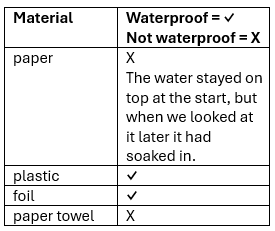
Co-construct a class statement such as: Some materials are waterproof and some materials are not. Waterproof materials can help keep water out.
Link the umbrella investigation to the toy shelter challenge by partly closing the umbrella so that it looks more like a tent frame. Discuss which parts of the umbrella match the parts of a shelter.
For example:
- umbrella frame = shelter frame.
- umbrella cover = shelter cover.
Discuss which materials might work well for a shelter cover and why.
- Which material kept water out best?
- Answers may include plastic or metal.
- Which material allowed water to soak through?
- Answers may include paper towel or some fabric.
- Why might a waterproof material be useful?
- Because it can keep rain out.
- Why might a material that is not waterproof be the wrong choice for a shelter cover?
- Because it soaks up water, which may then drip through.
- Which part of the umbrella is like a shelter frame?
- The umbrella frame.
- Which part of the umbrella is like a shelter cover?
- The cover.
- What type of material is an umbrella cover made from?
- It is a type of waterproof fabric called nylon or polyester.
- Why is the cover made from that material?
- Because it needs to help keep water out.
- How can this help us design a toy shelter?
- We can choose materials that keep water out for the cover.
Add new words and any related drawings or photos to the word wall.
Reflect on the lesson
You might:
- review the class science journal.
- review the parts of an umbrella and what each part does.
- reinforce that different parts of an object can use different materials for different purposes.
- review the terms “waterproof” and “not waterproof”.
- discuss how the umbrella investigation can help students choose materials for a shelter cover.