

Shelter in a storm
View Sequence overviewStudents will:
- identify that an object, such as a spoon, can be made from more than one type of material, e.g. metal, plastic or wood.
- distinguish between an object and the material it is made from.
- describe a simple material property using the words “stiff” and “bendy”.
- test materials safely and discuss what they observe.
Students will represent their understanding as they:
- discuss single-material objects and their materials.
- test and compare materials for stiffness and bendiness.
- contribute to a class results chart.
- record their observations in their science journals.
In this lesson, assessment is formative.
Feedback might focus on students’ ability to:
- identify an object and name the material it is made from.
- recognise that some objects are made from more than one material at a time.
- use the words “stiff” and “bendy” appropriately.
- discuss whether a material might be useful for a shelter.
Whole class
Class science journal (digital or hard-copy)
Materials to make a word wall
Examples of objects that have the same function but are made of different materials, for example, a wooden ruler and a plastic ruler, a pen and a pencil, as used in Lesson 2
Collection of single-material objects, including at least one plastic, metal or wooden spoon. Other examples might include:
- cloth
- wooden skewers or cutlery
- elastic bands
- wool
- cotton buds/pads
- paper/cardboard
Copy of the Paper spoon Resource sheet, with the spoon image resized to match the single-material spoon above then printed and cut out
A tissue
Each group
A collection of objects to test to determine whether they are bendy or stiff
Two labels under which students can place objects, one reading “bendy” and the other “stiff”
Each student
Individual science journal (digital or hard-copy)
Lesson
The Inquire phase allows students to cycle progressively and with increasing complexity through the key science ideas related to the core concepts. Each Inquire cycle is divided into three teaching and learning routines that allow students to systematically build their knowledge and skills in science and incorporate this into their current understanding of the world.
When designing a teaching sequence, it is important to consider the knowledge and skills that students will need in the final Act phase. Consider what the students already know and identify the steps that need to be taken to reach the level required. How could you facilitate students’ understanding at each step? What investigations could be designed to build the skills at each step?
Read more about using the LIA FrameworkRe-orient
Using the same objects as in Lesson 2, remind students that an object and the material from which it is made have different names. For example, a lid is an object, while plastic or metal is the material.
- What is an object?
- A thing that we can see, touch or use.
- What is a material?
- What an object is made of.
- Can two objects have the same material?
- Yes, different objects can be made from the same material.
- Can two similar objects be made from different materials?
- Yes, for example, a spoon can be made from metal, plastic or wood.
Remind students that shelters can be made from different materials and that the class is working towards designing a shelter for the toy characters that will protect them from wind and rain.
The Inquire phase allows students to cycle progressively and with increasing complexity through the key science ideas related to the core concepts. Each Inquire cycle is divided into three teaching and learning routines that allow students to systematically build their knowledge and skills in science and incorporate this into their current understanding of the world.
When designing a teaching sequence, it is important to consider the knowledge and skills that students will need in the final Act phase. Consider what the students already know and identify the steps that need to be taken to reach the level required. How could you facilitate students’ understanding at each step? What investigations could be designed to build the skills at each step?
Read more about using the LIA FrameworkIdentifying and constructing questions is the creative driver of the inquiry process. It allows students to explore what they know and how they know it. During the Inquire phase of the LIA Framework, the Question routine allows for past activities to be reviewed and to set the scene for the investigation that students will undertake. The use of effective questioning techniques can influence students’ view and interpretation of upcoming content, open them to exploration and link to their current interests and science capital.
When designing a teaching sequence, it is important to spend some time considering the mindset of students at the start of each Inquire phase. What do you want students to be thinking about, what do they already know and what is the best way for them to approach the task? What might tap into their curiosity?
Read more about using the LIA FrameworkExploring materials
Pose the question: What is an object made of?
Display a range of single-material objects. Model language such as: This is a spoon. This spoon is made of metal. Repeat with several examples so students hear both the object name and the material name. Invite students to name the object and material, where appropriate.
Support students to compare objects and notice that they are made of different materials, e.g. metal, wooden and plastic spoons.
Introduce the idea that materials have properties, which describe how they look or behave.
Show students two spoons: one made of paper using the template found on the Paper spoon Resource sheet, and one made of a typical material such as metal, plastic or wood.
Ask students to describe the similarities and differences between each spoon. Record any words that students use to describe each spoon’s properties. These might include “hard”, “straight”, “strong”, “soft”, “floppy”, “weak”.
If students do not suggest the terms themselves, introduce and explain the terms “stiff” and “bendy”. Ask students which term best describes each spoon and why they think that.
- What are these objects called?
- Spoons.
- What is it made from?
- Metal/plastic/wood/paper.
- Is each spoon made from one material or more than one material?
- One material.
- What do we mean by a “property”?
- A property is how a material looks or behaves.
- What does “stiff” mean?
- Stiff means it does not bend easily.
- What does “bendy” mean?
- Bendy means it can bend easily.
Pose the question: Which objects are stiff and which objects are bendy?
The property of flexibility
What is “flexibility” and “inflexibility”?
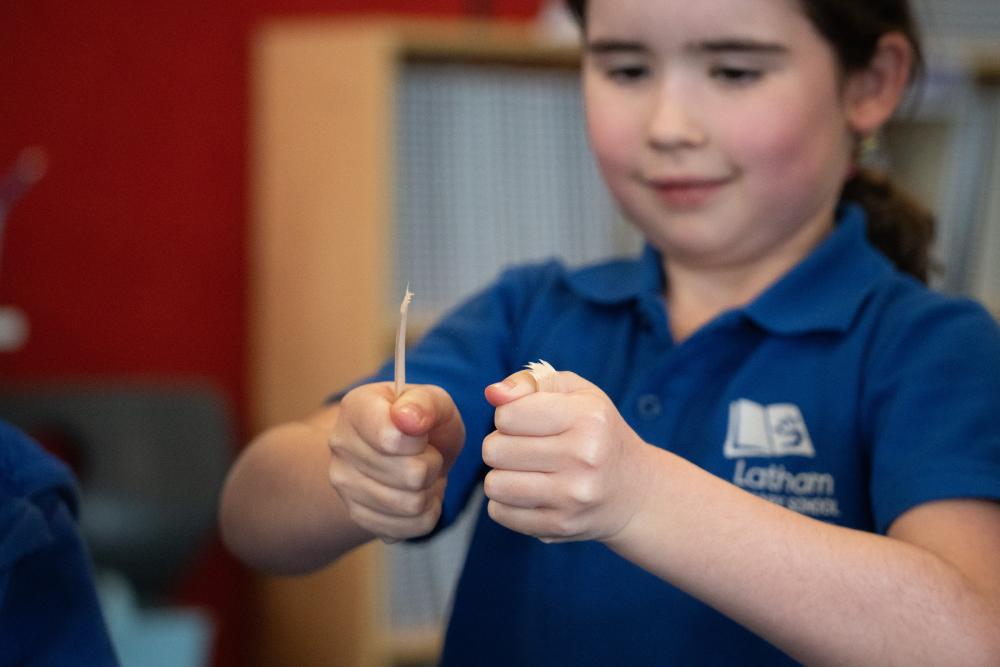
Flexibility is a material’s ability to bend or change shape without breaking. A flexible material can be bent, twisted or folded.
Some examples of materials that are flexible:
- Rubber bends and stretches easily.
- Plastic can be flexible, depending on the type.
- Steel is less flexible than rubber, but thin steel wires can bend without breaking.
Flexible materials are used when an object needs to bend or move, such as electrical cables, hoses and fabrics.
Inflexibility is a material’s ability to resist bending or changing shape. An inflexible material stays stiff and does not bend easily.
Some examples of materials that are inflexible:
- Wood does not bend easily.
- Glass is inflexible—it stays rigid and may break if you try to bend it.
- Brick and concrete are also very inflexible.
Inflexible materials are used when an object needs to stay strong and keep its shape, such as walls, bridges, tables.
Learning about how different materials behave helps students choose the correct materials for the correct purpose.
Flexibility is a material’s ability to bend or change shape without breaking. A flexible material can be bent, twisted or folded.
Some examples of materials that are flexible:
- Rubber bends and stretches easily.
- Plastic can be flexible, depending on the type.
- Steel is less flexible than rubber, but thin steel wires can bend without breaking.
Flexible materials are used when an object needs to bend or move, such as electrical cables, hoses and fabrics.
Inflexibility is a material’s ability to resist bending or changing shape. An inflexible material stays stiff and does not bend easily.
Some examples of materials that are inflexible:
- Wood does not bend easily.
- Glass is inflexible—it stays rigid and may break if you try to bend it.
- Brick and concrete are also very inflexible.
Inflexible materials are used when an object needs to stay strong and keep its shape, such as walls, bridges, tables.
Learning about how different materials behave helps students choose the correct materials for the correct purpose.
The Inquire phase allows students to cycle progressively and with increasing complexity through the key science ideas related to the core concepts. Each Inquire cycle is divided into three teaching and learning routines that allow students to systematically build their knowledge and skills in science and incorporate this into their current understanding of the world.
When designing a teaching sequence, it is important to consider the knowledge and skills that students will need in the final Act phase. Consider what the students already know and identify the steps that need to be taken to reach the level required. How could you facilitate students’ understanding at each step? What investigations could be designed to build the skills at each step?
Read more about using the LIA FrameworkThe Investigate routine provides students with an opportunity to explore the key ideas of science, to plan and conduct an investigation, and to gather and record data. The investigations are designed to systematically develop content knowledge and skills through increasingly complex processes of structured inquiry, guided inquiry and open inquiry approaches. Students are encouraged to process data to identify trends and patterns and link them to the real-world context of the teaching sequence.
When designing a teaching sequence, consider the diagnostic assessment (Launch phase) that identified the alternative conceptions that students held. Are there activities that challenge these ideas and provide openings for discussion? What content knowledge and skills do students need to be able to complete the final (Act phase) task? How could you systematically build these through the investigation routines? Are there opportunities to build students’ understanding and skills in the science inquiry processes through the successive investigations?
Read more about using the LIA FrameworkBendy or stiff?
Discuss with students ways they can safely test to see if a material is bendy or stiff. Model safe handling to test each idea using the paper and rigid spoons and record the test ideas that are possible. For example, a student might suggest that something that is bendy can be rolled up. Discuss how far each object should be bent during testing before it could be classified as bendy.
Provide small groups with similar objects made from different materials and explain that they will:
- Select an item from a pile.
- Name the material the item is made of.
- Test to see if the material is bendy or stiff.
- Place the item in the area on their table assigned for “stiff” or “bendy” items depending on what they think it is.
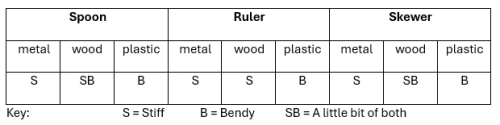
Guide students to talk about what they observe and to compare materials using simple language. For example, one material may be more stiff, more bendy or a little bit of both. If required, students could generate a scale of most bendy to most stiff by placing objects in a line along a table.
Co-create a class table or chart to record the results. Use simple words and symbols if needed, such as S for stiff and B for bendy.
- Does this material bend easily or not easily?
- It bends easily/it does not bend easily.
- Is this material stiff or bendy?
- It is stiff/bendy.
- Which object feels the most stiff?
- The metal or wooden objects may feel the most stiff.
- Which object feels the most bendy?
- The fabric or paper object may feel the most bendy.
- Do these similar objects behave in the same way or in different ways?
Extending the investigation
How might you extend this investigation to further develop students’ understanding?
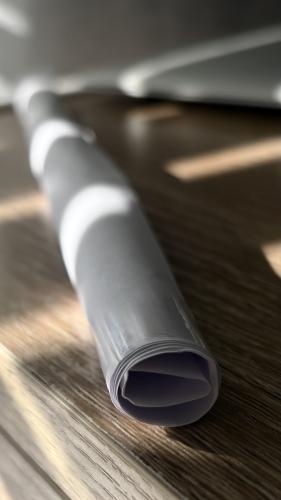
This investigation can be easily extended for students by posing the question: How can I change a material to make it more stiff or more bendy?
Students can then suggest and test simple changes that can be made to the materials that might alter the outcome of the original investigation.
For example, a piece of paper may be bendy, but when it is rolled into a tube, or folded many times upon itself, it becomes stiff and therefore more able to hold up weight. A wooden skewer may be stiff, but after it has been soaked in water for a period of time, it may bend more easily than when dry.
This investigation can be easily extended for students by posing the question: How can I change a material to make it more stiff or more bendy?
Students can then suggest and test simple changes that can be made to the materials that might alter the outcome of the original investigation.
For example, a piece of paper may be bendy, but when it is rolled into a tube, or folded many times upon itself, it becomes stiff and therefore more able to hold up weight. A wooden skewer may be stiff, but after it has been soaked in water for a period of time, it may bend more easily than when dry.
The Inquire phase allows students to cycle progressively and with increasing complexity through the key science ideas related to the core concepts. Each Inquire cycle is divided into three teaching and learning routines that allow students to systematically build their knowledge and skills in science and incorporate this into their current understanding of the world.
When designing a teaching sequence, it is important to consider the knowledge and skills that students will need in the final Act phase. Consider what the students already know and identify the steps that need to be taken to reach the level required. How could you facilitate students’ understanding at each step? What investigations could be designed to build the skills at each step?
Read more about using the LIA FrameworkFollowing an investigation, the Integrate routine provides time and space for data to be evaluated and insights to be synthesized. It reveals new insights, consolidates and refines representations, generalises context and broadens students’ perspectives. It allows student thinking to become visible and opens formative feedback opportunities. It may also lead to further questions being asked, allowing the Inquire phase to start again.
When designing a teaching sequence, consider the diagnostic assessment that was undertaken during the Launch phase. Consider if alternative conceptions could be used as a jumping off point to discussions. How could students represent their learning in a way that would support formative feedback opportunities? Could small summative assessment occur at different stages in the teaching sequence?
Read more about using the LIA FrameworkDoes it hold up?
In the following Integrate routine, students are guided to link their experiences testing materials with the science concept being explored: materials can have different observable properties, such as being bendy (flexible) or stiff (inflexible). Through modelling, questioning and discussion, students should come to a consensus that:
|
One at a time, each team shares one material they tested and whether they considered it bendy or stiff. Compare their result with the results of other teams. If there is agreement, add the name of the material to a table under the appropriate column, either “stiff” or “bendy”. You might also need a column for “not sure”, and depending on the materials you provide to students, a column titled “a bit bendy”. Reinforce that a property is how a material looks or behaves.
Discuss how stiff and bendy materials might be useful for different parts of a shelter. Encourage students to begin linking material properties to function. For example, a stiff material might help hold a shelter up, while a bendy material might wrap around or cover something.
- Why did this object go in the stiff group?
- Because it did not bend easily.
- Why did this object go in the bendy group?
- Because it bent easily.
- Could this material be useful in a shelter?
- Yes, it could be useful.
- Would this material be useful for a base, frame or cover? Why do you think that?
- It could be useful for a base/frame/cover because...
- Is there a material that you think would not be useful for a shelter? Why do you think that?
- Why might a stiff material be useful?
- Because it can help to hold something up.
- Why might a bendy material be useful?
- Because it can wrap around something or move without breaking.
- What if a chair leg was made of paper?
- It would bend or break and would not support someone sitting on it.
Show students two of the materials that were tested, one that they have determined is bendy and one that is stiff (for example, the paper spoon and a metal spoon or a wooden skewer and a piece of wool the same length). Ask students to predict which object would be able to hold a tissue up in the air and why they think that.
Demonstrate each one to show that a stiff material (metal or wood) can hold a tissue up in the air, but a bendy material (paper or wool) collapses and cannot hold the tissue up.
Write some statements in the class science journal about what students have learned during the investigation. For example:
- Objects are made from materials.
- Materials have properties.
- Some materials are stiff and some materials are bendy.
- Stiff materials can hold things up. Bendy materials are floppy and cannot make things stay up.
Optional: Students draw a simple “What if...?” picture to show an unsuitable material choice, for example: What if chair legs were made of paper? What if a walking stick was made of fabric?
Share relevant “What if…?” student drawings to emphasise the problems that occur when material properties do not match an object’s intended use.
Add new words and any related drawings or photos to the word wall.
Reflect on the lesson
You might:
- review the class science journal.
- review the idea that the names of objects and the names of materials are different.
- reinforce that materials have properties, including being stiff and bendy.
- link the learning back to the toy character challenge by reminding students that they will need to choose materials carefully for different parts of a shelter.
The skills of observation
Why is observation an important scientific skill to teach?
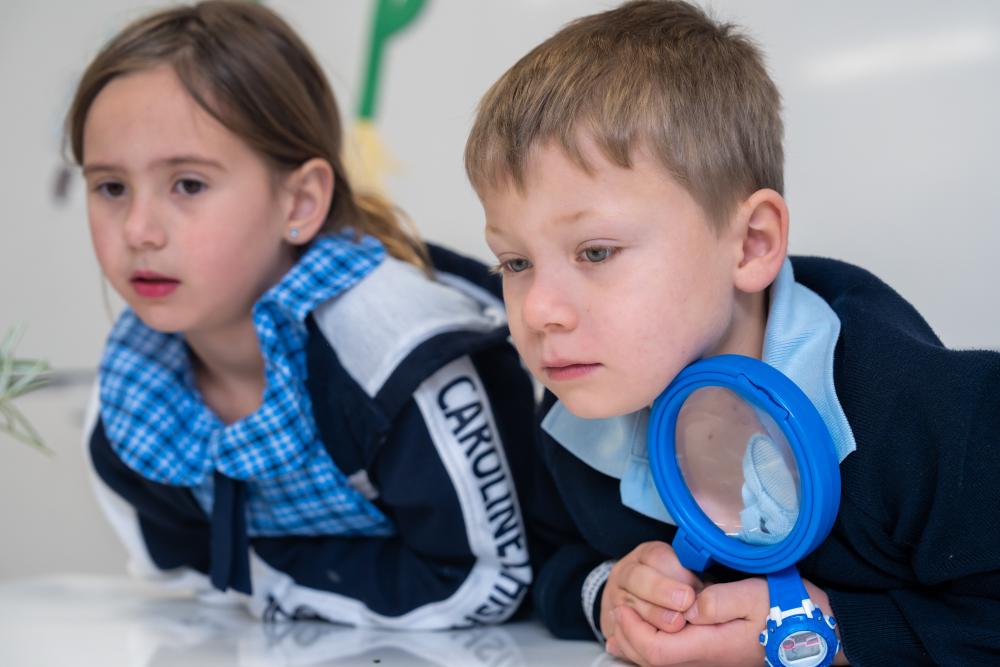
From an early age, students use their senses to explore the diverse nature of the world around them. They do so mainly through observation, a skill that is fundamental to science. Observation involves the use of the five main senses: touch, taste, hearing, sight and smell. Each sense provides different information about what we are observing. This can be emphasised by using the terms “I see...”, “I hear...”, “I smell...”, and “I feel...”. Tasting is not recommended in an educational science investigation.
Learning to observe involves learning to communicate observations to others, through representations or descriptions. This is an important skill that allows others to replicate an investigation or identify a described material.
Students might need practice and assistance through questioning to distinguish between observations and assumptions or inferences. For example, “I see that the material is shiny and I feel that it is smooth and cool to the touch” can lead to the inference that “I think that the material is metal”.
From an early age, students use their senses to explore the diverse nature of the world around them. They do so mainly through observation, a skill that is fundamental to science. Observation involves the use of the five main senses: touch, taste, hearing, sight and smell. Each sense provides different information about what we are observing. This can be emphasised by using the terms “I see...”, “I hear...”, “I smell...”, and “I feel...”. Tasting is not recommended in an educational science investigation.
Learning to observe involves learning to communicate observations to others, through representations or descriptions. This is an important skill that allows others to replicate an investigation or identify a described material.
Students might need practice and assistance through questioning to distinguish between observations and assumptions or inferences. For example, “I see that the material is shiny and I feel that it is smooth and cool to the touch” can lead to the inference that “I think that the material is metal”.