

Shelter in a storm
View Sequence overviewStudents will:
- determine whether a material can be easily torn.
- describe materials in terms of how easily they can be torn.
- determine which materials make a suitable cover for a shelter.
Students will represent their understanding as they:
- predict whether a material can be torn.
- record results of their investigations about whether a material can be torn.
- contribute to discussions about which materials make suitable covers for a shelter and why.
In this lesson, assessment is formative.
Feedback might focus on:
- students’ predictions about which materials can be torn. Can they justify their predictions based on their experiences?
- students’ results when testing tearability. Can they explain how hard they pulled and why that may have made a difference? Can they give reasons as to why their results may have been different to another team's results?
Whole class
Class science journal (digital or hard-copy)
A tissue
A variety of materials that can be tested for tearability, such as paper, cloth, cardboard, foil, cling wrap, baking paper, paper towel, rocks, spoons
Demonstration copy of the Does it tear? Resource sheet
Each group
At least 3 x materials that can be tested for tearability, such as paper, cloth, cardboard, foil, cling wrap, baking paper, paper towel, rocks, spoons. Ensure each team has at least 1 x material each of the following:
- a material that tears easily.
- a material that does not tear easily.
- a material that does not tear easily, but is not suitable to use as the cover for a shelter.
Each student
Individual science journal (digital or hard-copy)
Does it tear? Resource sheet
Lesson
The Inquire phase allows students to cycle progressively and with increasing complexity through the key science ideas related to the core concepts. Each Inquire cycle is divided into three teaching and learning routines that allow students to systematically build their knowledge and skills in science and incorporate this into their current understanding of the world.
When designing a teaching sequence, it is important to consider the knowledge and skills that students will need in the final Act phase. Consider what the students already know and identify the steps that need to be taken to reach the level required. How could you facilitate students’ understanding at each step? What investigations could be designed to build the skills at each step?
Read more about using the LIA FrameworkRe-orient
Use the class science journal to review the process students followed in Lessons 3 and 4 to learn about frames and determine which materials and shapes were suitable for building them, including:
- testing whether materials were bendy or stiff.
- determining that stiff materials are better at holding things up.
- determining that shelter frames need to be made from stiff materials because they hold up the covers.
- determine that shelter frames need wide bases to stay upright without being held.
The Inquire phase allows students to cycle progressively and with increasing complexity through the key science ideas related to the core concepts. Each Inquire cycle is divided into three teaching and learning routines that allow students to systematically build their knowledge and skills in science and incorporate this into their current understanding of the world.
When designing a teaching sequence, it is important to consider the knowledge and skills that students will need in the final Act phase. Consider what the students already know and identify the steps that need to be taken to reach the level required. How could you facilitate students’ understanding at each step? What investigations could be designed to build the skills at each step?
Read more about using the LIA FrameworkIdentifying and constructing questions is the creative driver of the inquiry process. It allows students to explore what they know and how they know it. During the Inquire phase of the LIA Framework, the Question routine allows for past activities to be reviewed and to set the scene for the investigation that students will undertake. The use of effective questioning techniques can influence students’ view and interpretation of upcoming content, open them to exploration and link to their current interests and science capital.
When designing a teaching sequence, it is important to spend some time considering the mindset of students at the start of each Inquire phase. What do you want students to be thinking about, what do they already know and what is the best way for them to approach the task? What might tap into their curiosity?
Read more about using the LIA FrameworkWhat can be torn?
Remind students of the tests conducted in the previous lessons, including trying to hold up a tissue with a skewer and with a wider frame.
Ask students to consider whether they think a tissue would make a good cover for a shelter and why or why not.
Students’ responses might include ideas such as the tissue not being heavy enough and flying away in the wind, or that it could get wet and tear easily.
Introduce the terms “rip” and “tear” to students and ask them what they think the terms mean. Explain the terms as required: a hole or split in a material, or the act of making a hole or split in a material.
Ask whether they think a tissue would rip or tear easily and what action they could use to test this (typically by holding the tissue in two places and pulling in opposite directions).
Demonstrate that the tissue can be easily torn.
Show students the range of different materials you have collected and ask them to predict whether each material will tear easily. Include some examples of materials that will not tear easily but are not suitable shelter covers for other reasons e.g. rocks, metal items, such as spoons (too heavy and difficult to shape), paper, cardboard and fabric (not waterproof), and thick plastic sheets (difficult to shape).
Pose the question: Which materials rip or tear easily?
The property of tearing strength (tearability or tear-resistance)
Tearing strength is a material property that describes how well the material resists the extension of a tear.
Tearing strength, also known as tear resistance, is a material property that describes how well the material resists the extension of a tear once a cut, hole or notch has formed. It differs from tensile strength, which measures the force needed to pull a material apart. A material may have high tensile strength but still tear easily if a small cut is present.
Factors that can affect a material’s ability to resist tearing include: its type, thickness or fibre direction; its internal structure (woven, cross-linked polymer or layered); the amount of moisture; and the temperature (extreme cold can make materials more brittle).
Common alternative conceptions include:
- Thicker materials are always harder to tear.
- Thickness helps, but material structure is often more important. Thin woven fabric can be more tear-resistant than thick paper.
- Strong materials never tear.
- Even very strong materials can tear once a crack or cut forms.
- A material that stretches easily will also tear easily.
- Many flexible materials, such as nylon, stretch while absorbing energy, making them highly tear-resistant.
Tearing strength, also known as tear resistance, is a material property that describes how well the material resists the extension of a tear once a cut, hole or notch has formed. It differs from tensile strength, which measures the force needed to pull a material apart. A material may have high tensile strength but still tear easily if a small cut is present.
Factors that can affect a material’s ability to resist tearing include: its type, thickness or fibre direction; its internal structure (woven, cross-linked polymer or layered); the amount of moisture; and the temperature (extreme cold can make materials more brittle).
Common alternative conceptions include:
- Thicker materials are always harder to tear.
- Thickness helps, but material structure is often more important. Thin woven fabric can be more tear-resistant than thick paper.
- Strong materials never tear.
- Even very strong materials can tear once a crack or cut forms.
- A material that stretches easily will also tear easily.
- Many flexible materials, such as nylon, stretch while absorbing energy, making them highly tear-resistant.
The Inquire phase allows students to cycle progressively and with increasing complexity through the key science ideas related to the core concepts. Each Inquire cycle is divided into three teaching and learning routines that allow students to systematically build their knowledge and skills in science and incorporate this into their current understanding of the world.
When designing a teaching sequence, it is important to consider the knowledge and skills that students will need in the final Act phase. Consider what the students already know and identify the steps that need to be taken to reach the level required. How could you facilitate students’ understanding at each step? What investigations could be designed to build the skills at each step?
Read more about using the LIA FrameworkThe Investigate routine provides students with an opportunity to explore the key ideas of science, to plan and conduct an investigation, and to gather and record data. The investigations are designed to systematically develop content knowledge and skills through increasingly complex processes of structured inquiry, guided inquiry and open inquiry approaches. Students are encouraged to process data to identify trends and patterns and link them to the real-world context of the teaching sequence.
When designing a teaching sequence, consider the diagnostic assessment (Launch phase) that identified the alternative conceptions that students held. Are there activities that challenge these ideas and provide openings for discussion? What content knowledge and skills do students need to be able to complete the final (Act phase) task? How could you systematically build these through the investigation routines? Are there opportunities to build students’ understanding and skills in the science inquiry processes through the successive investigations?
Read more about using the LIA FrameworkTorn and tested
Students work in teams to test different materials to see whether they can be easily torn.
Each team should test at least three different materials. You might ask all teams to test the same three materials. Alternatively, you might test six different materials across teams and collate the data during the Integrate step. Determine the approach that best suits your students.
Demonstrate the techniques students should use to attempt to tear the materials, such as stretching the materials by pulling from opposite ends in opposite directions or by pulling or pushing them in different directions from the centre.
You might demonstrate how a material, such as paper, cannot be torn easily when pulled from opposite ends, but can be torn easily when pulled in opposite directions from the centre.
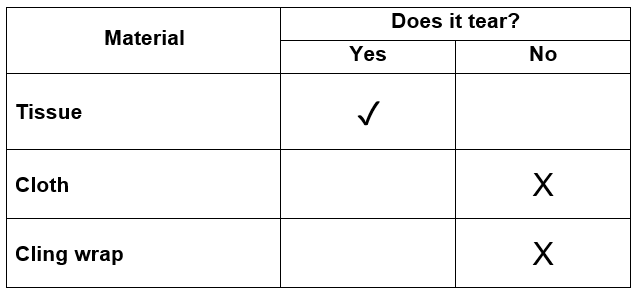
Model how students can record their data in their prepared data table on the Does it tear? Resource sheet using an X or a ✓ (see sample table below).
The Inquire phase allows students to cycle progressively and with increasing complexity through the key science ideas related to the core concepts. Each Inquire cycle is divided into three teaching and learning routines that allow students to systematically build their knowledge and skills in science and incorporate this into their current understanding of the world.
When designing a teaching sequence, it is important to consider the knowledge and skills that students will need in the final Act phase. Consider what the students already know and identify the steps that need to be taken to reach the level required. How could you facilitate students’ understanding at each step? What investigations could be designed to build the skills at each step?
Read more about using the LIA FrameworkFollowing an investigation, the Integrate routine provides time and space for data to be evaluated and insights to be synthesized. It reveals new insights, consolidates and refines representations, generalises context and broadens students’ perspectives. It allows student thinking to become visible and opens formative feedback opportunities. It may also lead to further questions being asked, allowing the Inquire phase to start again.
When designing a teaching sequence, consider the diagnostic assessment that was undertaken during the Launch phase. Consider if alternative conceptions could be used as a jumping off point to discussions. How could students represent their learning in a way that would support formative feedback opportunities? Could small summative assessment occur at different stages in the teaching sequence?
Read more about using the LIA FrameworkTough shelter materials
In the following Integrate routine, students are guided to link their experiences of testing the tearability of materials with their learning about shelters and the suitability appropriate of different materials used for building them. Through modelling, questioning and discussion, students should come to a consensus that:
|
Bring the class together to share and collate the results of the tearing investigation.
Using an extended version of the table on the Does it tear? Resource sheet, list all the materials that were tested across the teams. Use tally marks or a similar method to record whether each team that tested a material determined that it tore easily.
Where there are differing results (some teams found that a material tore and other teams found that it did not), discuss why this may have been the case. Contributing factors may include the technique teams used to try to tear the material, the force they applied, any small rips or holes that were already present or any other differences, such as the location of the tears or if the material had been doubled over.
Discuss how the results will affect which materials students select as covers for their shelters.
- Which materials tore easily?
- Which materials did not tear easily?
- Did you have to pull harder to tear some materials than others?
- What does this tell you about the material?
- Why would a material that tears easily be unsuitable to use for a shelter in a storm?
- What would happen if a stick poked a hole in the shelter's cover?
Co-construct a class statement such as: A shelter needs a cover that won't tear in a storm.
Reflect on the lesson
You might:
- add new words and any related drawings or photos to the word wall.
- discuss and identify which materials will make a suitable cover for the students’ shelters.