

Adapt to survive
View Sequence overviewStudents will:
- explore and compare camouflage and mimicry as structural adaptations.
- examine the story of the peppered moth and consider how it demonstrates the mechanism of natural selection.
Students will represent their understanding as they:
- discuss structural features of animals and how they enable survival.
- discuss and justify how some structural adaptations serve a similar purpose (for example defence from predators).
- model camouflage by creating a moth (or similar) to camouflage in the classroom.
- contribute to discussions and a storyboard about peppered moths and how the population has changed over time.
In this lesson, assessment is formative.
Feedback might focus on:
- students’ moth camouflage design. Do their moths camouflage with the colours, textures and patterns in the position they are placed?
- students’ discussions about adaptations. Do they recognise that animal populations change slowly over time as the mutation with a survival advantage breed?
Whole class
Class science journal (digital or hard-copy)
Demonstration copy of the Aussie animal adaptations Resource sheet
Video: Natural selection and the peppered moth (1:52)
Optional: Demonstration copy of the Peppered moth storyboard Resource sheet
Moth outlines from Moth template Resource sheet, cut up and ready to distribute to students (determine how many moths you would like each student to camouflage and hide, and print as many copies as required)
Each group
Sticky notes
Each student
Individual science journal (digital or hard-copy)
Scissors
Textas, pencils
Blu tack/sticky tape
Lesson
The Inquire phase allows students to cycle progressively and with increasing complexity through the key science ideas related to the core concepts. Each Inquire cycle is divided into three teaching and learning routines that allow students to systematically build their knowledge and skills in science and incorporate this into their current understanding of the world.
When designing a teaching sequence, it is important to consider the knowledge and skills that students will need in the final Act phase. Consider what the students already know and identify the steps that need to be taken to reach the level required. How could you facilitate students’ understanding at each step? What investigations could be designed to build the skills at each step?
Read more about using the LIA FrameworkRe-orient
Revise the meaning of the term “adaptation” and discuss animal and plant adaptations that students have so far explored, including:
- different mouth shapes supporting feeding on different food sources.
- differences between ant species and the possible explanations for these differences.
- leaf size and shape, and which is best suited to wetter and drier environments and why.
The Inquire phase allows students to cycle progressively and with increasing complexity through the key science ideas related to the core concepts. Each Inquire cycle is divided into three teaching and learning routines that allow students to systematically build their knowledge and skills in science and incorporate this into their current understanding of the world.
When designing a teaching sequence, it is important to consider the knowledge and skills that students will need in the final Act phase. Consider what the students already know and identify the steps that need to be taken to reach the level required. How could you facilitate students’ understanding at each step? What investigations could be designed to build the skills at each step?
Read more about using the LIA FrameworkIdentifying and constructing questions is the creative driver of the inquiry process. It allows students to explore what they know and how they know it. During the Inquire phase of the LIA Framework, the Question routine allows for past activities to be reviewed and to set the scene for the investigation that students will undertake. The use of effective questioning techniques can influence students’ view and interpretation of upcoming content, open them to exploration and link to their current interests and science capital.
When designing a teaching sequence, it is important to spend some time considering the mindset of students at the start of each Inquire phase. What do you want students to be thinking about, what do they already know and what is the best way for them to approach the task? What might tap into their curiosity?
Read more about using the LIA FrameworkHiding in plain sight
Using a demonstration copy of the Aussie animal adaptations Resource sheet observe and discuss the images of the animals shown on pages 1-4 (a tawny frogmouth and a bird-dropping spider).
- How many animals can you see in the first image?
- There are four tawny frogmouths in the first image, two adults and two juveniles.
- What type of animal is a tawny frogmouth? How do you know?
- A bird. While they are often mistaken for owls, their feet are weaker without the curved talons of an owl.
- Do you think a tawny frogmouth would be easy to spot in real life? Why do you think that?
- What structural adaptation has the tawny frogmouth developed and how do you think it might help them?
- Similar colouring to a tree branch or trunk.
- Why do you think this spider is called the bird-dropping spider?
- Because it looks like common bird droppings.
- Does the spider use the same method as the tawny frogmouth to hide from prey? Why do you think that?
- The bird-dropping spider looks like one specific object (bird droppings), while the tawny frogmouth has the colouring of most tree branches.
- What method does the bird-dropping spider use to hide?
Read the information about tawny frogmouths and bird-dropping spiders found on pages 5-6 of the Aussie animal adaptations Resource sheet.
With/for students, define the terms “camouflage” and “mimicry” as required:
- Camouflage: a disguise that helps something blend into its surroundings.
- Mimicry: imitating, either by appearance or behaviour, something else.
Discuss the difference between camouflage and mimicry, specifically referring back to the tawny frogmouth (camouflage) and bird-dropping spiders (mimicry) as examples.
Discuss any other animals that students think they know that use camouflage and/or mimicry as a means of hiding from predators, or any that use it as a means of helping them catch prey.
Optional: View a collection of videos to observe and discuss the wide variety of animals that use the adaptive feature of camouflage, such as:
- World’s best disguised predator fish (stone fish) (1:19)
- How many lizards do you see? (0:16)
- Tawny Frogmouths are the masters of camouflage (0:21)
Pose the question: How do camouflage and mimicry adaptations help an animal to survive?
Camouflage and mimicry
Why do animals use camouflage and mimicry?
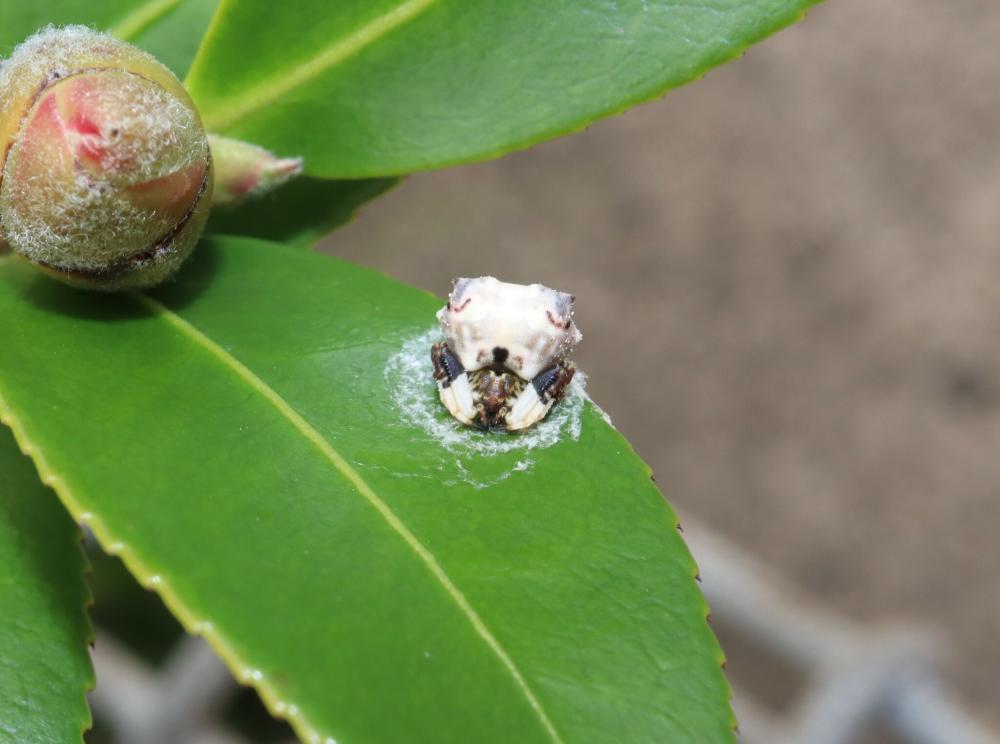
Camouflage and mimicry are two clever survival strategies.
Camouflage helps animals blend into their surroundings so predators can’t easily see them. For example, a leafy sea dragon looks like floating seaweed, and stick insects look just like twigs or branches.
Mimicry is when an animal imitates another species to gain an advantage. The owl moth has big eye-shaped patterns on its wings that make it look like a more dangerous owl. This scares smaller birds that may eat the moth. The non-venomous scarlet kingsnake has bright colours that look very similar to the venomous coral snake. This encourages potential predators to mistake it for the more dangerous species and stay away.
Both camouflage and mimicry help animals survive in their habitats.
Camouflage and mimicry are two clever survival strategies.
Camouflage helps animals blend into their surroundings so predators can’t easily see them. For example, a leafy sea dragon looks like floating seaweed, and stick insects look just like twigs or branches.
Mimicry is when an animal imitates another species to gain an advantage. The owl moth has big eye-shaped patterns on its wings that make it look like a more dangerous owl. This scares smaller birds that may eat the moth. The non-venomous scarlet kingsnake has bright colours that look very similar to the venomous coral snake. This encourages potential predators to mistake it for the more dangerous species and stay away.
Both camouflage and mimicry help animals survive in their habitats.
The Inquire phase allows students to cycle progressively and with increasing complexity through the key science ideas related to the core concepts. Each Inquire cycle is divided into three teaching and learning routines that allow students to systematically build their knowledge and skills in science and incorporate this into their current understanding of the world.
When designing a teaching sequence, it is important to consider the knowledge and skills that students will need in the final Act phase. Consider what the students already know and identify the steps that need to be taken to reach the level required. How could you facilitate students’ understanding at each step? What investigations could be designed to build the skills at each step?
Read more about using the LIA FrameworkThe Investigate routine provides students with an opportunity to explore the key ideas of science, to plan and conduct an investigation, and to gather and record data. The investigations are designed to systematically develop content knowledge and skills through increasingly complex processes of structured inquiry, guided inquiry and open inquiry approaches. Students are encouraged to process data to identify trends and patterns and link them to the real-world context of the teaching sequence.
When designing a teaching sequence, consider the diagnostic assessment (Launch phase) that identified the alternative conceptions that students held. Are there activities that challenge these ideas and provide openings for discussion? What content knowledge and skills do students need to be able to complete the final (Act phase) task? How could you systematically build these through the investigation routines? Are there opportunities to build students’ understanding and skills in the science inquiry processes through the successive investigations?
Read more about using the LIA FrameworkMoth search
Investigation part 1
Explain that moths are a popular food source for many animals the world over, including bats, birds, spiders, small mammals, lizards, frogs. As such, moths have become experts at camouflage and mimicry.
Next explain to students that for the first part of their investigation they are going to “decorate” some paper moths and hide them around the classroom (or school grounds) for their classmates to find. The goal is to camouflage the moths so well that they cannot that be found. This can be done in teams or as an individual task. A template has been provided on the Moth template Resource sheet.
- Lay out some ground rules for hiding the moths, including:
- Moths must be hidden within a specified “hiding zone”, so that students can be adequately supervised.
- Moths must be hidden in plain sight and rely on their shape/colouring to hide. Being hidden underneath or inside an object does not utilise camouflage and mimicry.
- Allow students/teams time to inspect the hiding zone and plan how they might decorate their moths. Taking photos for future reference with a digital device can be helpful.
- Allow students/teams time to decorate their moths, writing their names on the back so that moths can be identified when they are found. Every student/team should have the same number of moths.
- Students/teams hide their moths within the hiding zone. They should note where they hide the moths so they can be retrieved later if not found.
- Students/teams try to find the moths hidden by other students/teams. They should note where they find each moth and how easy the moths were to spot in their hidden location.
- Students/teams share the moths that they found, where they were located, how easy they were to locate, and why they think that was so.
- Tally how many of each student/team’s moths were found to determine if there are any left still camouflaged in the hiding zone.
- Teams with any moths remaining in the hiding zone can retrieve their moths, taking photos of the moth before retrieval, or taking the class to see it in situ.
Discuss why some moths may have been more successfully hidden than others.
Investigation part 2
Watch the video Natural selection and the peppered moth (1:52), stopping at intervals so that students can record key words they have heard. Re-watch the video as required.
In teams, students use the Peppered moth storyboard Resource sheet to retell the story of the peppered moth.
The Inquire phase allows students to cycle progressively and with increasing complexity through the key science ideas related to the core concepts. Each Inquire cycle is divided into three teaching and learning routines that allow students to systematically build their knowledge and skills in science and incorporate this into their current understanding of the world.
When designing a teaching sequence, it is important to consider the knowledge and skills that students will need in the final Act phase. Consider what the students already know and identify the steps that need to be taken to reach the level required. How could you facilitate students’ understanding at each step? What investigations could be designed to build the skills at each step?
Read more about using the LIA FrameworkFollowing an investigation, the Integrate routine provides time and space for data to be evaluated and insights to be synthesized. It reveals new insights, consolidates and refines representations, generalises context and broadens students’ perspectives. It allows student thinking to become visible and opens formative feedback opportunities. It may also lead to further questions being asked, allowing the Inquire phase to start again.
When designing a teaching sequence, consider the diagnostic assessment that was undertaken during the Launch phase. Consider if alternative conceptions could be used as a jumping off point to discussions. How could students represent their learning in a way that would support formative feedback opportunities? Could small summative assessment occur at different stages in the teaching sequence?
Read more about using the LIA FrameworkNatural selection
In the following Integrate routine, students are guided to link their experiences in the investigation with the science concept being explored, that is, that some animals have adapted to use camouflage and mimicry as a means of avoiding and/or catching prey. Through modelling, questioning and discussion, students should come to a consensus that:
|
Teams share their peppered moth storyboards. Allow opportunities for storyboards to be added to based on details shared by other teams.
Optional: Create a class version of the storyboard for the class science journal.
Introduce the term “natural selection”: a mechanism of evolution whereby individuals of a species who are better suited to their environment are more likely to survive, breed and pass on those favourable traits to their offspring (nature selecting for or against certain traits).
Using the story of the peppered moth, consider how this definition of natural selection applies. See the embedded professional learning The story of the peppered moth for more information.
Discuss how peppered moths use camouflage to blend into their environment, and how, when their environment changed, the species was able to adapt so quickly.
- How were the peppered moths able to survive when the pollution turned the trees black?
- Why were they able to adapt so quickly?
- The mutation that caused the black moths already existed, so when the trees turned black those moths were able to flourish.
Return to the Aussie animal adaptations Resource sheet and read the information about the tawny frogmouth and the bird-dropping spider found on pages 5 and 6. Discuss what might need to change in these animals' environments for them to adapt as the peppered moth did, and why it's unlikely.
- What do you think would happen to the tawny frogmouth or the bird-dropping spider if their habitat suddenly and dramatically changed?
- Do you think they would be able to adapt and survive? Why do you think that?
- For a species to change, it must have some individuals in the environment that are capable of surviving to have babies. If (for example) all trees were to turn blue, the tawny frogmouth would not survive because they do not have any individuals that could camouflage against the blue trees. Blue feathers do not appear on demand.
- Which species do you think would adapt more quickly? Why do you think that?
- Note for students that the average lifespan of the tawny frogmouth is up to 14 years in the wild (up to 30 in captivity). They reproduce only once per year, laying between 1-3 eggs, with about 60-65% of chicks surviving beyond 30 days.
- Also note that the average lifespan of the bird-dropping spider is about 1 year. They usually reproduce once in this time, laying 10+ egg-sacs containing up to 200 eggs each; however, only between 1-10% of the spiderlings survive.
- Do you think most animal adaptations take a long time or a short time? Why do you think that?
- All animal adaptations take many generations to affect the whole species.
Reflect on the lesson
You might:
- add vocabulary related to camouflage and mimicry the class word wall or glossary.
- add to the W and H sections of the TWLH chart.
- discuss how students were thinking and working like scientists during the lesson. Focus on grouping adaptations with similar purposes and establishing a timeline of peppered moth populations in the storyboard.
- invite responses about animal species adaptations that seem creative, inspiring or interesting.
The story of the peppered moth
Why are the peppered moths such a good example of natural selection?
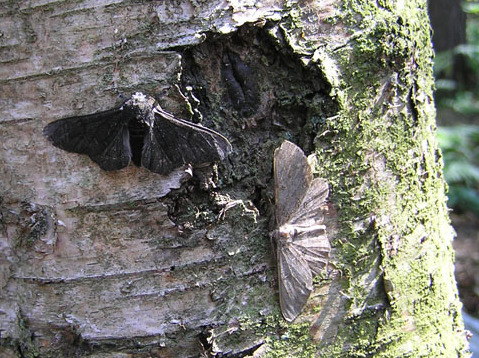
The peppered moth is a species that is common in England and Ireland. It is predominantly white, with black speckles across its wings. This speckled appearance helps it to blend into the lichen covered trees in its typical forest habitats. However, a genetic mutation found in some peppered moths causes them to be almost entirely black.
Before the Industrial Revolution, the tree trunks of the forests the peppered moths lived in were mostly white. This meant that predominantly white moths had the favourable traits—it was easier for them to camouflage among the trees. They therefore survived and were more likely to reproduce in greater numbers, making more predominantly white moths. The black moths were easier to find on the white tree trunks, and therefore got eaten more and reproduced less (they were selected against).
After the Industrial Revolution began, pollution turned the trees in the peppered moth's habitat black. This meant the black moths now had the favourable traits—it was easier for them to camouflage on the trunks of the soot-blackened trees. This meant more black moths surviving and reproducing more black moths (they were selected for). The white moths were now easy to find, so they were eaten more often and didn’t reproduce as much.
When environmental initiatives reduced pollution levels, the trees in the peppered moths’ habitat returned to white again, so now the few white moths that were still around had the advantage again, and once again the trait of being white was favourable.
Because the moths have a relatively short life span (between 8-9 months), and reproduce prolifically (a female lays up to 2000 eggs), scientists were able to see this process of natural selection happening in a relatively short space of time. It is much harder to track natural selection in longer-lived species, as it takes place over many generations. In fact, it took less than 50 years from the sighting of the first black moth in Manchester, England, in 1948, for scientists to record that 98% of the species was black, which happened in 1895.
By about the 1950s, environmental initiatives meant the trees had returned to white, and the numbers of white moths began to increase again.
Information on the peppered moth sourced from:
The peppered moth is a species that is common in England and Ireland. It is predominantly white, with black speckles across its wings. This speckled appearance helps it to blend into the lichen covered trees in its typical forest habitats. However, a genetic mutation found in some peppered moths causes them to be almost entirely black.
Before the Industrial Revolution, the tree trunks of the forests the peppered moths lived in were mostly white. This meant that predominantly white moths had the favourable traits—it was easier for them to camouflage among the trees. They therefore survived and were more likely to reproduce in greater numbers, making more predominantly white moths. The black moths were easier to find on the white tree trunks, and therefore got eaten more and reproduced less (they were selected against).
After the Industrial Revolution began, pollution turned the trees in the peppered moth's habitat black. This meant the black moths now had the favourable traits—it was easier for them to camouflage on the trunks of the soot-blackened trees. This meant more black moths surviving and reproducing more black moths (they were selected for). The white moths were now easy to find, so they were eaten more often and didn’t reproduce as much.
When environmental initiatives reduced pollution levels, the trees in the peppered moths’ habitat returned to white again, so now the few white moths that were still around had the advantage again, and once again the trait of being white was favourable.
Because the moths have a relatively short life span (between 8-9 months), and reproduce prolifically (a female lays up to 2000 eggs), scientists were able to see this process of natural selection happening in a relatively short space of time. It is much harder to track natural selection in longer-lived species, as it takes place over many generations. In fact, it took less than 50 years from the sighting of the first black moth in Manchester, England, in 1948, for scientists to record that 98% of the species was black, which happened in 1895.
By about the 1950s, environmental initiatives meant the trees had returned to white, and the numbers of white moths began to increase again.
Information on the peppered moth sourced from: