

Adapt to survive
View Sequence overviewStudents will:
- draw reasoned conclusions about the structural adaptations of little penguins and their purpose.
- construct waterproof, insulated mittens to model cold climate adaptations.
- compare feathers, fur and blubber as insulators.
Students will represent their understanding as they:
- select/devise a fair method to compare the insulators.
- discuss findings about feathers, fur and blubber as insulators.
- discuss challenges and improvements for the investigation.
In this lesson, assessment is formative.
Feedback might focus on:
- students’ observations and findings. Did students recognise that feathers, fur and blubber are all insulators? Have they used qualitative and quantitative language as appropriate to their data collection method to compare the insulators?
- students’ discussions about challenges and limitations. Are they able to identify limitations with the investigation? Can they suggest improvements to collect accurate data?
Whole class
Class science journal (digital or hard-copy)
Demonstration copy of the Little penguin Resource sheet
2 or 4 sandwich-sized resealable lunch bags
A material to use as a model for blubber e.g. vegetable shortening such as Copha, animal shortening such as Fairy or Superfry, or regular butter or margarine (see the embedded professional learning Adapting to your context below for further guidance)
Optional: Waterproof tape such as gaffer tape
Tub of cold water
Ice to make water colder
Thermometer
Video: How do whales, penguins, and polar bears keep warm? (3:44)
Each group
A material to use as a model for feathers e.g. craft feathers, feather boa, doona/duvet feathers and down
A material to use as a model for fur e.g. wool, faux fur, old vintage fur from coat/hat
4 sandwich size resealable lunch bags
Access to a thermometer
Optional: Waterproof tape such as gaffer tape
Each student
Individual science journal (digital or hard-copy)
Lesson
The Inquire phase allows students to cycle progressively and with increasing complexity through the key science ideas related to the core concepts. Each Inquire cycle is divided into three teaching and learning routines that allow students to systematically build their knowledge and skills in science and incorporate this into their current understanding of the world.
When designing a teaching sequence, it is important to consider the knowledge and skills that students will need in the final Act phase. Consider what the students already know and identify the steps that need to be taken to reach the level required. How could you facilitate students’ understanding at each step? What investigations could be designed to build the skills at each step?
Read more about using the LIA FrameworkRe-orient
Recall the previous lesson, focusing on camouflage and mimicry, and how it supports animals to survive.
The Inquire phase allows students to cycle progressively and with increasing complexity through the key science ideas related to the core concepts. Each Inquire cycle is divided into three teaching and learning routines that allow students to systematically build their knowledge and skills in science and incorporate this into their current understanding of the world.
When designing a teaching sequence, it is important to consider the knowledge and skills that students will need in the final Act phase. Consider what the students already know and identify the steps that need to be taken to reach the level required. How could you facilitate students’ understanding at each step? What investigations could be designed to build the skills at each step?
Read more about using the LIA FrameworkIdentifying and constructing questions is the creative driver of the inquiry process. It allows students to explore what they know and how they know it. During the Inquire phase of the LIA Framework, the Question routine allows for past activities to be reviewed and to set the scene for the investigation that students will undertake. The use of effective questioning techniques can influence students’ view and interpretation of upcoming content, open them to exploration and link to their current interests and science capital.
When designing a teaching sequence, it is important to spend some time considering the mindset of students at the start of each Inquire phase. What do you want students to be thinking about, what do they already know and what is the best way for them to approach the task? What might tap into their curiosity?
Read more about using the LIA FrameworkLittle penguins
Display the demonstration copy of the Little penguin Resource sheet and read the information about little penguins.
Ask students to draw a reasoned claim based on this information, and in reference to what they have learned about camouflage, about the possible advantages of the little penguins’ specific colouring.
As required, explain that:
- the blue/black feathers on their back help them camouflage when in deeper water, making it difficult for birds of prey to spot them from above.
- when viewed from below, their white belly blends with the bright, sunlit sea above, making it difficult for predators below them in the water to see them.
- being dark across the back and light on the front is known as counter-shading.
Ask if they are aware of any other animals that use this two-toned colour strategy, e.g. whales, birds, snakes and lizards, deer. It is a common camouflage strategy found in the animal kingdom.
Discuss other structural adaptations that students can see in the images and think may increase the little penguins’ chances of survival.
- What observations can you make about the little penguin’s beak shape that make you think it is well adapted to catching wet, slippery prey like fish, squid, and prawns?
- Their beaks have sharp edges to grip the slippery prey and a slight hook on the end to assist with holding onto the food.
- What observations can you make about the little penguins’ feet that you think might assist them to survive in their natural habitat?
- Their webbed feet make them good swimmers because the skin between their toes can move a greater volume of water, making them swim faster. This also applies to moving sand or soil when digging burrows, which is also aided by their sharp claws.
Draw students’ attention to the location where little penguins typically live, the cold waters of Southern Australia and New Zealand (both close to Antarctica).
Pose the question: What adaptations might little penguins have developed to help keep them warm in the cold southern oceans?
The Inquire phase allows students to cycle progressively and with increasing complexity through the key science ideas related to the core concepts. Each Inquire cycle is divided into three teaching and learning routines that allow students to systematically build their knowledge and skills in science and incorporate this into their current understanding of the world.
When designing a teaching sequence, it is important to consider the knowledge and skills that students will need in the final Act phase. Consider what the students already know and identify the steps that need to be taken to reach the level required. How could you facilitate students’ understanding at each step? What investigations could be designed to build the skills at each step?
Read more about using the LIA FrameworkThe Investigate routine provides students with an opportunity to explore the key ideas of science, to plan and conduct an investigation, and to gather and record data. The investigations are designed to systematically develop content knowledge and skills through increasingly complex processes of structured inquiry, guided inquiry and open inquiry approaches. Students are encouraged to process data to identify trends and patterns and link them to the real-world context of the teaching sequence.
When designing a teaching sequence, consider the diagnostic assessment (Launch phase) that identified the alternative conceptions that students held. Are there activities that challenge these ideas and provide openings for discussion? What content knowledge and skills do students need to be able to complete the final (Act phase) task? How could you systematically build these through the investigation routines? Are there opportunities to build students’ understanding and skills in the science inquiry processes through the successive investigations?
Read more about using the LIA FrameworkSurviving cold waters
Discuss what students already know about feathers, fur and blubber and list animals that have them. Record their ideas in the class science journal.
If required, define “blubber”: the thick layer of fat that sits directly under the skin of marine animals, including mammals such as whales, seals and dolphins and birds such as penguins. Polar bears also have blubber whilst not strictly marine animals. Blubber insulates heat keeping the animal warm, stores energy and increases buoyancy.
Note for students that little penguins have both blubber and feathers, and explain that in this investigation they will work in teams to explore how animals keep warm in cold climates by creating mittens to compare the insulating effect of feathers, fur and blubber.
Display and examine the materials that students have available to use as insulation for the investigation and determine which ones are the best models for feathers, fur and blubber and why.
- Feathers: craft feathers, feather boa, doonah/duvet feathers and down (soft fluffy feathers beneath a bird’s outer feathers).
- Fur: wool, faux fur, old vintage fur from coat/hat.
- Blubber: vegetable shortening such as Copha, animal shortening such as Fairy or Superfry, or regular butter or margarine.
Explain and model how to create the mittens by creating one or two “blubber” mittens that will be shared between groups to reduce wastage:
- Place a sandwich-sized plastic bag inside another bag of the same size.
- Sandwich-sized resealable bags are ideal. Turning the inside bag inside out means the resealing mechanism can still be used to help seal the bags.
- Put a large amount of the insulating material between each side of the two layers of plastic.
- Seal the edges of the bags together so the insulating material cannot escape.
- Grey electrical tape/gaffer tape is ideal for this as it is wide and waterproof.
- Manipulate the insulating material between the bags so it is spread out in an even layer.
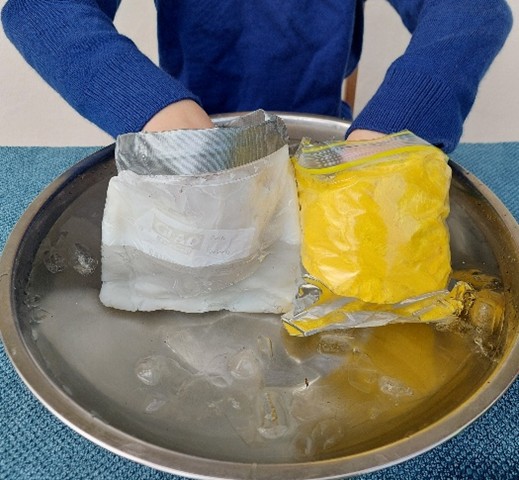
Discuss and determine:
- why plastic bags are being used.
- As this is a model exploring the insulating effect of blubber, feathers, and fur in water, there has to be a means of ensuring that the mittens are waterproof. Plastic is the best material to ensure this.
- how students will undertake the investigation.
- Students will place a hand inside each mitten in turn, then place this hand/mitten into a bowl of iced water for a set period of time.
- how students might collect fair, accurate and comparable data.
- Determine how long each hand/mitten can stay in the iced water.
- Take temperature readings of the water to ensure it is at the same/similar temperature when each mitten is placed in the water.
- If the temperature of the water rises significantly, add more ice until the temperature returns to the same baseline as when the first test was carried out.
- Determine how students will rate the effectiveness of each insulating material.
- For example, will they dip their hands simultaneously in the iced water with a different insulator on each hand? Will they leave one hand ungloved as a comparison? Will they use a thermometer (without touching the bulb at the base, as this will affect the reading)? Will they rate the “coldness” after an elapsed time? Will they take notes?
Allow teams time to make their feather and fur mittens, carry out their investigation, and record observations and results using the agreed-upon method.
Optional: Teams take photos during their investigation.
Adapting to your context
Which material is the best model for blubber?
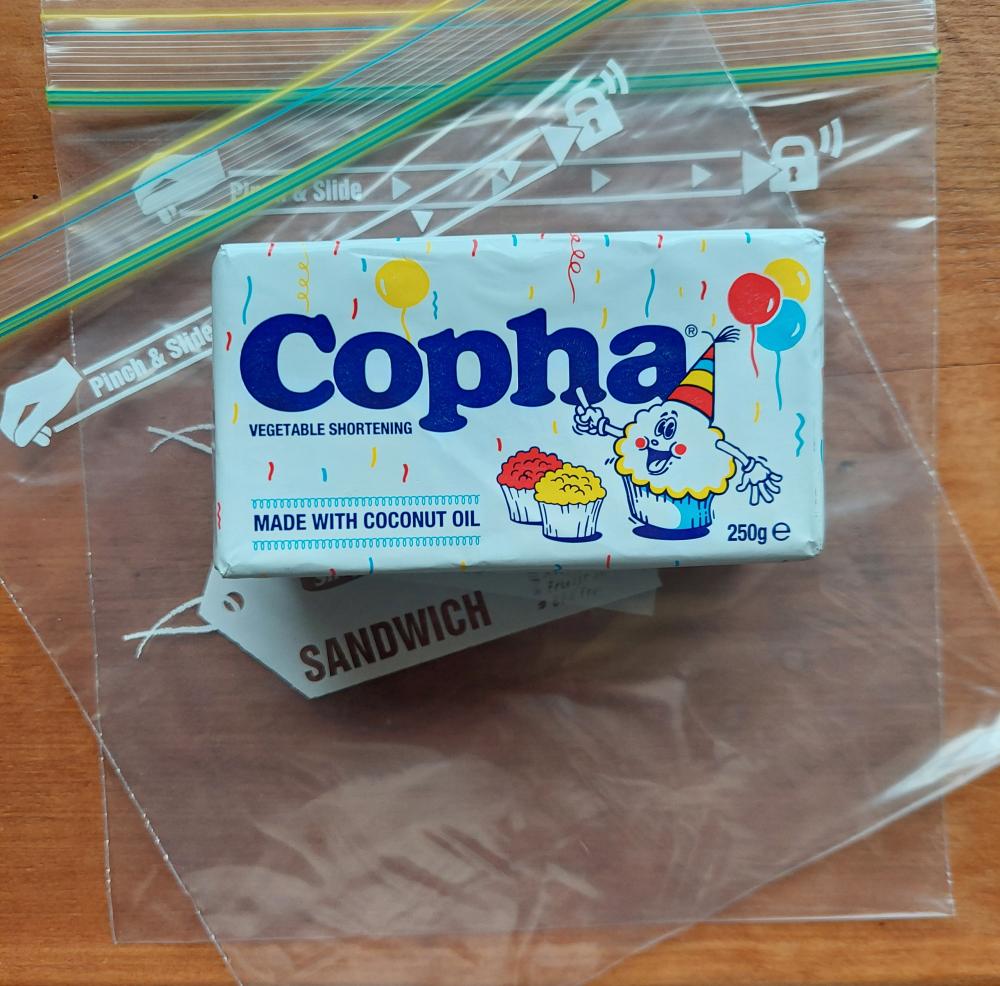
In this investigation vegetable shortening (such as Fairy or Copha) are used to represent blubber. Butter and margarine can be substituted, each with slightly different qualities.
Butter
Works well, but it softens and melts more quickly at warm room temperature. The experiment will still show insulation, but the “blubber layer” may feel softer and break down faster.
Margarine
A better substitute than butter because its texture is closer to shortening. It stays more stable and melts less during handling, so it usually gives more consistent insulation results.
Vegetable shortening (best option)
Vegetable shortening is ideal because it has a higher melting point, is thicker with a more uniform consistency, making it a better insulator.
Tips
If using butter or margarine:
- Keep them chilled before the activity
- Add a slightly thicker layer than you would with shortening. This should be matched by the thickness of the feather and fur layers.
In this investigation vegetable shortening (such as Fairy or Copha) are used to represent blubber. Butter and margarine can be substituted, each with slightly different qualities.
Butter
Works well, but it softens and melts more quickly at warm room temperature. The experiment will still show insulation, but the “blubber layer” may feel softer and break down faster.
Margarine
A better substitute than butter because its texture is closer to shortening. It stays more stable and melts less during handling, so it usually gives more consistent insulation results.
Vegetable shortening (best option)
Vegetable shortening is ideal because it has a higher melting point, is thicker with a more uniform consistency, making it a better insulator.
Tips
If using butter or margarine:
- Keep them chilled before the activity
- Add a slightly thicker layer than you would with shortening. This should be matched by the thickness of the feather and fur layers.
The Inquire phase allows students to cycle progressively and with increasing complexity through the key science ideas related to the core concepts. Each Inquire cycle is divided into three teaching and learning routines that allow students to systematically build their knowledge and skills in science and incorporate this into their current understanding of the world.
When designing a teaching sequence, it is important to consider the knowledge and skills that students will need in the final Act phase. Consider what the students already know and identify the steps that need to be taken to reach the level required. How could you facilitate students’ understanding at each step? What investigations could be designed to build the skills at each step?
Read more about using the LIA FrameworkFollowing an investigation, the Integrate routine provides time and space for data to be evaluated and insights to be synthesized. It reveals new insights, consolidates and refines representations, generalises context and broadens students’ perspectives. It allows student thinking to become visible and opens formative feedback opportunities. It may also lead to further questions being asked, allowing the Inquire phase to start again.
When designing a teaching sequence, consider the diagnostic assessment that was undertaken during the Launch phase. Consider if alternative conceptions could be used as a jumping off point to discussions. How could students represent their learning in a way that would support formative feedback opportunities? Could small summative assessment occur at different stages in the teaching sequence?
Read more about using the LIA FrameworkComparing methods and findings
In the following Integrate routine, students are guided to link their experiences building a model of animal insulation features with the science concept being explored, that is, that some animals have adaptation that help them to survive in cold climates. Through modelling, questioning and discussion, students should come to a consensus that:
|
Allow teams to share their results and the methods they used to compare the insulating properties of feathers, fur and blubber.
Determine if one was a more successful insulator and why/why not.
Consider how some animals, like the little penguins, have more than one insulating feature (feathers and blubber). List other animals the students think also have multiple insulating features, and any animals that only utilise one (and why they think that might be the case).
Discuss challenges and limitations that students faced during the investigation, such as differences in judgement about warmth/cold, variations in scoring and changing water temperatures over time.
- What challenges did you face when comparing the feathers, fur and blubber?
- Do you think everyone has the same tolerance for cold?
- Did you find that everyone in the team agreed with each other or did you have different opinions?
- How could this investigation be modified to collect accurate and measurable data?
- For example, matching jars could be filled with warm water, each wrapped in feathers/fur/blubber, and we could use multiple thermometers to measure heat loss over time.
Show the video How do whales, penguins, and polar bears keep warm? (3:44).
Optionally:
- explain and discuss the following:
- Little penguins have both feathers and a thin layer of blubber to keep them warm.
- Larger penguins, like emperor penguins, have more blubber to survive colder conditions in Antarctica.
- Little penguins have many more feathers than other birds, around 10,000 in total. The feathers interlock to trap warm air and create a waterproof layer. The trapped air also helps with buoyancy.
- Penguins have an oil gland near their tail and spend a significant amount of time oiling their feathers by running their beak through the feathers to distribute the oil. This is known as preening and assists with waterproofing.
- show the video Little blue penguins (1:14) for an explanation of moulting and the importance of feathers.
- show the video 10 things you didn’t know about Australia’s little penguin (7:39) to explore more structural features and behavioural adaptations of little penguins, including three eyelids and crossing beaches in groups.
- show the live video feed Little penguin burrow camera at Phillips Island to observe penguin features and behaviours (such as preening) in real time.
- consider (or research) if the animals found during Lesson 2’s habitat survey can warm themselves or if they are affected by the environmental temperature. Discuss how this affects their need for insulating layers such as feathers and fur.
Reflect on the lesson
You might:
- add vocabulary related to body covering and surviving cold temperatures to the class word wall or glossary.
- add to the W and H sections of the TWLH chart.
- review what’s been added to the class science journal during the lesson, determining if the ideas are supported by evidence, if further investigation or research is required to confirm them or making additions and amendments where needed.