

Adapt to survive
View Sequence overviewStudents will:
- explore how the behavioural adaptation of migration can help an animal to survive.
- participate in a migration simulation.
- compare winter dormancy (hibernation) and summer dormancy (aestivation) and consider how the mountain pygmy possum and bogong moth use these adaptations to survive.
Students will represent their understanding as they:
- discuss the behavioural adaptations of migration, hibernation and aestivation.
- complete the Survival behaviours Resource sheet.
In this lesson, assessment is formative.
Feedback might focus on:
- students’ discussions about migration. Are they able to describe how migration can help a species to survive? Can they explain why the bogong moth migrates?
- students’ discussions about hibernation and aestivation. Do they recognise the similarities and differences between the two?
- students’ responses on the Survival behaviours Resource sheet. Do students accurately identify and record migration, aestivation and hibernation as survival behaviours of the bogong moth and mountain pygmy possum?
Whole class
Class science journal (digital or hard-copy)
Video: On the move: Exploring animal migration across the globe (3:31)
Demonstration copy of the Animal migration and the bogong moth Resource sheet
Stopwatch or timer
Heat stress token for each student (counters, red paper pieces, blocks, or pom-poms)
Cool down token for each student (that look different to heat stress tokens, such as blue paper pieces)
Cones, hoops, desks, cloths, or tape or similar to mark spaces on the floor/yard
Signs or a visible key displayed in the classroom to mark the features of the landscape for the bogong moth simulation—Mount Bogong, eucalypts, grevilleas and crevices. For example, a key might look like:
- Desk = Mount Bogong
- Green markers = eucalypts
- Red markers = grevilleas
- Black circles = crevices
Space for students to safely move around
Videos:
Each student
Individual science journal (digital or hard-copy)
Survival behaviours Resource sheet
Lesson
The Inquire phase allows students to cycle progressively and with increasing complexity through the key science ideas related to the core concepts. Each Inquire cycle is divided into three teaching and learning routines that allow students to systematically build their knowledge and skills in science and incorporate this into their current understanding of the world.
When designing a teaching sequence, it is important to consider the knowledge and skills that students will need in the final Act phase. Consider what the students already know and identify the steps that need to be taken to reach the level required. How could you facilitate students’ understanding at each step? What investigations could be designed to build the skills at each step?
Read more about using the LIA FrameworkRe-orient
Recall the adaptations that help animals survive in their natural habitats that have been investigated in the sequence to date, including camouflage and body coverings.
The Inquire phase allows students to cycle progressively and with increasing complexity through the key science ideas related to the core concepts. Each Inquire cycle is divided into three teaching and learning routines that allow students to systematically build their knowledge and skills in science and incorporate this into their current understanding of the world.
When designing a teaching sequence, it is important to consider the knowledge and skills that students will need in the final Act phase. Consider what the students already know and identify the steps that need to be taken to reach the level required. How could you facilitate students’ understanding at each step? What investigations could be designed to build the skills at each step?
Read more about using the LIA FrameworkIdentifying and constructing questions is the creative driver of the inquiry process. It allows students to explore what they know and how they know it. During the Inquire phase of the LIA Framework, the Question routine allows for past activities to be reviewed and to set the scene for the investigation that students will undertake. The use of effective questioning techniques can influence students’ view and interpretation of upcoming content, open them to exploration and link to their current interests and science capital.
When designing a teaching sequence, it is important to spend some time considering the mindset of students at the start of each Inquire phase. What do you want students to be thinking about, what do they already know and what is the best way for them to approach the task? What might tap into their curiosity?
Read more about using the LIA FrameworkIntroducing animal migration
Discuss what students understand about the meaning of the term “migration”: the movement of people or animals from one place to another, often over long distances, to settle permanently or temporarily.
Asks students what they think they know about animals that migrate from one place to another and why the animals might do so.
Explain that students are going to watch a short video, On the move: Exploring animal migration across the globe (3:31), with the purpose of answering the question: When and why do animals migrate?
Ask students to use a note-taking method such as the 10-keyword strategy, where they write down 10 keywords or phrases they hear in the video clip that they think are relevant to the question.
Show the video, pausing or replaying as required.
When students have their list of 10 keywords, use the cumulative listing strategy to tally the most frequently occurring terms.
Present the chart found on page 1 of the Animal migration and the bogong moth Resource sheet to students. Determine if they agree that the information presented reflects their keyword summary and the information presented in the video.
Look at the image of the bogong moth found on page 2 of the Animal migration and the bogong moth Resource sheet and read the information about them.
Pose the question: What does a bogong moth experience during migration?
The Inquire phase allows students to cycle progressively and with increasing complexity through the key science ideas related to the core concepts. Each Inquire cycle is divided into three teaching and learning routines that allow students to systematically build their knowledge and skills in science and incorporate this into their current understanding of the world.
When designing a teaching sequence, it is important to consider the knowledge and skills that students will need in the final Act phase. Consider what the students already know and identify the steps that need to be taken to reach the level required. How could you facilitate students’ understanding at each step? What investigations could be designed to build the skills at each step?
Read more about using the LIA FrameworkThe Investigate routine provides students with an opportunity to explore the key ideas of science, to plan and conduct an investigation, and to gather and record data. The investigations are designed to systematically develop content knowledge and skills through increasingly complex processes of structured inquiry, guided inquiry and open inquiry approaches. Students are encouraged to process data to identify trends and patterns and link them to the real-world context of the teaching sequence.
When designing a teaching sequence, consider the diagnostic assessment (Launch phase) that identified the alternative conceptions that students held. Are there activities that challenge these ideas and provide openings for discussion? What content knowledge and skills do students need to be able to complete the final (Act phase) task? How could you systematically build these through the investigation routines? Are there opportunities to build students’ understanding and skills in the science inquiry processes through the successive investigations?
Read more about using the LIA FrameworkMigration simulation
Students participate in a simulation of the migration of the bogong moth, becoming a bogong moth and creating a movement-based model of the process.
Preparing for the simulation
- In reference to the maps found on pages 3-4 of the Animal migration and the bogong moth Resource sheet, and using the equipment noted in the List of materials above, set up a space that can act as the “bogong moth habitat zone”. Within this zone, include markers or labels for the following:
- Mount Bogong (marked with a yellow pin on the maps)
- Mount Bogong is found in the Australian Alps and is a location where many bogong moths return to for aestivation.
- As a place of high altitude, it is much cooler than the low-lying places where the moths spend the first part of their lives.
- Place a pile of “cool down” tokens at the “base” of Mount Bogong.
- Students will exchange a “heating up” token for a “cool down” token once they reach the mountain for aestivation.
- Grevillea bushes and eucalypt trees
- The flowers of these plants make up a large proportion of the bogong moth’s diet.
- Crevices
- Bogong moths rest in dark crevices during the day, as they are nocturnal.
- Mount Bogong (marked with a yellow pin on the maps)
- Explain each of these markers and their meaning to the students.
- Ask teams/students to spread out within the habitat space. It would be ideal if their locations in the space reflect locations where sightings of bogong moths have been recorded (marked with blue pins on the map).
- Provide each student with a “heating up” token, which they should clasp in a closed fist, so that they can feel the “rising temperatures” as summer approaches.
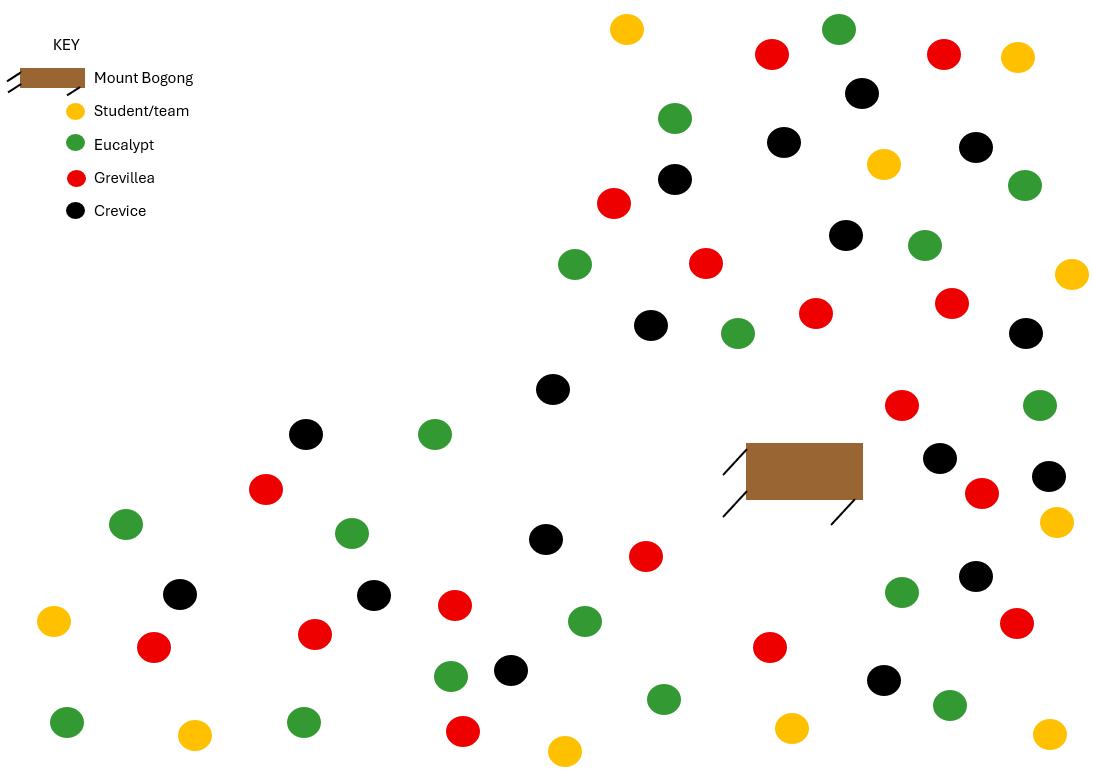
A mock-up plan showing how to set up a habitat zone.
Running the simulation
- Use a stopwatch or timer to indicate to students the changeover between day and night. Each should last for a set period e.g. 20 seconds.
- Students make their way from their location towards Mount Bogong.
- As the bogong moth is small and the distance to travel is vast, students should take small steps as they move.
- During the “day”, students must find a “crevice” to rest in.
- During the “night”, students must move towards Mount Bogong, feeding at least twice by stopping at either a grevillea or eucalypt for that period of time for at least five seconds.
- Discuss how students might ensure they are feeding for the required amount of time, as simply counting to five is not an accurate measure of time elapsed. Adding a long word between each count can make it more accurate, for example, “one hippopotamus, two hippopotamus” or “one bogong moth, two bogong moth”.
- Once students reach Mount Bogong (which may occur at different times depending on their starting location in the habitat zone), they exchange their “heating up” token for a “cool down” token, making a mental note of the temperature difference between the tokens as they exchange them: the "heating up" token will have warmed in their hand during the simulation, but the "cool down" token will still be room temperature.
You may need to run the simulation a few times to allow students to fully understand each requirement and complete it successfully.
Migration and bogong moths
Why do animals migrate?
Animals migrate as a survival strategy to cope with seasonal changes, find food, reproduce, or avoid harsh environmental conditions.
Migration allows animals to move from one habitat to another where resources are more abundant or conditions are more favourable. For example, before summer, the bogong moth migrates from lowland regions to the cooler Australian Alps to access suitable aestivation (short-term summer dormancy) sites. They then migrate back to the lowlands for winter breeding.
Migration demonstrates how behavioural adaptations help animals survive and reproduce in changing environments.
Alternative conceptions
Students may have alternative conceptions about migration and hibernation. For example, some students might think animals migrate simply for exercise or fun rather than to access food, favourable climates, or breeding sites. Students may also assume all birds migrate without recognizing that these behaviours are species-specific and depend on environmental pressures. Addressing these misconceptions explicitly helps students develop a more accurate understanding of how behavioural adaptations support survival in particular habitats.
Animals migrate as a survival strategy to cope with seasonal changes, find food, reproduce, or avoid harsh environmental conditions.
Migration allows animals to move from one habitat to another where resources are more abundant or conditions are more favourable. For example, before summer, the bogong moth migrates from lowland regions to the cooler Australian Alps to access suitable aestivation (short-term summer dormancy) sites. They then migrate back to the lowlands for winter breeding.
Migration demonstrates how behavioural adaptations help animals survive and reproduce in changing environments.
Alternative conceptions
Students may have alternative conceptions about migration and hibernation. For example, some students might think animals migrate simply for exercise or fun rather than to access food, favourable climates, or breeding sites. Students may also assume all birds migrate without recognizing that these behaviours are species-specific and depend on environmental pressures. Addressing these misconceptions explicitly helps students develop a more accurate understanding of how behavioural adaptations support survival in particular habitats.
Hibernation versus aestivation
What is the difference between hibernation and aestivation?
Hibernation
Some animals hibernate to survive periods of extreme cold or food scarcity. During hibernation, animals reduce their metabolic activity, slowing their heart rate and conserving energy. The mountain pygmy possum in Australia hibernates during winter in alpine regions, conserving energy when insects and other food sources are scarce. Hibernation allows these animals to survive harsh conditions that would otherwise be fatal.
For more information about hibernation see Not just sleep: all about hibernation.
Aestivation
A variety of animals, such as snails, ladybugs and bogong moths, enter a state of summer dormancy known as aestivation to survive soaring temperatures and water scarcity. During aestivation activity is suppressed and the animals have slowed metabolism, heart rate and breathing rate. This conserves energy and reduces heat generating activities and water loss until more favourable conditions return.
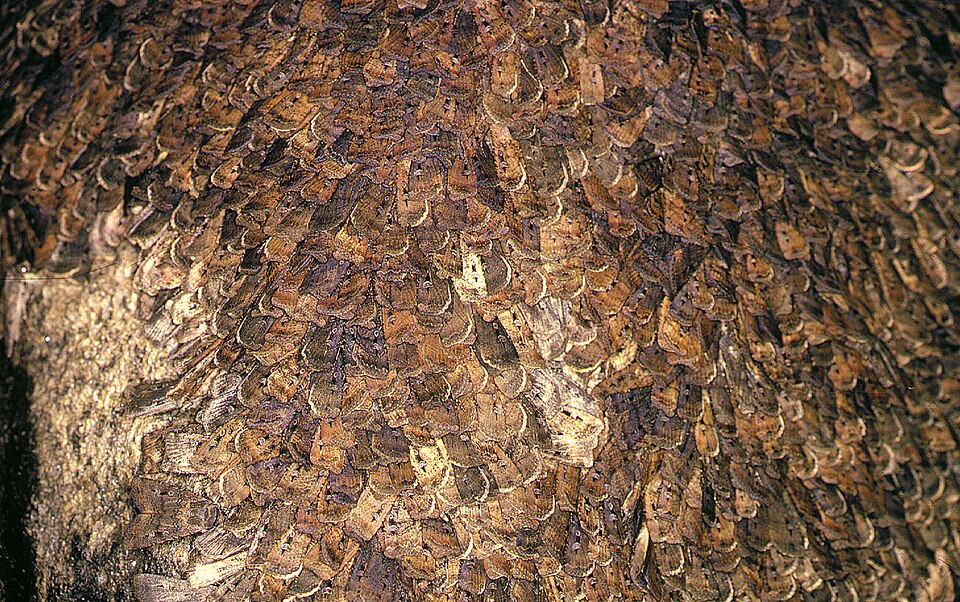
Bogong moths migrate to alpine caves in southeastern Australia, “tiling” cave walls, each moth tucking their head under the wing and abdomen of another moth. The tiling may decrease their rate of desiccation (moisture loss) during aestivation from October to March, surviving summer’s heat in the cooler mountain caves.
Australia’s water-holding frogs survive years underground in a state of aestivation awaiting heavy rains, living off fat reserves and water stored in its bladder.
Alternative conceptions
Students may believe hibernation and aestivation involve “sleeping all the time”, without realising that animals significantly reduce their metabolism and energy use. Some students may also assume all animals in cold climates hibernate.
Hibernation
Some animals hibernate to survive periods of extreme cold or food scarcity. During hibernation, animals reduce their metabolic activity, slowing their heart rate and conserving energy. The mountain pygmy possum in Australia hibernates during winter in alpine regions, conserving energy when insects and other food sources are scarce. Hibernation allows these animals to survive harsh conditions that would otherwise be fatal.
For more information about hibernation see Not just sleep: all about hibernation.
Aestivation
A variety of animals, such as snails, ladybugs and bogong moths, enter a state of summer dormancy known as aestivation to survive soaring temperatures and water scarcity. During aestivation activity is suppressed and the animals have slowed metabolism, heart rate and breathing rate. This conserves energy and reduces heat generating activities and water loss until more favourable conditions return.
Bogong moths migrate to alpine caves in southeastern Australia, “tiling” cave walls, each moth tucking their head under the wing and abdomen of another moth. The tiling may decrease their rate of desiccation (moisture loss) during aestivation from October to March, surviving summer’s heat in the cooler mountain caves.
Australia’s water-holding frogs survive years underground in a state of aestivation awaiting heavy rains, living off fat reserves and water stored in its bladder.
Alternative conceptions
Students may believe hibernation and aestivation involve “sleeping all the time”, without realising that animals significantly reduce their metabolism and energy use. Some students may also assume all animals in cold climates hibernate.
The Inquire phase allows students to cycle progressively and with increasing complexity through the key science ideas related to the core concepts. Each Inquire cycle is divided into three teaching and learning routines that allow students to systematically build their knowledge and skills in science and incorporate this into their current understanding of the world.
When designing a teaching sequence, it is important to consider the knowledge and skills that students will need in the final Act phase. Consider what the students already know and identify the steps that need to be taken to reach the level required. How could you facilitate students’ understanding at each step? What investigations could be designed to build the skills at each step?
Read more about using the LIA FrameworkFollowing an investigation, the Integrate routine provides time and space for data to be evaluated and insights to be synthesized. It reveals new insights, consolidates and refines representations, generalises context and broadens students’ perspectives. It allows student thinking to become visible and opens formative feedback opportunities. It may also lead to further questions being asked, allowing the Inquire phase to start again.
When designing a teaching sequence, consider the diagnostic assessment that was undertaken during the Launch phase. Consider if alternative conceptions could be used as a jumping off point to discussions. How could students represent their learning in a way that would support formative feedback opportunities? Could small summative assessment occur at different stages in the teaching sequence?
Read more about using the LIA FrameworkBogongs on the move
In the following Integrate routine, students are guided to link their experiences simulating bogong moth migration to the science content being explored, that is that animals migrate for a variety of reasons. Through modelling, questioning and discussion, students should come to a consensus that:
|
Discuss students’ experiences with the migration simulation.
- What did you think about the migration simulation? Do you think it helped you understand how and why an animal might migrate? Why or why not?
- Why do you think the Bogong moths migrate to the mountains?
- Why would they move at night and sleep during the day?
- Why do you think they feed so much along the way?
Show the video Mysteries of the bogong moth (3:42) then provide students with an opportunity to record their ideas on:
- how the bogong moths find their way in and out of the breeding ground.
- the 2019-2024 population decline of bogong moths.
- Climate change, pesticides in breeding areas, habitat destruction, and artificial lights have all been identified as factors in the population decline.
- what humans can do to help struggling bogong moth populations.
- For example, turning lights off, planting/leaving out nectar-rich foods, recording any sightings on Zoos Victoria’s Moth Tracker, the Atlas of Living Australia, or iNaturalist.
The Inquire phase allows students to cycle progressively and with increasing complexity through the key science ideas related to the core concepts. Each Inquire cycle is divided into three teaching and learning routines that allow students to systematically build their knowledge and skills in science and incorporate this into their current understanding of the world.
When designing a teaching sequence, it is important to consider the knowledge and skills that students will need in the final Act phase. Consider what the students already know and identify the steps that need to be taken to reach the level required. How could you facilitate students’ understanding at each step? What investigations could be designed to build the skills at each step?
Read more about using the LIA FrameworkIdentifying and constructing questions is the creative driver of the inquiry process. It allows students to explore what they know and how they know it. During the Inquire phase of the LIA Framework, the Question routine allows for past activities to be reviewed and to set the scene for the investigation that students will undertake. The use of effective questioning techniques can influence students’ view and interpretation of upcoming content, open them to exploration and link to their current interests and science capital.
When designing a teaching sequence, it is important to spend some time considering the mindset of students at the start of each Inquire phase. What do you want students to be thinking about, what do they already know and what is the best way for them to approach the task? What might tap into their curiosity?
Read more about using the LIA FrameworkThe Investigate routine provides students with an opportunity to explore the key ideas of science, to plan and conduct an investigation, and to gather and record data. The investigations are designed to systematically develop content knowledge and skills through increasingly complex processes of structured inquiry, guided inquiry and open inquiry approaches. Students are encouraged to process data to identify trends and patterns and link them to the real-world context of the teaching sequence.
When designing a teaching sequence, consider the diagnostic assessment (Launch phase) that identified the alternative conceptions that students held. Are there activities that challenge these ideas and provide openings for discussion? What content knowledge and skills do students need to be able to complete the final (Act phase) task? How could you systematically build these through the investigation routines? Are there opportunities to build students’ understanding and skills in the science inquiry processes through the successive investigations?
Read more about using the LIA FrameworkWaking up
Explain that the mountain pygmy possum lives in the same mountains where the bogong moth migrates to, and pose the questions: How is the survival of the mountain pygmy possum linked to the bogong moth? and What might happen if either species suddenly disappeared?
Show the video Moths, mountains and marsupials (6:17).
Ask students to use the 10-keyword strategy (or any other note-taking method they are familiar with) to record 10 keywords or phrases they hear in the video clip that they think are relevant to the questions.
Pause and/or rewatch the video as required.
When students have their list of 10 keywords, use the cumulative listing strategy to tally the most frequently occurring terms.
The Inquire phase allows students to cycle progressively and with increasing complexity through the key science ideas related to the core concepts. Each Inquire cycle is divided into three teaching and learning routines that allow students to systematically build their knowledge and skills in science and incorporate this into their current understanding of the world.
When designing a teaching sequence, it is important to consider the knowledge and skills that students will need in the final Act phase. Consider what the students already know and identify the steps that need to be taken to reach the level required. How could you facilitate students’ understanding at each step? What investigations could be designed to build the skills at each step?
Read more about using the LIA FrameworkFollowing an investigation, the Integrate routine provides time and space for data to be evaluated and insights to be synthesized. It reveals new insights, consolidates and refines representations, generalises context and broadens students’ perspectives. It allows student thinking to become visible and opens formative feedback opportunities. It may also lead to further questions being asked, allowing the Inquire phase to start again.
When designing a teaching sequence, consider the diagnostic assessment that was undertaken during the Launch phase. Consider if alternative conceptions could be used as a jumping off point to discussions. How could students represent their learning in a way that would support formative feedback opportunities? Could small summative assessment occur at different stages in the teaching sequence?
Read more about using the LIA FrameworkRefining understanding
In the following Integrate routine, students are guided to link the information they have gathered in the video with the science concept being explored, that is, that the mountain pygmy possum has adapted to survive on the bogong moth, and that their survival depends on the survival of the moth. Through modelling, questioning and discussion, students should come to a consensus that:
|
Discuss the adaptive behaviours of the mountain pygmy possum, including the “perfect timing” of the arrival of the bogong moths.
- How are the bogong moth behaviours of migration and aestivation (summer dormancy) important to the mountain pygmy possum?
- While the bogong moths are aestivating in the caves in summer, the mountain pygmy possums eat them to build up fat reserves before going into hibernation themselves for the winter.
- How are the periods of dormancy similar for the bogong moth and mountain pygmy possum?
- Both slow their metabolism and use very little energy.
- How is the hibernation of the mountain pygmy possum different to the aestivation of the bogong moth?
- Hibernation is in winter, aestivation is in summer.
- How are the mountain pygmy possums dependent on the bogong moths?
- What do you think happened to the possums when the bogong moth populations suddenly dramatically decreased?
Students record their thinking on the Survival behaviours Resource sheet.
Optional extensions:
- Students could create an infographic, storyboard or simulation to explain mountain pygmy possum hibernation.
- Students could investigate whether any of the animals found during Lesson 2’s habitat survey (such as slaters, snails and ants) migrate, hibernate (winter dormancy) or aestivate (summer dormancy.)
- Discuss how students can get involved in citizen science by using the Moth Tracker app, as explained in Bogong Moth Tracker - Behind the News (3:24)
Reflect on the lesson
You might:
- add vocabulary relating to the migration of the bogong moth to the class word wall or glossary.
- add to the W and H sections of the TWLH chart.