

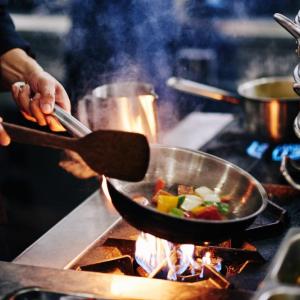
'Chemistry in the kitchen' IS ONE OF OUR NEW TEACHING SEQUENCES FOR V9
- On the 'Sequence overview' tab you'll find all the lessons in this sequence and curriculum alignment.
- The 'Our design decisions' tab shows how key scientific ideas develop over the sequence, and shows how the sequence addresses curriculum achievement standards.
- The 'Preparing for this sequence' tab guides you through important information and considerations for this sequence.
- Have you taught this sequence? Use the Feedback button to let us know how it went!
Launch
Lesson 1 • Ingredients for change
Students are introduced to the sequence content—classifying and comparing reversible and irreversible changes to substances—and the context: making observations about the food that is prepared in their kitchen, in preparation for sharing/explaining the changes food undergoes.

Inquire
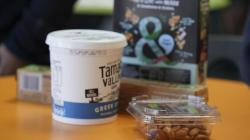
Lesson 2 • That’s salty
Students investigate reversible change and the process of dissolving by creating a saturated salt solution then evaporating the water to retrieve the salt.
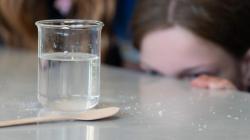
Lesson 3 • From plastic to cheese
Students explore the irreversible chemical changes that occur by combining warm milk and vinegar to create casein, a protein found in fresh cheeses and that can also be used to make bioplastic.
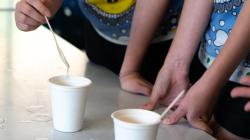
Lesson 4 • Bubble, bubble
Students investigate how combining two solutions, a sodium bicarbonate solution and a tartaric/citric acid solution, creates a change that produces gas.
Lesson 5 • Nicely toasted
Students explore how heat irreversibly changes food by exploring the Maillard reaction and its effect on sliced bread, creating toast.
Lesson 6 • Fire for food
Students conduct a fair test to investigate the requirements that make or keep a fire burning.
Lesson 7 • Really rusty
Students make reasoned predictions about rust, then plan and conduct an investigation into the factors that affect how quickly steel rusts.
Act
Lesson 8 • Chemistry in my kitchen
Students apply their understanding of reversible and irreversible change by designing (and potentially producing) a food experience involving irreversible change for a specific event/purpose.
The Australian Academy of Science supports and encourages broad use of its material. Unless indicated below, copyright material available on this website is licensed under a Creative Commons Attribution-NonCommercial-ShareAlike 4.0 International (CC BY-NC-SA 4.0) licence.
Curriculum and syllabus alignment
Year 6
By the end of Year 6 students classify and compare reversible and irreversible changes to substances. They explain why science is often collaborative and describe different individuals’ contributions to scientific knowledge. They describe how individuals and communities use scientific knowledge.
Students plan safe, repeatable investigations to identify patterns and test relationships and make reasoned predictions. They describe risks associated with investigations and key intercultural considerations when planning field work. They identify variables to be changed, measured and controlled. They use equipment to generate and record data with appropriate precision. They construct representations to organise and process data and information and describe patterns, trends and relationships. They identify possible sources of error in their own and others’ methods and findings, pose questions for further investigation and select evidence to support reasoned conclusions. They select and use language features effectively for their purpose and audience when communicating their ideas and findings.
Science as a human endeavour
Science understanding
Compare reversible changes, including dissolving and changes of state, and irreversible changes, including cooking and rusting that produce new substances
Science inquiry
Pose investigable questions to identify patterns and test relationships and make reasoned predictions
Plan and conduct repeatable investigations to answer questions including, as appropriate, deciding the variables to be changed, measured and controlled in fair tests; describing potential risks; planning for the safe use of equipment and materials; and identifying required permissions to conduct investigations on Country/Place
Use equipment to observe, measure and record data with reasonable precision, using digital tools as appropriate
Construct and use appropriate representations, including tables, graphs and visual or physical models, to organise and process data and information and describe patterns, trends and relationships
Compare methods and findings with those of others, recognise possible sources of error, pose questions for further investigation and select evidence to draw reasoned conclusions
Write and create texts to communicate ideas and findings for specific purposes and audiences, including selection of language features, using digital tools as appropriate
Australian curriculum content links
| Science understanding core concept: Substances change and new substances are produced by rearranging atoms; these changes involve energy transfer and transformation. |
| Sub-strand | Content descriptor | AC code | Achievement standard | How the sequence addresses this content |
|---|---|---|---|---|
| SHE: Nature and development of science | Examine why advances in science are often the result of collaboration or build on the work of others. | AC9S6H01
| Explain why science is often collaborative and describe different individuals’ contributions to scientific knowledge. | Examine how discoveries in food making have been built over time and impact our actions today. (Lessons 1-8) |
| SHE: Use and influence of science | Investigate how scientific knowledge is used by individuals and communities to identify problems, consider responses and make decisions. | AC9S6H02 | Describe how individuals and communities use scientific knowledge. | Explore real-life examples of reversible and irreversible changes that affect people in everyday life. (Lessons 1-8) Design and potentially produce a food experience for a specific event/purpose. (Lesson 8) |
| SU: Chemical sciences | Compare reversible changes, including dissolving and changes of state, and irreversible changes, including cooking and rusting that produce new substances. | AC9S6U04 | Classify and compare reversible and irreversible changes to substances. | Use scientific explanations, supported by data and observations, to describe reversible and irreversible changes. (Lessons 1-8) Classify and compare changes explored in the sequence. (Lesson 8) |
| SI: Questioning and predicting | Pose investigable questions to identify patterns and test relationships and make reasoned predictions. | AC9S6I01 | Plan safe, repeatable investigations to identify patterns and test relationships and make reasoned predictions. | Pose investigable questions to identify patterns, such as: What happens to the amount of rust created when we change the substance it is in? and What happens to the amount of time the candle stays lit when we change the size of the jar? (Lessons 5-7) |
| SI: Planning and conducting | Plan and conduct repeatable investigations to answer questions including, as appropriate, deciding the variables to be changed, measured and controlled in fair tests; describing potential risks; planning for the safe use of equipment and materials; and identifying required permissions to conduct investigations on Country/Place.
| AC9S6I02 | Identify variables to be changed, measured and controlled. Describe risks associated with investigations and key intercultural considerations when planning field work. | Determine which is the variable being tested and which variable is being measured, and which other variables might affect students’ investigations and need to be kept the same. (Lessons 5-7) Discuss risks (including electrical, burn and fire) then implement safety measures for equipment and materials. (Lessons 5-7) |
| SI: Planning and conducting | Use equipment to observe, measure and record data with reasonable precision, using digital tools as appropriate. | AC9S6I03 | Use equipment to generate and record data with appropriate precision. | Select and use instruments with the correct scale for measuring data with appropriate accuracy, such as a scales and timers. (Lessons 4-7) |
| SI: Processing, modelling and analysing | Construct and use appropriate representations, including tables, graphs and visual or physical models, to organise and process data and information and describe patterns, trends and relationships. | AC9S6I04 | Construct representations to organise and process data and information and describe patterns, trends and relationships. | Display/present information in graphic organisers to describe patterns and trends. (Lessons 2-7) Construct and use line graphs to describe and predict patterns and trends. (Lesson 6) |
| SI: Evaluating | Compare methods and findings with those of others, recognise possible sources of error, pose questions for further investigation and select evidence to draw reasoned conclusions. | AC9S6I05 | Identify possible sources of error in their own and others’ methods and findings, pose questions for further investigation and select evidence to support reasoned conclusions. | Work collaboratively to identify the strengths and weaknesses of their own and others’ investigations including where testing was not fair, and practices could be improved. (Lessons 2-7) |
| SI: Communicating | Write and create texts to communicate ideas and findings for specific purposes and audiences, including selection of language features, using digital tools as appropriate. | AC9S6I06 | Select and use language features effectively for their purpose and audience when communicating their ideas and findings. | Design a food experience that involves irreversible change and present their experience to an appropriate audience. (Lesson 8) |
Science journals
Create a class science journal, either in hard-copy or digitally. You might:
- use/create a large scrap book or flip chart.
- use poster/butchers’ paper so learning can be displayed in sequence on the wall.
- create a digital journal using your platform/ technology of choice.
- any combination of the above.
Plan for students’ creation of an individual science journal, either in hard-copy or digitally. They might:
- use an exercise book, scrap book or flip chart to record their thinking and gather resource sheets together.
- use a folder to store and collate resource sheets, diagrams, photographs etc.
- use a digital folder to store work samples, images and videos.
- any combination of the above.
See Using a science journal throughout inquiry for more detailed information on the importance of science journals.
Additional preparation
- Read through the teaching sequence.
- Note any adaptations you would like to make to suit your school’s and students’ context.
- Prepare demonstration copies of Resource sheets as required.
- Collect the resources required for the sequence.
Selecting a focus for the Act phase
At this end of this sequence students demonstrate their learning about physical and chemical changes through the context of food preparation and cooking.
What they produce to demonstrate their learning can be catered to their interests, needs and context. Select or design an option that is best suited to you students. Some suggestions include:
- students create a written, visual or video guide to the changes that occur in their kitchen.
- designing a class recipe book, where students contribute a favourite recipe and explain the chemical and physical changes that occurred during the preparation and cooking of that food.
- planning and undertaking a cultural food sharing day, with explanations of the chemical and physical changes ingredients have undergone. Be aware of and cater for any food allergies or dietary requirements if undertaking this task.
- students research a culturally/historically important food item and explain the changes food undergoes during the prepartion of that item, for example:
- the history of drying, preserving or pickling of food.
- the food specific to a geographical location.
- different methods for preparing similar foods from different locations around the world and how they came to be.
Safety considerations when teaching this sequence
Throughout this sequence students work with food. It is essential that you are aware of any allergy or intolerance concerns for students in your class and take all necessary steps to eliminate or reduce these risks.
The foods students work with include salt, milk, vinegar and/or lemon juice, and bread. Students are not required to eat/taste these foods but contact allergies can be a concern.
Milk is a common food allergy or intolerance. Wheat and gluten contained in bread is also a common allergy or intolerance.
Students will also use sodium bicarbonate (bicarb soda) and tartaric/citric acid. While allergies to these substances are uncommon, they may trigger an immune response leading to skin irritation, or cause issues if powder is inhaled.
Lesson 6 involves observations of fire in the form of a burning candle. This lesson is described as an observation only investigation. Students are not expected to directly supervise and control open flames.
Remind students of all safety measure as the sequence progresses as appropriate. Also, always provide appropriate supervision so that students are adhering to safety rules.
Preparing for Lesson 4
In Lesson 4 of this sequence students will work in teams to investigate how gas can be created by mixing substances. For this investigation each team will require 4 transparent bottles of the same size (350–400 ml approximately).
You might like to begin collecting bottles ahead of time so that each team can have 4 identical bottles for their investigation (however all teams do not need to have identical bottles).
The materials required for each lesson are listed on the lesson's page. For the full sequence resource list, download the Preparing to teach this sequence document below.

'Chemistry in the kitchen' IS ONE OF OUR NEW TEACHING SEQUENCES FOR V9
- On the 'Sequence overview' tab you'll find all the lessons in this sequence and curriculum alignment.
- The 'Our design decisions' tab shows how key scientific ideas develop over the sequence, and shows how the sequence addresses curriculum achievement standards.
- The 'Preparing for this sequence' tab guides you through important information and considerations for this sequence.
- Have you taught this sequence? Use the Feedback button to let us know how it went!