

Chemistry in the kitchen
View Sequence overviewStudents will:
- work in teams to plan and conduct an investigation to explore factors affecting how quickly steel rusts.
Students will represent their understanding as they:
- make reasoned predictions about factors affecting rusting.
- describe factors affecting rusting and make a claim that responds to the prediction(s) they made with supporting evidence and reasoning.
- contribute to discussions about painting and galvanising to protect steel from rusting.
- update the TWLH chart.
In this lesson, assessment is formative.
Feedback might focus on:
- students’ claims (with supporting evidence and reasoning) about factors affecting rust.
- the conclusions that students draw about how painting or galvanising steel reduces rusting rates.
- the representations students generated.
In this lesson, assessment can be summative.
Students working at the achievement standard for Science inquiry should have:
- posed an investigable question.
- planned safe, repeatable investigations to identify patterns, test relationships, and make reasoned predictions.
- identified variables to be changed, measured, and controlled.
- used equipment to generate and record data with appropriate precision.
- used equipment to observe, measure and record data with reasonable precision.
- constructed appropriate representations of this data.
- analysed the data to identify patterns.
- made a claim based on the data/evidence to answer their question.
- communicated their claim/s and evidence clearly.
- compared their methods and findings with others, determining sources of possible error, and where their claims correlate with those of others.
Refer to the Australian Curriculum content links on the Our design decisions tab for further information.
Whole class
Class science journal (digital or hard-copy)
1 x galvanised nail
1 x steel nail that will rust (these are commonly called ‘bright’ nails).
Note: Galvanised nails have been coated in zinc to protect them from rusting, whereas bright nails have not. The look of a galvanised nail is dependent on the process used (hot dipped, electro-galvanised etc.). See the embedded professional learning What causes things to rust? below for more guidance on equipment for this experiment.
Each group
Variety of liquids to represent conditions steel may be exposed to, such as water (rain/humidity), salty water (waves/sea spray), vinegar (acid rain), and oil (protective layer such as paint)
4-5 matching small jars (clean and dry)—one for each liquid, lids optional
4-5 pieces of steel wool. Alternatively, steel (bright) nails can be used.
Note: Steel wool will have visible signs of rust in approximately 2 days, compared to the nails, which may take 2 weeks to show obvious signs of rust.
Marker to label jars
Magnifying glass (optional)
Each student
Individual science journal
Rust investigation planner Resource sheet
Lesson
The Inquire phase allows students to cycle progressively and with increasing complexity through the key science ideas related to the core concepts. Each Inquire cycle is divided into three teaching and learning routines that allow students to systematically build their knowledge and skills in science and incorporate this into their current understanding of the world.
When designing a teaching sequence, it is important to consider the knowledge and skills that students will need in the final Act phase. Consider what the students already know and identify the steps that need to be taken to reach the level required. How could you facilitate students’ understanding at each step? What investigations could be designed to build the skills at each step?
Read more about using the LIA FrameworkRe-orient
Review the irreversible chemical reactions that students have investigated so far in this sequence, including splitting curds from whey in milk using acid, generating gas by combining ingredients, the Maillard reaction, and how fire consumes substances.
The Inquire phase allows students to cycle progressively and with increasing complexity through the key science ideas related to the core concepts. Each Inquire cycle is divided into three teaching and learning routines that allow students to systematically build their knowledge and skills in science and incorporate this into their current understanding of the world.
When designing a teaching sequence, it is important to consider the knowledge and skills that students will need in the final Act phase. Consider what the students already know and identify the steps that need to be taken to reach the level required. How could you facilitate students’ understanding at each step? What investigations could be designed to build the skills at each step?
Read more about using the LIA FrameworkIdentifying and constructing questions is the creative driver of the inquiry process. It allows students to explore what they know and how they know it. During the Inquire phase of the LIA Framework, the Question routine allows for past activities to be reviewed and to set the scene for the investigation that students will undertake. The use of effective questioning techniques can influence students’ view and interpretation of upcoming content, open them to exploration and link to their current interests and science capital.
When designing a teaching sequence, it is important to spend some time considering the mindset of students at the start of each Inquire phase. What do you want students to be thinking about, what do they already know and what is the best way for them to approach the task? What might tap into their curiosity?
Read more about using the LIA FrameworkWhat is rust?
Students recount their observations of the use of metal utensils and equipment while completing the My kitchen observations table. List the names of any metal items that get used in the kitchen and how they are cleaned and stored.
Note: Students may give varying responses based on the practices of their home. All responses should be acknowledged and (within reason) validated.
Ask students if they know what rust is, and if they have observed any rust on metal utensils during their observations. If necessary, provide a simple explanation of what rust looks like, including any images if appropriate.
Pose the questions: What is rust? Why does it appear on metal utensils? What causes metal to change and go rusty?
The Inquire phase allows students to cycle progressively and with increasing complexity through the key science ideas related to the core concepts. Each Inquire cycle is divided into three teaching and learning routines that allow students to systematically build their knowledge and skills in science and incorporate this into their current understanding of the world.
When designing a teaching sequence, it is important to consider the knowledge and skills that students will need in the final Act phase. Consider what the students already know and identify the steps that need to be taken to reach the level required. How could you facilitate students’ understanding at each step? What investigations could be designed to build the skills at each step?
Read more about using the LIA FrameworkThe Investigate routine provides students with an opportunity to explore the key ideas of science, to plan and conduct an investigation, and to gather and record data. The investigations are designed to systematically develop content knowledge and skills through increasingly complex processes of structured inquiry, guided inquiry and open inquiry approaches. Students are encouraged to process data to identify trends and patterns and link them to the real-world context of the teaching sequence.
When designing a teaching sequence, consider the diagnostic assessment (Launch phase) that identified the alternative conceptions that students held. Are there activities that challenge these ideas and provide openings for discussion? What content knowledge and skills do students need to be able to complete the final (Act phase) task? How could you systematically build these through the investigation routines? Are there opportunities to build students’ understanding and skills in the science inquiry processes through the successive investigations?
Read more about using the LIA FrameworkRusty nails
Explain that students will plan and conduct an investigation to explore factors affecting how quickly metal rusts, by using steel wool (or alternatively steel nails) as a representative for the metal utensils that are used in the kitchen, which are often made of stainless steel. The observations will be ongoing over several days/weeks.
Outlined below is a detailed guide for supporting students to plan and conduct this investigation. Make modifications to this guide based on how experienced your students are with fair testing and the assessment data required.
- Students experienced with planning and conducting their own investigations can do so independently in collaborative teams, using the materials available. This will allow you to gather summative assessment data on all aspects of science inquiry. In that case, teams can fill in their own variables grid, write an investigable question, and plan and conduct an investigation with the materials provided.
- If students are less experienced, they may require more guidance in questioning and planning an investigation. The collection of assessment data can then focus on specific aspects of science inquiry, such as how they analyse and draw conclusions from the data, or how they represent and communicate their findings. You might support students to identify variables, and then ask them to write the investigable question independently. Alternatively you might support the entire planning process and provide a scaffold to analyse the data that students can complete independently.
Use the approach that is appropriate for your students.
Brainstorm what things (variables) might affect how quickly steel rusts, recording students’ answers using a demonstration copy of the Variables grid Resource sheet.
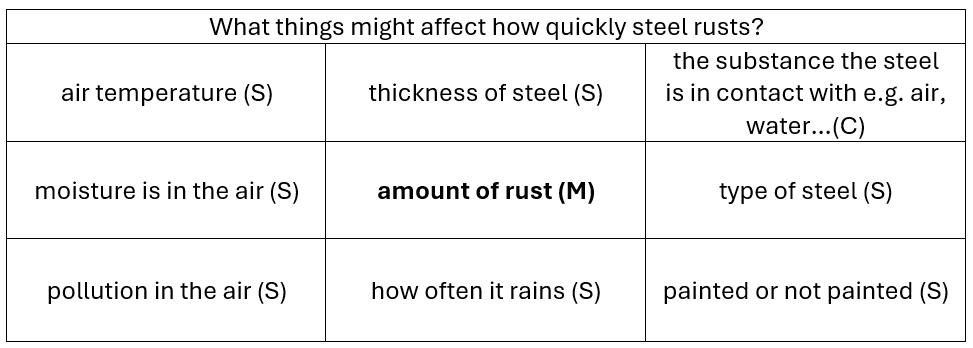
Model how to use the variables grid to plan a fair test by only changing one variable and keeping all others the same. For example, if they investigate the effect of different substances on the rate of rusting, students might:
- Change: what substance the steel is in contact with
- Measure/Observe: amount of rust produced
- Keep the same: air temperature, thickness of steel, moisture in the air etc.
Display this information in the classroom for easy student reference.
Use the scaffold ‘What happens to _____________ when we change _____________?’ to help students develop specific questions for their investigation. For example, What happens to the amount of rust created when we change the substance it contacts/touches?
Allow students adequate time to:
- record their investigation question, predictions, variables, setup and equipment list on Rust investigation planner Resource sheet.
- set up their investigation—this is an ongoing investigation, and students will record observations for several days/weeks.
- make initial observations and discuss the importance of using detailed vocabulary in diagrams/notes, such as ‘small amount of rust on nail’ and ‘clear water/no discoloration’.
- Why do we need to include details in our observations?
- To show small differences between samples
- What words can we use to describe each liquid today?
- What colour is the steel wool (or nail) today?
- Are there any lumps/pieces/foreign objects other than the steel wool (or nail) in the jar? How might this affect results?
Over the next few days/weeks, provide opportunities for students to make ongoing observations.
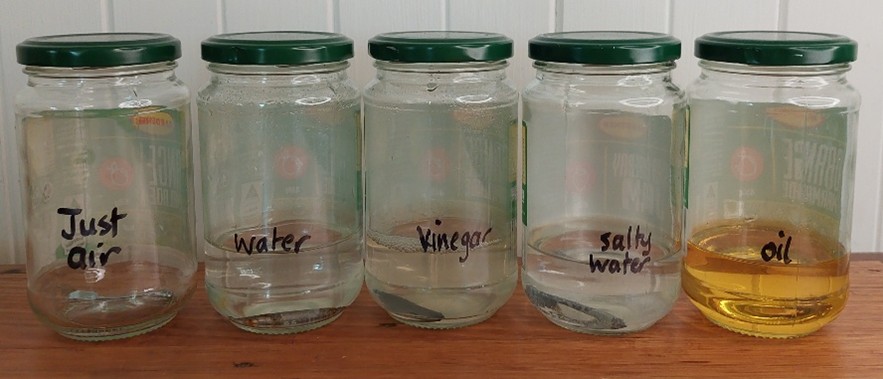
Steel that rusts
What causes things to rust?
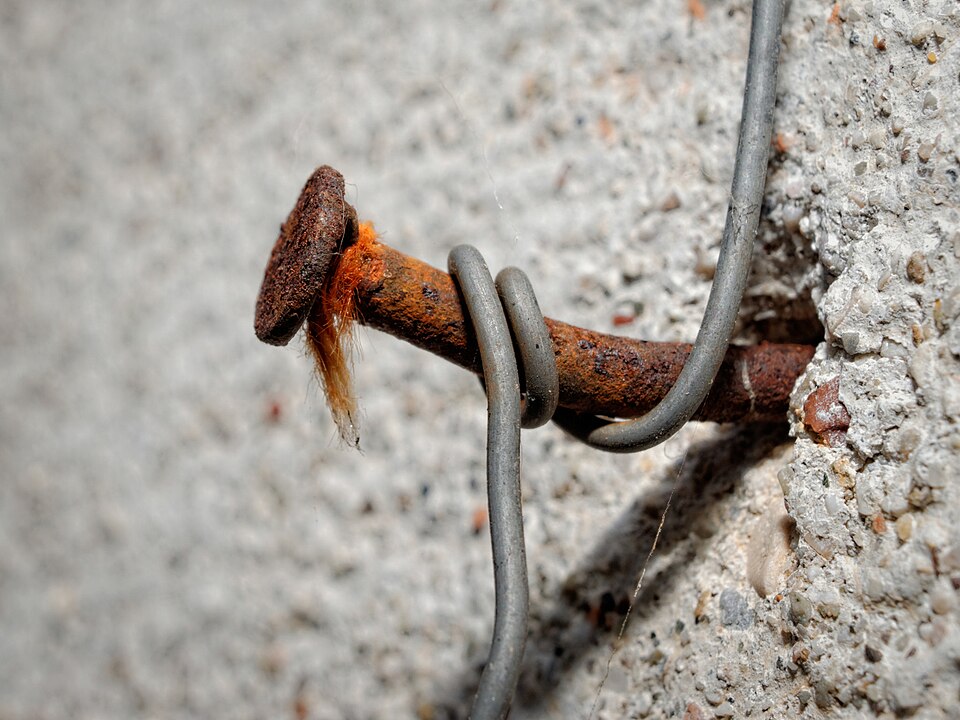
Steel is an alloy, a mixture of metals that can include iron, carbon, and (in stainless steel) chromium. Iron rusts when it reacts with oxygen and water, forming hydrated iron oxide: a reddish-brown compound that weakens the metal over time. This process is especially aggressive in humid or coastal environments where water and salt accelerate the reaction. To prevent rust, steel is often coated with protective layers. Galvanising, for example, involves coating steel with a thin layer of zinc metal. The zinc metal is more reactive than iron and will react with the oxygen and water, shielding the underlying steel. Another method is painting the steel, which creates a barrier between the steel and the surrounding oxygen and water. Products like Colorbond roofing use baked-on paint coating to provide long-term resistance to rust. In this investigation, oil provides a protective coating over the steel, preventing oxygen and water from reaching the iron.
For this investigation, it is important to source materials that haven’t been treated to prevent rusting. This could include:
- steel wool—but not stainless-steel scourers.
- ‘bright’ nails—not galvanised.
These items are both available from hardware stores. Steel wool is also available from supermarkets, often in multipacks as ‘steel wool soap pads’. Most of the supermarket brands will rust when exposed to air and water, making them suitable for this experiment. Steel wool can be ripped into many smaller pieces, making it cost-effective. Steel wool will have visible signs of rust in approximately 2 days, compared to the nails, which may take 2 weeks to show obvious signs of rust.
Steel is an alloy, a mixture of metals that can include iron, carbon, and (in stainless steel) chromium. Iron rusts when it reacts with oxygen and water, forming hydrated iron oxide: a reddish-brown compound that weakens the metal over time. This process is especially aggressive in humid or coastal environments where water and salt accelerate the reaction. To prevent rust, steel is often coated with protective layers. Galvanising, for example, involves coating steel with a thin layer of zinc metal. The zinc metal is more reactive than iron and will react with the oxygen and water, shielding the underlying steel. Another method is painting the steel, which creates a barrier between the steel and the surrounding oxygen and water. Products like Colorbond roofing use baked-on paint coating to provide long-term resistance to rust. In this investigation, oil provides a protective coating over the steel, preventing oxygen and water from reaching the iron.
For this investigation, it is important to source materials that haven’t been treated to prevent rusting. This could include:
- steel wool—but not stainless-steel scourers.
- ‘bright’ nails—not galvanised.
These items are both available from hardware stores. Steel wool is also available from supermarkets, often in multipacks as ‘steel wool soap pads’. Most of the supermarket brands will rust when exposed to air and water, making them suitable for this experiment. Steel wool can be ripped into many smaller pieces, making it cost-effective. Steel wool will have visible signs of rust in approximately 2 days, compared to the nails, which may take 2 weeks to show obvious signs of rust.
Using a variables grid to plan a fair test investigation
How might you support students to conduct an accurate fair test investigation, with a clear investigable question?

All scientific fair tests involve variables. Variables are things that can be changed (independent), measured/observed (dependent) or kept the same (controlled) in an investigation.
When planning a fair-test investigation, to make it a fair, we need to identify the variables. A variables grid can be used to record the identified variables. We then use these variables to turn a broad question, such as What affects plant growth? into an investigable one, such as What happens to the growth of a plant when I change how much water it gets?.
Investigable questions are characterised by their clear identification of what is being changed and what outcome is being measured in a fair test, supporting students to investigate a specific physical phenomenon.
Investigable questions enable students to plan a fair test investigation. The question they have devised can be answered empirically, and data can be collected to support and justify claims made.
By planning for and conducting a fair test, students can make claims about how the variable they have changed in their investigation may have affected what is being measured and/or observed.
To support students to identify variables, and to use those variables to inform their planning of a fair test, we suggest this handy mnemonic ‘Cows Moo Softly’. This helps students remember the letters C, M and S, representing the three types of variables in a fair test:
- Cows: Change one thing (independent variable)
- Moo: Measure/Observe the outcome (dependent variable) and
- Softly: Keep the other things (controlled variables) the Same
All scientific fair tests involve variables. Variables are things that can be changed (independent), measured/observed (dependent) or kept the same (controlled) in an investigation.
When planning a fair-test investigation, to make it a fair, we need to identify the variables. A variables grid can be used to record the identified variables. We then use these variables to turn a broad question, such as What affects plant growth? into an investigable one, such as What happens to the growth of a plant when I change how much water it gets?.
Investigable questions are characterised by their clear identification of what is being changed and what outcome is being measured in a fair test, supporting students to investigate a specific physical phenomenon.
Investigable questions enable students to plan a fair test investigation. The question they have devised can be answered empirically, and data can be collected to support and justify claims made.
By planning for and conducting a fair test, students can make claims about how the variable they have changed in their investigation may have affected what is being measured and/or observed.
To support students to identify variables, and to use those variables to inform their planning of a fair test, we suggest this handy mnemonic ‘Cows Moo Softly’. This helps students remember the letters C, M and S, representing the three types of variables in a fair test:
- Cows: Change one thing (independent variable)
- Moo: Measure/Observe the outcome (dependent variable) and
- Softly: Keep the other things (controlled variables) the Same
The Inquire phase allows students to cycle progressively and with increasing complexity through the key science ideas related to the core concepts. Each Inquire cycle is divided into three teaching and learning routines that allow students to systematically build their knowledge and skills in science and incorporate this into their current understanding of the world.
When designing a teaching sequence, it is important to consider the knowledge and skills that students will need in the final Act phase. Consider what the students already know and identify the steps that need to be taken to reach the level required. How could you facilitate students’ understanding at each step? What investigations could be designed to build the skills at each step?
Read more about using the LIA FrameworkFollowing an investigation, the Integrate routine provides time and space for data to be evaluated and insights to be synthesized. It reveals new insights, consolidates and refines representations, generalises context and broadens students’ perspectives. It allows student thinking to become visible and opens formative feedback opportunities. It may also lead to further questions being asked, allowing the Inquire phase to start again.
When designing a teaching sequence, consider the diagnostic assessment that was undertaken during the Launch phase. Consider if alternative conceptions could be used as a jumping off point to discussions. How could students represent their learning in a way that would support formative feedback opportunities? Could small summative assessment occur at different stages in the teaching sequence?
Read more about using the LIA FrameworkIrreversible rust
Conduct this Integrate step once enough time has passed for signs of rust to have formed on the steel wool/nails. This should happen in a few days to two weeks.
In this Integrate step, guide students to link their experiences in the investigation to the science concept being explored—in this instance, that some metals can change in water and become rusty. Through questioning and discussion, students should come to a consensus that:
|
Students complete final rust observations on Rust investigation planner Resource sheet.
Ask teams to report back to the rest of the class on their findings, including a claim that responds to the prediction(s) they made with supporting evidence and reasoning.
Encourage students to probe deeply into groups’ results and claims using the science question starters.
- What did you predict would happen?
- What did you observe?
- Was your prediction different to what you observed?
- Why do you think that happened?
- What claim might you make to answer your question “What happens to the amount of rust created when we change the substance it contacts/touches?”
- What evidence do you have to support your claim?
Discuss what sort of change students think has occurred and if they think that the metal and rust can be separated again, like the salt and water could.
- How has the nail changed?
- Do you think the change can be reversed, and the rust and nail separated again?
- How might you do that?
- If we scraped the rust off the nail, would the nail be the same size underneath? Would what we scraped off turn back into steel/metal?
Explain that:
- like with the creation of CO2 gas and the Maillard effect, the rust created on the nails is a completely new substance; the metal itself has changed and become something new.
- this means that the change is irreversible—even if you filed or blasted the rust away, the bits you remove would still be rust, and what’s left behind would be smaller.
- a chemical reaction between the steel wool/nail, water, and oxygen has occurred, generating the rust (also known as iron oxide).
Show students a galvanised nail and a steel (bright) nail noting that they are both made out of the same type of metal as the steel wool, and to compare the difference between the two nails. The galvanised coating helps to stop oxygen and water reaching the steel, preventing rust. Discuss the importance of painting and other protective coatings (such as galvanising) to reduce rust on kitchen implements and utensils, especially those that are in frequent contact with water for cleaning etc.
- Do you think the metal utensils in your kitchen have a protective layer on them, as the galvanised nail did? Why do you think that?
- What do you think would happen if they didn’t have a protective layer?
- Do you know of any other techniques people use to protect metal cooking implements? What are they?
- Some pans, particularly those made of cast iron and carbon steel, need to be ‘seasoned’. This involves coating the pan with a thin film of cooking oil and heating it to high temperatures. The oil itself then undergoes a chemical change called polymerisation, which bonds the oil to the surface. This protects the pan from rust. After use and cleaning, these utensils should be dried very thoroughly, and need to have a thin layer of oil applied to protect them from rusting between uses.
Reflect on the lesson
You might:
- invite students to summarise their understanding by drawing an annotated representation to explain how painting or galvanising steel reduces the rate of rusting (last section of the Rust investigation planner Resource sheet).
- add to the class word wall any vocabulary related to rust, including irreversible, chemical change, iron oxide, oxidation.
- add to the L and H columns of the TWLH chart.