

Chemistry in the kitchen
View Sequence overviewStudents will:
- examine food items and identify their components and any changes that occurred during the preparation of the food.
- consider if these changes can be reversed.
- identify what they think they know about changes.
Students will represent their understanding as they:
- share and discuss their observations of the food items and the changes they may have undergone.
- ask questions about changes.
- record prior learning about changes.
In the Launch phase, assessment is diagnostic.
Take note of:
- students’ ideas about changes, particularly what types of changes are made to food ingredients and if these changes can be reversed.
- the embedded professional learning Students’ conceptions and alternative conceptions in the Elicit step of this lesson.
Whole class
Class science journal (digital or hard-copy)
Audio-visual equipment to view images and or videos
Videos that show food being prepared, for example:
- Zucchini and cheese (0:20)
- Soft cake base (0:10)
- Fruit salad (0:22)
Sticky notes or slips of paper
Demonstration copy of the My kitchen observations Resource sheet
Each group
A food, or images of a food, to examine. Each group should have a different food item. These might include:
- foods in as unchanged a state as possible, such as:
- whole fruits and vegetables, or fruits and vegetables that have been cut.
- rice, grains and legumes.
- items that can be combined to make other foods, such as:
- flour, water and salt (to make pasta).
- soluble solids in liquids, such as:
- salt + water. Note that observations of a salt water solution are used in Lesson 2 so one should be included in this lesson.
- Liquids that can be combined, such as:
- milk and vinegar/lemon juice.
- Food that are a combination of ingredients, such as:
- breads, cakes or other baked goods.
- salads.
- Foods that have been cooked, such as:
- cooked meats and vegetables.
Note: Be aware of any potential allergies before introducing food items to students. Images of food/food components can be used for this task if more appropriate for your students and context.
Each student
Individual science journal (digital or hard-copy)
My kitchen observations Resource sheet
Lesson
The Launch phase is designed to increase the science capital in a classroom by asking questions that elicit and explore students’ experiences. It uses local and global contexts and real-world phenomena that inspire students to recognise and explore the science behind objects, events and phenomena that occur in the material world. It encourages students to ask questions, investigate concepts, and engage with the Core Concepts that anchor each unit.
The Launch phase is divided into four routines that:
- ensure students experience the science for themselves and empathise with people who experience the problems science seeks to solve (Experience and empathise)
- anchor the teaching sequence with the key ideas and core science concepts (Anchor)
- elicit students’ prior understanding (Elicit)
- and connect with the students’ lives, languages and interests (Connect).
Students arrive in the classroom with a variety of scientific experiences. This routine provides an opportunity to plan for a common shared experience for all students. The Experience may involve games, role-play, local excursions or yarning with people in the local community. This routine can involve a chance to Empathise with the people who experience the problems science seeks to solve.
When designing a teaching sequence, consider what experiences will be relevant to your students. Is there a location for an excursion, or people to talk to as part of an incursion? Are there local people in the community who might be able to talk about what they are doing? How could you set up your classroom to broaden the students’ thinking about the core science ideas? How could you provide a common experience that will provide a talking point throughout the sequence?
Read more about using the LIA FrameworkExamining food
In collaborative teams, students will observe and explore foods or food components, determining what they are/contain, if and how any components have been changed, and if these changes can be reversed.
Provide each team with a different food or food component to examine. See the List of materials above for suggestions.
Note: Be aware of any potential allergies before introducing food items to students. Images of food/food components can be used for this task if more appropriate for you students and context.
Challenge each team to make initial observations about their food/food components in their science journal, including:
- What is the food you are examining?
- What ingredients do you think it contains?
- Have the ingredients been changed in any way already? For example, have they been cut, peeled, mixed, cooked?
- Can the ingredients be further changed in any way? If so, how?
- Are you able to separate the ingredients easily?
- How might you separate the ingredients?
- If/when the ingredients are separated, will they be in their original form, or will something about them still be changed from the original form?
Teams record their ideas on a mind-map.
Core concepts and key ideas
Where does this sequence fit into the larger picture of science and the science curriculum?
When planning for teaching in your classroom, it can be useful to see where a sequence fits into the larger picture of science. This unit is anchored to the Science understanding core concepts for Chemical sciences.
- Substances change and new substances are produced by rearranging atoms; these changes involve energy transfer and transformation.
By Year 6, students have already recognised that materials can be changed physically without changing their material composition (Year 2 Take, shape and create), observed the properties of solids and liquids and how adding or removing heat energy leads to a change of state (Year 3 teaching sequence Making sense of changes), and explained the observable properties of solids, liquids and gases by modelling the motion and arrangement of particles (Year 5 teaching sequence Communicating matters).
In this teaching sequence, students compare reversible changes, including dissolving and changes of state, and irreversible changes, including cooking and rusting that produce new substances.
This core concept is linked to the key science ideas:
- Classification can be used to inform predictions about properties and behaviours. (Patterns, order and organisation)
- Patterns can be used to identify cause and effect relationships and make predictions. (Patterns, order and organisation).
- Stability can be disrupted by sudden changes or gradual changes over time. (Stability and change)
- The use of appropriate units of measurement is important to understand and compare the scale of events and objects. (Scale and measurement)
- Energy moves through and can cause observable changes to systems. (Matter and energy)
When your students next progress through this core concept, they will use particle theory to explain the physical properties of substances and apply their understanding of properties to separate mixtures (Year 7).
When planning for teaching in your classroom, it can be useful to see where a sequence fits into the larger picture of science. This unit is anchored to the Science understanding core concepts for Chemical sciences.
- Substances change and new substances are produced by rearranging atoms; these changes involve energy transfer and transformation.
By Year 6, students have already recognised that materials can be changed physically without changing their material composition (Year 2 Take, shape and create), observed the properties of solids and liquids and how adding or removing heat energy leads to a change of state (Year 3 teaching sequence Making sense of changes), and explained the observable properties of solids, liquids and gases by modelling the motion and arrangement of particles (Year 5 teaching sequence Communicating matters).
In this teaching sequence, students compare reversible changes, including dissolving and changes of state, and irreversible changes, including cooking and rusting that produce new substances.
This core concept is linked to the key science ideas:
- Classification can be used to inform predictions about properties and behaviours. (Patterns, order and organisation)
- Patterns can be used to identify cause and effect relationships and make predictions. (Patterns, order and organisation).
- Stability can be disrupted by sudden changes or gradual changes over time. (Stability and change)
- The use of appropriate units of measurement is important to understand and compare the scale of events and objects. (Scale and measurement)
- Energy moves through and can cause observable changes to systems. (Matter and energy)
When your students next progress through this core concept, they will use particle theory to explain the physical properties of substances and apply their understanding of properties to separate mixtures (Year 7).
The Launch phase is designed to increase the science capital in a classroom by asking questions that elicit and explore students’ experiences. It uses local and global contexts and real-world phenomena that inspire students to recognise and explore the science behind objects, events and phenomena that occur in the material world. It encourages students to ask questions, investigate concepts, and engage with the Core Concepts that anchor each unit.
The Launch phase is divided into four routines that:
- ensure students experience the science for themselves and empathise with people who experience the problems science seeks to solve (Experience and empathise)
- anchor the teaching sequence with the key ideas and core science concepts (Anchor)
- elicit students’ prior understanding (Elicit)
- and connect with the students’ lives, languages and interests (Connect).
The Elicit routine provides opportunities to identify students’ prior experiences, existing science capital and potential alternative conceptions related to the Core concepts. The diagnostic assessment allows teachers to support their students to build connections between what they already know and the teaching and learning that occurs during the Inquire cycle.
When designing a teaching sequence, consider when and where students may have been exposed to the core concepts and key ideas in the past. Imagine how a situation would have looked without any prior knowledge. What ideas and thoughts might students have used to explain the situation or phenomenon? What alternative conceptions might your students hold? How will you identify these?
The Deep connected learning in the ‘Pedagogical Toolbox: Deep connected learning’ provides a set of tools to identify common alternative conceptions to aid teachers during this routine.
Read more about using the LIA FrameworkWhat’s in food?
Undertake a gallery walk so that teams may observe other teams’ food items and ideas recorded on their mind-maps. Huddle at each group and discuss each food and the team's ideas about them—allowing each team to present their thinking and giving other teams an opportunity to ask questions and give ideas.
- What food item did you examine?
- Was it changed, and if so, how?
- Can the change be reversed? Why/why not? How?
- What other food items could be made with similar ingredients?
Revise/introduce the terms ‘physical changes’, ‘reversible’ and ‘irreversible’.
With students, create a data table recording each food item and the changes it has undergone. Note if students think these changes were simply physical changes (the ingredient/material stayed the same, but the shape was changed), and if they think this change can be reversed.
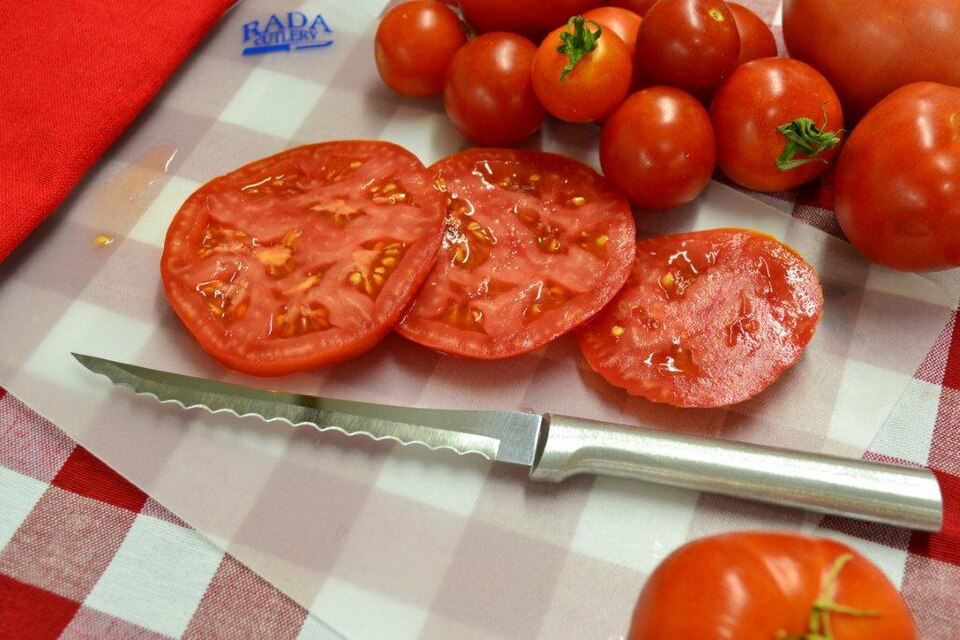
Highlight the difference between everyday language and scientific language by discussing instances where physical changes can be considered hard to undo in an everyday sense. For example, a tomato is physically changed when it is sliced, however, this change can only be partially reversed if you put the slices next to each other so they resemble the original tomato. The tomato cannot be unsliced.
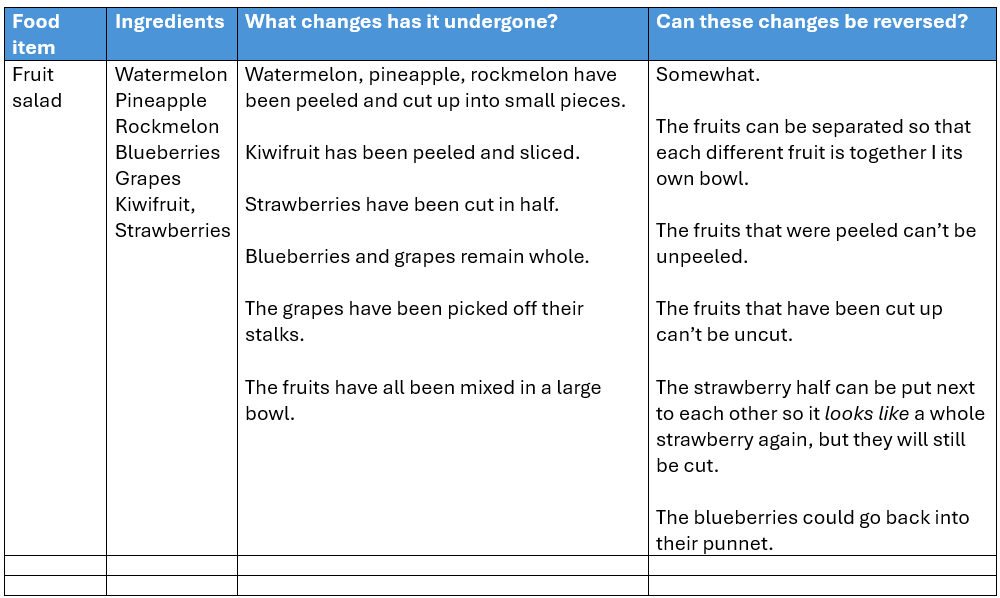
Begin building a class TWLH chart by recording what students THINK they know about the changes in general, as well as the changes food undergoes as it is prepared, stored etc. in the T section of the chart. Demonstrate the affinity between students’ ideas and understandings in the following way:
- Students list any learnings they remember from previous years about changes in general. They write one idea per slip of paper or sticky note.
- Consider limiting the number of ideas students can contribute at the present time. They can always add more ideas later.
- Provide the following prompts as a reminder as needed:
- Year 2—learning about how materials can be changed by bending, folding, twisting, scrunching, tearing, cutting, etc., but they are still the same material.
- Year 3—learning that heating and cooling solids and liquids can make them change.
- Year 4—learning about the water cycle and how water becomes clouds, which then become water again as rain.
- Year 5—learning about how gases change with heating and cooling.
- Ask a student to share something they think they know about changes.
- Other students who wrote down the same/similar ideas share their thoughts.
- Add these slips of paper/sticky notes collectively to the T column of the TWLH chart.
- Ask other members of the class (who did not share this idea) if they would agree with it. Record this information in an appropriate way. For example, as a number, a percentage, or a sentence: “Most students who didn’t share this idea said they agreed with it”.
- Repeat this process, focusing on the changes that food undergoes as it is prepared, stored etc.
- If an idea is shared that should be grouped with one that has already been added to the chart, ask students if they think this is a new idea or if it is similar to one already shared.
Physical and chemical changes
What distinguishes a chemical change from a physical change?
Physical change
Something is classified as a physical change when a change to the observable properties of an object or material takes place, but the particles or molecules of that object or material remain the same. Observable properties might include the size, shape, colour, texture or hardness of a material or object. The changes might affect how the object or material can be used.
Physical changes often involve cutting, tearing, scrunching, twisting, bending, etc.
For example, a tomato may be cut into smaller pieces, but it is still a tomato. A piece of paper can be cut or torn into small pieces. The size of the paper has changed, you might not be able to use the paper to write a letter to a friend, but the material itself is still paper. When a rock crumbles it might no longer be large, round and a visible part of the landscape, but the pieces of rock have not changed, just gotten smaller.
Physical changes are described as reversible because the chemical composition of the substance has not changed. Practically, though, some physical changes cannot be reversed. A cut tomato cannot be put back together to make a whole tomato again.
Physical change occurs when an object gains or loses energy. This might be from a force (for example, by being hit) or when a substance gains or loses heat energy. Water, ice or steam all consist of H2O molecules whether it is in the form of a gas (water vapour), liquid (water), or solid (ice).
Chemical change
A chemical change is different to a physical change because a chemical change leads to the creation of a new substance. The particles or molecules break apart and reform into something else. The newly rearranged chemical particles or molecules might be in the form of a gas, liquid or solid.
When you burn a piece of toast, the bread changes into charcoal, carbon dioxide, and water. Other examples of chemical change include rusting or mixing sodium bicarbonate (bicarb soda) with an acid (such as citric or tartaric) in water to create carbon dioxide and water.
Chemical changes are almost impossible to reverse because the original substance/s no longer exist, and a new chemical substance has been formed.
Can physical and chemical changes occur together?
Some substances can undergo both physical and chemical changes at the same time. These changes are only detectable through scientific testing. For example, when sodium bicarbonate dissolves in water, the majority of the change is physical dissolving, however, some of the sodium bicarbonate and water react chemically to produce a slightly alkaline solution.
Salt dissolving in water is considered a reversible change, as it is possible to retrieve the salt by evaporating the water from the salty solution. While this may be considered a physical change by some, the actual salt particles do change into ‘new’ charged particles (ions) that reform the original particles when the water is removed. This means that dissolving is a chemical change rather than a physical change. For Year 6 students, classifying dissolving as a reversible change is appropriate.
Physical change
Something is classified as a physical change when a change to the observable properties of an object or material takes place, but the particles or molecules of that object or material remain the same. Observable properties might include the size, shape, colour, texture or hardness of a material or object. The changes might affect how the object or material can be used.
Physical changes often involve cutting, tearing, scrunching, twisting, bending, etc.
For example, a tomato may be cut into smaller pieces, but it is still a tomato. A piece of paper can be cut or torn into small pieces. The size of the paper has changed, you might not be able to use the paper to write a letter to a friend, but the material itself is still paper. When a rock crumbles it might no longer be large, round and a visible part of the landscape, but the pieces of rock have not changed, just gotten smaller.
Physical changes are described as reversible because the chemical composition of the substance has not changed. Practically, though, some physical changes cannot be reversed. A cut tomato cannot be put back together to make a whole tomato again.
Physical change occurs when an object gains or loses energy. This might be from a force (for example, by being hit) or when a substance gains or loses heat energy. Water, ice or steam all consist of H2O molecules whether it is in the form of a gas (water vapour), liquid (water), or solid (ice).
Chemical change
A chemical change is different to a physical change because a chemical change leads to the creation of a new substance. The particles or molecules break apart and reform into something else. The newly rearranged chemical particles or molecules might be in the form of a gas, liquid or solid.
When you burn a piece of toast, the bread changes into charcoal, carbon dioxide, and water. Other examples of chemical change include rusting or mixing sodium bicarbonate (bicarb soda) with an acid (such as citric or tartaric) in water to create carbon dioxide and water.
Chemical changes are almost impossible to reverse because the original substance/s no longer exist, and a new chemical substance has been formed.
Can physical and chemical changes occur together?
Some substances can undergo both physical and chemical changes at the same time. These changes are only detectable through scientific testing. For example, when sodium bicarbonate dissolves in water, the majority of the change is physical dissolving, however, some of the sodium bicarbonate and water react chemically to produce a slightly alkaline solution.
Salt dissolving in water is considered a reversible change, as it is possible to retrieve the salt by evaporating the water from the salty solution. While this may be considered a physical change by some, the actual salt particles do change into ‘new’ charged particles (ions) that reform the original particles when the water is removed. This means that dissolving is a chemical change rather than a physical change. For Year 6 students, classifying dissolving as a reversible change is appropriate.
Alternative conceptions
What alternative conceptions might students hold about physical and chemical changes?

Many students might hold non-scientific conceptions about physical and chemical changes because the changes that occur at a particle level are not observable.
In physical changes that bring about a change of state, such as freezing, melting, evaporation and boiling, students might believe that substances which evaporate simply disappear and no longer exist and that heat and cold are actual substances involved in these changes.
Students may not realise that salt is still present when it is dissolved in water. They may believe that the salt has ‘disappeared’. Tasting the water before and after the addition of salt can support students in reconsidering their alternative conception.
Students might not realise that the substances produced by a chemical reaction are new substances, different from the original substances. For example, rust is not iron—it is a new molecule (iron oxide) generated when iron reacts with oxygen in the presence of water. Students might think that the same materials or substances are still present after a chemical change. A chemical change produces new substances by rearranging the chemical components of the original substances.
Many students do not understand that mass is conserved in a chemical change, that is, the combined mass of substances before and after the change is the same. Many students believe that the mass of exhaust gases is less than the mass of liquid petrol burnt in the car’s engine. This is related to the alternative conception that gases have no mass. Many students also believe that air or oxygen plays no active role in combustion reactions. Students may view the oxygen as a ‘fuel’ that is needed for fire but is not involved in the reaction itself.
Many students might hold non-scientific conceptions about physical and chemical changes because the changes that occur at a particle level are not observable.
In physical changes that bring about a change of state, such as freezing, melting, evaporation and boiling, students might believe that substances which evaporate simply disappear and no longer exist and that heat and cold are actual substances involved in these changes.
Students may not realise that salt is still present when it is dissolved in water. They may believe that the salt has ‘disappeared’. Tasting the water before and after the addition of salt can support students in reconsidering their alternative conception.
Students might not realise that the substances produced by a chemical reaction are new substances, different from the original substances. For example, rust is not iron—it is a new molecule (iron oxide) generated when iron reacts with oxygen in the presence of water. Students might think that the same materials or substances are still present after a chemical change. A chemical change produces new substances by rearranging the chemical components of the original substances.
Many students do not understand that mass is conserved in a chemical change, that is, the combined mass of substances before and after the change is the same. Many students believe that the mass of exhaust gases is less than the mass of liquid petrol burnt in the car’s engine. This is related to the alternative conception that gases have no mass. Many students also believe that air or oxygen plays no active role in combustion reactions. Students may view the oxygen as a ‘fuel’ that is needed for fire but is not involved in the reaction itself.
The Launch phase is designed to increase the science capital in a classroom by asking questions that elicit and explore students’ experiences. It uses local and global contexts and real-world phenomena that inspire students to recognise and explore the science behind objects, events and phenomena that occur in the material world. It encourages students to ask questions, investigate concepts, and engage with the Core Concepts that anchor each unit.
The Launch phase is divided into four routines that:
- ensure students experience the science for themselves and empathise with people who experience the problems science seeks to solve (Experience and empathise)
- anchor the teaching sequence with the key ideas and core science concepts (Anchor)
- elicit students’ prior understanding (Elicit)
- and connect with the students’ lives, languages and interests (Connect).
Science education consists of a series of key ideas and core concepts that can explain objects, events and phenomena, and link them to the experiences encountered by students in their lives. The purpose of the Anchor routine is to identify the key ideas and concepts in a way that builds and deepens students’ understanding. During the Launch phase, the Anchor routine provides a lens through which to view the classroom context, and a way to frame the key knowledge and skills students will be learning.
When designing a teaching sequence, consider the core concepts and key ideas that are relevant. Break these into small bite-sized pieces that are relevant to the age and stage of your students. Consider possible alternative concepts that students might hold. How could you provide activities or ask questions that will allow students to consider what they know?
Each student comes to the classroom with experiences made up from science-related knowledge, attitudes, experiences and resources in their life. The Connect routine is designed to tap into these experiences and that of their wider community. It is also an opportunity to yarn with community leaders (where appropriate) to gain an understanding of the student’s lives, languages and interests. In the Launch phase, this routine identifies and uses the science capital of students as the foundation of the teaching sequence so students can appreciate the relevance of their learning and its potential impact on future decisions. In short, this routine moves beyond scientific literacy and increases the science capital in the classroom and science identity of the students.
When planning a teaching sequence, take an interest in the lives of your students. What are their hobbies, how do they travel to and from school? What might have happened in the lives of your students (i.e. blackouts) that might be relevant to your next teaching sequence? What context might be of interest to your students?
Read more about using the LIA FrameworkCan we go back?
Watch a video or short clip that shows food being prepared. Some examples are provided below or you might like to find your own.
- Zucchini and cheese (0:20)
- Soft cake base (0:10)
- Fruit salad (0:22)
After watching each clip, list the ingredients shown and any changes they underwent. For example, fruits and vegetables may have been sliced, cheese melted, flour mixed with eggs and sugar and baked.
Next, ask students if they think any of the ingredients have become something new after undergoing these changes. Record students’ ideas in the class science journal.
Some of the below questions are based on the ingredients visible in the clips above. Make any changes or additions required due to the clips you choose to view.
- What change can we see occurring to the ingredients in the video?
- Is the tomato still a tomato, the cheese still cheese, or the flour still flour?
- Can you still ‘pick out’ each ingredient in the final product?
- Have the ingredients been combined to create something else? Or something new?
- How does adding sugar/salt change food?
- Can you tell if it has/hasn't been added to food?
Explain to students that during this sequence they will:
- make detailed observational notes about the food storage and preparation methods that occur in their home kitchens, including ingredients/foods and utensils used as well as the cooking methods.
- work like scientists to investigate changes so that they are able to understand why certain ingredients and items are used in the kitchen.
- create a Chemistry in my kitchen experience at the end of the sequence, to share with a selected audience.
- This task can be modified to suit your students’ specific needs and context. See the ‘Selecting a focus for the Act phase’ section in the Preparing for this sequence tab.
- Optional: If known, explain the specific requirements of the Chemistry in my kitchen experience for students. Otherwise, discuss options with students and allow them to select what they would like to do to demonstrate their learning.
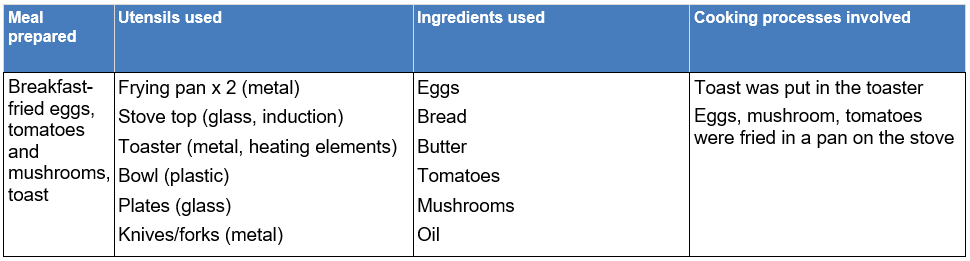
Introduce the My kitchen observations Resource sheet. Discuss, and demonstrate if required, how students might complete the table over the course of the sequence. Include any parameters that you feel will be useful and achievable for students, for example:
- observing the preparation of a variety of meals (breakfast, lunch. dinner, snacks) and recording at least 3 observations per week.
- assisting in the preparation of meals.
- attending and/or observing community or family festivals and events involving food.
- interviewing family members about specific cultural food traditions.
Students might record their observations in situ at home, or you might provide time during the school day for students to record what they have observed at home or elsewhere.
The Launch phase is designed to increase the science capital in a classroom by asking questions that elicit and explore students’ experiences. It uses local and global contexts and real-world phenomena that inspire students to recognise and explore the science behind objects, events and phenomena that occur in the material world. It encourages students to ask questions, investigate concepts, and engage with the Core Concepts that anchor each unit.
The Launch phase is divided into four routines that:
- ensure students experience the science for themselves and empathise with people who experience the problems science seeks to solve (Experience and empathise)
- anchor the teaching sequence with the key ideas and core science concepts (Anchor)
- elicit students’ prior understanding (Elicit)
- and connect with the students’ lives, languages and interests (Connect).
Identifying and constructing questions is the creative driver of the inquiry process. It allows students to explore what they know and how they know it. During the Inquire phase of the LIA Framework, the Question routine allows for past activities to be reviewed and to set the scene for the investigation that students will undertake. The use of effective questioning techniques can influence students’ view and interpretation of upcoming content, open them to exploration and link to their current interests and science capital.
When designing a teaching sequence, it is important to spend some time considering the mindset of students at the start of each Inquire phase. What do you want students to be thinking about, what do they already know and what is the best way for them to approach the task? What might tap into their curiosity?
Read more about using the LIA FrameworkWhat do we want to know?
Use the Question Formulation Technique to brainstorm questions to add further questions to the ‘What we want to know’ column of the class TWLH chart. Prompt students to ask a broad range of questions about substances changing by referring to ideas from this lesson, including:
- the foods they observed and the changes the foods underwent.
- learnings about changes in previous years.
- changes to food.
- other changing substances students have an interest in.
Reflect on the lesson
You might:
- begin a class word wall or glossary of relevant terms and images that students will likely use through the sequence.
- review the class TWLH chart.