

What‘s great for growth?
View Sequence overviewStudents will:
- create a yeast culture and measure its growth over twelve minutes.
- work in teams to plan and conduct an investigation to explore the effect of food types on yeast growth.
Students will represent their understanding as they:
- make reasoned predictions about food types affecting yeast growth.
- contribute to discussions and compare yeast growth.
- describe how the type of food affects yeast growth and make a claim that responds to the prediction(s) they made with supporting evidence and reasoning.
In this lesson, assessment is formative.
Feedback might focus on students’:
- line graphs. Have students clearly represented their observations for increased growth with certain food types?
- statements about which food helps yeast grow best. Have students identified and provided evidence to support their claim?
- recipe for the best yeast culture. Have students identified the food that resulted in the most yeast growth?
Whole class
Class science journal (digital or hard-copy)
Demonstration copy of the Fantastic fungi Resource sheet
A sample of dry yeast
Optional: Demonstration copy of the Variables grid yeast food Resource sheet OR Demonstration copy of the Variable grid Resource sheet
Each group
2 x clear jars or cups
Ruler
1 x teaspoon
1 x permanent marker
2 x teaspoons of dry yeast
1 x teaspoon of sugar
200ml of warm water
One ingredient from a selection to be tested as food for yeast, such as: flour, cornflour, juice, honey, powdered milk
Timing device
Each student
Individual science journal (digital or hard-copy)
Yeast feast Resource sheet
Lesson
The Inquire phase allows students to cycle progressively and with increasing complexity through the key science ideas related to the core concepts. Each Inquire cycle is divided into three teaching and learning routines that allow students to systematically build their knowledge and skills in science and incorporate this into their current understanding of the world.
When designing a teaching sequence, it is important to consider the knowledge and skills that students will need in the final Act phase. Consider what the students already know and identify the steps that need to be taken to reach the level required. How could you facilitate students’ understanding at each step? What investigations could be designed to build the skills at each step?
Read more about using the LIA FrameworkRe-orient
Recall the previous lesson, focusing on the duckweed growth. Allow time for students to record further observations if the investigation is ongoing.
Discuss how duckweed needs sunlight and still water to grow.
If still continuing the radish race, share and compare recently collected data about the growth of the radishes (or other seeds), discussing how their growth has changed since they were first planted, particularly in relation to the conditions they are growing in.
- Which radishes are growing “the best” so far? Why do you think that?
- Do you think this will continue to be the case? Why/why not?
- How have you ensured that you are keeping conditions as close to the required parameters as possible (i.e. maintaining levels of light, temperature, water, nutrients each day)?
- How have the conditions helped or hindered the growth of each radish?
- Are any radishes showing signs of distress or disease? What are they and why do you think they are occurring?
Students continue the radish race until they are able to determine which radishes grew “best”.
The Inquire phase allows students to cycle progressively and with increasing complexity through the key science ideas related to the core concepts. Each Inquire cycle is divided into three teaching and learning routines that allow students to systematically build their knowledge and skills in science and incorporate this into their current understanding of the world.
When designing a teaching sequence, it is important to consider the knowledge and skills that students will need in the final Act phase. Consider what the students already know and identify the steps that need to be taken to reach the level required. How could you facilitate students’ understanding at each step? What investigations could be designed to build the skills at each step?
Read more about using the LIA FrameworkIdentifying and constructing questions is the creative driver of the inquiry process. It allows students to explore what they know and how they know it. During the Inquire phase of the LIA Framework, the Question routine allows for past activities to be reviewed and to set the scene for the investigation that students will undertake. The use of effective questioning techniques can influence students’ view and interpretation of upcoming content, open them to exploration and link to their current interests and science capital.
When designing a teaching sequence, it is important to spend some time considering the mindset of students at the start of each Inquire phase. What do you want students to be thinking about, what do they already know and what is the best way for them to approach the task? What might tap into their curiosity?
Read more about using the LIA FrameworkFungi
Explain to students that over the next few sessions they are going to investigate the conditions needed to grow a different type of living thing: fungus. Explain that fungi are everywhere and that students might even eat fungi every day.
Show the image of leavened bread from page 1 of the Fantastic fungi Resource sheet and ask students if they know how fungi played a role in making this loaf of bread. Explain and discuss the basic role of yeast in making bread—it helps the bread to rise.
- Have you heard of yeast before?
- What is yeast used for?
- What foods would you find yeast in?
- As necessary, explain to students that yeast is a type of fungus that is used in the baking of (leavened) bread.
- At this stage do not specifically discuss how yeast helps bread to rise (by producing gas that expands the dough), just that it does. Students will explore this as they watch the yeast grow during the investigations. If students offer the information themselves it is fine to acknowledge and discuss, as you may well have already explored yeast in the Year 6 Chemical science sequence Chemistry in the kitchen.
Ask students what conditions they think that yeast fungi need to grow. Show students the sample of dry yeast and specifically discuss how they might test the yeast to see if it needs sunlight, air, water and nutrients as a plant does, or if it can make its own food.
Pose the question: Does yeast need an external source of food to grow?
Fungi
What are the different types of fungi?
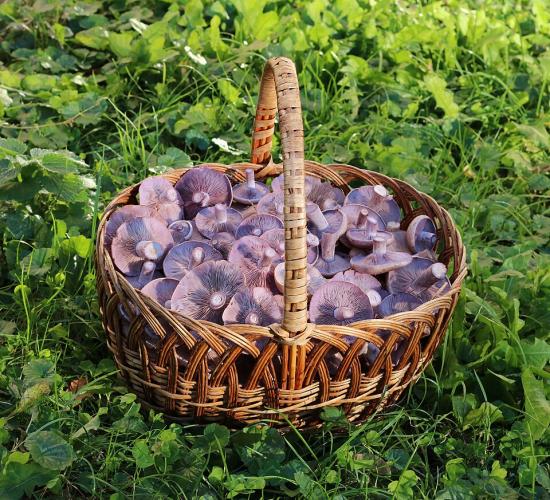
Fungi are living organisms that cannot make their own food, so they get nutrients from external sources—other living things or decaying material. This is why they are often described as decomposers or recyclers in ecosystems, as they help break down dead material and recycle nutrients in ecosystems.
In this lesson students discuss three common types of fungi:
- Mushrooms—as an edible fungi students are likely familiar with them.
- Yeast—another edible fungi, it is key to making bread and will be used as part of investigations.
- Mould—another common fungi and a key decomposer. Students will grow mould in a later investigation.
Mushrooms
Mushrooms are a type of fungus that usually grow in soil, on trees, or on other organic material. They are not plants because they cannot make their own food using sunlight. Instead, mushrooms get nutrients by breaking down and absorbing material from their surroundings.
A mushroom usually has a stem and a cap. Under the cap are gills, which produce and release tiny spores. These spores help mushrooms reproduce and spread to new places. Mushrooms come in many different shapes, sizes and colours. Some mushrooms are safe to eat, while others are poisonous.
Mushrooms are important to the environment because they help decompose dead plants and animals. This returns nutrients to the soil and helps new plants grow. Mushrooms are also used by people as food and in some medicines.
Yeasts
Yeast is a type of fungus made up of tiny, single-celled organisms. Unlike mushrooms and mould, yeast is usually too small to see without a microscope. Yeast can be found naturally in places such as soil, plants, fruits and the air.
Yeast gets its nutrients from sugars and other organic materials around it. It reproduces by a process called “budding”, where a small new cell grows from the parent cell and eventually separates. When there is plenty of food and suitable conditions, yeast can reproduce very quickly.
Yeast is an important part of nature because it helps break down organic materials and recycle nutrients. It is also useful to people in baking, where yeast helps dough rise by producing carbon dioxide gas. Some types of yeast are also used to make foods such as certain cheeses and fermented foods.
Moulds
Mould is a type of fungus that grows in many different places, especially where there is moisture, warmth and food. It can grow on bread, fruit, vegetables, walls, wood and other materials. Mould can be many different colours, including green, black, white, blue and orange.
Mould is made up of tiny, thread-like structures called “hyphae”. A group of hyphae forms a network called a “mycelium”. Mould reproduces by producing tiny spores, which can travel through the air and grow into new mould when they land in a suitable place.
Mould is important because it helps break down dead plants, animals and other materials. This returns nutrients to the environment. However, some types of mould can spoil food or cause health problems, so it is important to avoid eating mouldy food and to keep damp areas clean and dry.
Mushrooms, moulds and yeasts are common groups of fungi, but there are many other types.
- Parasitic fungi—live on or inside living organisms and take nutrients from them. Some can cause diseases in plants, animals and humans.
- Lichens—a partnership between a fungus and an organism such as algae or cyanobacteria. They can grow on rocks, trees and other surfaces.
- Rust fungi—usually grow on plants and can cause orange, yellow or brown spots on leaves and stems.
- Smuts—fungi that commonly infect plants, especially grasses and crops, and can produce dark, powdery spores.
- Mildew—grows on damp surfaces and plants, often appearing as a thin, powdery or fuzzy coating.
- Truffles—fungi that grow underground and form edible fruiting bodies. They are related to mushrooms but look very different.
Fungi are living organisms that cannot make their own food, so they get nutrients from external sources—other living things or decaying material. This is why they are often described as decomposers or recyclers in ecosystems, as they help break down dead material and recycle nutrients in ecosystems.
In this lesson students discuss three common types of fungi:
- Mushrooms—as an edible fungi students are likely familiar with them.
- Yeast—another edible fungi, it is key to making bread and will be used as part of investigations.
- Mould—another common fungi and a key decomposer. Students will grow mould in a later investigation.
Mushrooms
Mushrooms are a type of fungus that usually grow in soil, on trees, or on other organic material. They are not plants because they cannot make their own food using sunlight. Instead, mushrooms get nutrients by breaking down and absorbing material from their surroundings.
A mushroom usually has a stem and a cap. Under the cap are gills, which produce and release tiny spores. These spores help mushrooms reproduce and spread to new places. Mushrooms come in many different shapes, sizes and colours. Some mushrooms are safe to eat, while others are poisonous.
Mushrooms are important to the environment because they help decompose dead plants and animals. This returns nutrients to the soil and helps new plants grow. Mushrooms are also used by people as food and in some medicines.
Yeasts
Yeast is a type of fungus made up of tiny, single-celled organisms. Unlike mushrooms and mould, yeast is usually too small to see without a microscope. Yeast can be found naturally in places such as soil, plants, fruits and the air.
Yeast gets its nutrients from sugars and other organic materials around it. It reproduces by a process called “budding”, where a small new cell grows from the parent cell and eventually separates. When there is plenty of food and suitable conditions, yeast can reproduce very quickly.
Yeast is an important part of nature because it helps break down organic materials and recycle nutrients. It is also useful to people in baking, where yeast helps dough rise by producing carbon dioxide gas. Some types of yeast are also used to make foods such as certain cheeses and fermented foods.
Moulds
Mould is a type of fungus that grows in many different places, especially where there is moisture, warmth and food. It can grow on bread, fruit, vegetables, walls, wood and other materials. Mould can be many different colours, including green, black, white, blue and orange.
Mould is made up of tiny, thread-like structures called “hyphae”. A group of hyphae forms a network called a “mycelium”. Mould reproduces by producing tiny spores, which can travel through the air and grow into new mould when they land in a suitable place.
Mould is important because it helps break down dead plants, animals and other materials. This returns nutrients to the environment. However, some types of mould can spoil food or cause health problems, so it is important to avoid eating mouldy food and to keep damp areas clean and dry.
Mushrooms, moulds and yeasts are common groups of fungi, but there are many other types.
- Parasitic fungi—live on or inside living organisms and take nutrients from them. Some can cause diseases in plants, animals and humans.
- Lichens—a partnership between a fungus and an organism such as algae or cyanobacteria. They can grow on rocks, trees and other surfaces.
- Rust fungi—usually grow on plants and can cause orange, yellow or brown spots on leaves and stems.
- Smuts—fungi that commonly infect plants, especially grasses and crops, and can produce dark, powdery spores.
- Mildew—grows on damp surfaces and plants, often appearing as a thin, powdery or fuzzy coating.
- Truffles—fungi that grow underground and form edible fruiting bodies. They are related to mushrooms but look very different.
The Inquire phase allows students to cycle progressively and with increasing complexity through the key science ideas related to the core concepts. Each Inquire cycle is divided into three teaching and learning routines that allow students to systematically build their knowledge and skills in science and incorporate this into their current understanding of the world.
When designing a teaching sequence, it is important to consider the knowledge and skills that students will need in the final Act phase. Consider what the students already know and identify the steps that need to be taken to reach the level required. How could you facilitate students’ understanding at each step? What investigations could be designed to build the skills at each step?
Read more about using the LIA FrameworkThe Investigate routine provides students with an opportunity to explore the key ideas of science, to plan and conduct an investigation, and to gather and record data. The investigations are designed to systematically develop content knowledge and skills through increasingly complex processes of structured inquiry, guided inquiry and open inquiry approaches. Students are encouraged to process data to identify trends and patterns and link them to the real-world context of the teaching sequence.
When designing a teaching sequence, consider the diagnostic assessment (Launch phase) that identified the alternative conceptions that students held. Are there activities that challenge these ideas and provide openings for discussion? What content knowledge and skills do students need to be able to complete the final (Act phase) task? How could you systematically build these through the investigation routines? Are there opportunities to build students’ understanding and skills in the science inquiry processes through the successive investigations?
Read more about using the LIA FrameworkHow fast does yeast grow?
Explain that students are going to investigate whether yeast can make its own food using light and water, or if it needs to get its food from somewhere else. Note for students that this will help them work out how to make yeast grow, before they can then test to see if changing the conditions can affect how much it grows.
Using a demonstration copy of Part 1 of the Yeast feast Resource sheet look at and discuss the setup of the investigation:
- Begin with two jars/cups that are the same size.
- Add 100 ml warm water to each jar.
- Add 1 teaspoon of yeast to each jar.
- Add 1 teaspoon of sugar to jar 2.
List the variables that are the same (jar size, amount of water, amount of yeast, temperature of water) and the variable that has changed (one jar has a food source added, sugar).
Ask students what they know about sugar and if they think it will help the yeast grow or not.
Complete Part 1 of the Yeast feast investigation, either with students in teams or as a demonstration with the whole class (this is a useful method if careful modelling of conducting the investigation and gathering and recording the data is required).
- Label the jars/cups as 1 and 2.
- Add the following ingredients to two separate jars and stir.
- Jar 1: 1 teaspoon yeast, 100ml warm water
- Jar 2: 1 teaspoon yeast, 100ml warm water, 1 teaspoon sugar
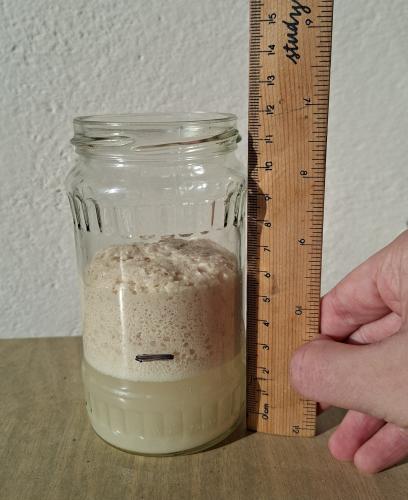
- Mark the jars at the top of the mixture with a permanent marker.
- Measure and record the height from the bottom of the jar to the marks.
- Leave the jars sitting on a bench for two minutes.
- Measure how much the yeast mixtures have grown by using a ruler to measure the height from the bottom of the jar to the top of the froth.
- Repeat these measurements every two minutes for 12 minutes.
The Inquire phase allows students to cycle progressively and with increasing complexity through the key science ideas related to the core concepts. Each Inquire cycle is divided into three teaching and learning routines that allow students to systematically build their knowledge and skills in science and incorporate this into their current understanding of the world.
When designing a teaching sequence, it is important to consider the knowledge and skills that students will need in the final Act phase. Consider what the students already know and identify the steps that need to be taken to reach the level required. How could you facilitate students’ understanding at each step? What investigations could be designed to build the skills at each step?
Read more about using the LIA FrameworkIdentifying and constructing questions is the creative driver of the inquiry process. It allows students to explore what they know and how they know it. During the Inquire phase of the LIA Framework, the Question routine allows for past activities to be reviewed and to set the scene for the investigation that students will undertake. The use of effective questioning techniques can influence students’ view and interpretation of upcoming content, open them to exploration and link to their current interests and science capital.
When designing a teaching sequence, it is important to spend some time considering the mindset of students at the start of each Inquire phase. What do you want students to be thinking about, what do they already know and what is the best way for them to approach the task? What might tap into their curiosity?
Read more about using the LIA FrameworkFollowing an investigation, the Integrate routine provides time and space for data to be evaluated and insights to be synthesized. It reveals new insights, consolidates and refines representations, generalises context and broadens students’ perspectives. It allows student thinking to become visible and opens formative feedback opportunities. It may also lead to further questions being asked, allowing the Inquire phase to start again.
When designing a teaching sequence, consider the diagnostic assessment that was undertaken during the Launch phase. Consider if alternative conceptions could be used as a jumping off point to discussions. How could students represent their learning in a way that would support formative feedback opportunities? Could small summative assessment occur at different stages in the teaching sequence?
Read more about using the LIA FrameworkComparing results
In the following Integrate routine, students are guided to link their experiences and observations in the growing yeast investigation to the science concept being explored—that is, that organisms need specific conditions in which to grow and thrive. Through questioning and discussion, students should come to a consensus that:
|
Discuss the results of the investigation with the class.
- What condition did we investigate?
- Was this a physical (non-living) condition? Why do you think that?
- How much did the yeast grow over the 12 minutes?
- Did it grow by the same amount over each two minute interval? Or did it grow quickly at first and then slow, or vice versa? Why do you think that happened?
- What do you think would happen if we added more sugar and less water, or more water and less sugar?
- What did the growth of the yeast look, sound or smell like?
- How/why do you think the yeast grew in these conditions? What role did the sugar and water play?
- If required, explain that:
- Water rehydrates the dry yeast cells and lets them start moving and working.
- The yeast feeds on the sugar for energy, breaking down the sugar molecules.
- During this process the yeast consumes the oxygen and releases carbon dioxide gas, which makes the mixture foam and rise.
- If required, explain that:
- What other conditions could we change to help the yeast grow better?
If the investigation was carried out by students in teams, also discuss the similarities and differences between teams’ results.
- What did you notice about how your yeast grew compared to other groups?
- Why do you think some groups got different results even if the experiment was similar?
- What factors (like temperature, sugar, or time) might have affected the yeast growth?
- Did anything surprise you about your results or another group’s results?
- If you could repeat the experiment, what would you change to get better or more consistent results?
Pose the question: Is sugar the only food or the best food for yeast?
The Inquire phase allows students to cycle progressively and with increasing complexity through the key science ideas related to the core concepts. Each Inquire cycle is divided into three teaching and learning routines that allow students to systematically build their knowledge and skills in science and incorporate this into their current understanding of the world.
When designing a teaching sequence, it is important to consider the knowledge and skills that students will need in the final Act phase. Consider what the students already know and identify the steps that need to be taken to reach the level required. How could you facilitate students’ understanding at each step? What investigations could be designed to build the skills at each step?
Read more about using the LIA FrameworkThe Investigate routine provides students with an opportunity to explore the key ideas of science, to plan and conduct an investigation, and to gather and record data. The investigations are designed to systematically develop content knowledge and skills through increasingly complex processes of structured inquiry, guided inquiry and open inquiry approaches. Students are encouraged to process data to identify trends and patterns and link them to the real-world context of the teaching sequence.
When designing a teaching sequence, consider the diagnostic assessment (Launch phase) that identified the alternative conceptions that students held. Are there activities that challenge these ideas and provide openings for discussion? What content knowledge and skills do students need to be able to complete the final (Act phase) task? How could you systematically build these through the investigation routines? Are there opportunities to build students’ understanding and skills in the science inquiry processes through the successive investigations?
Read more about using the LIA FrameworkWhat food helps yeast grow best?
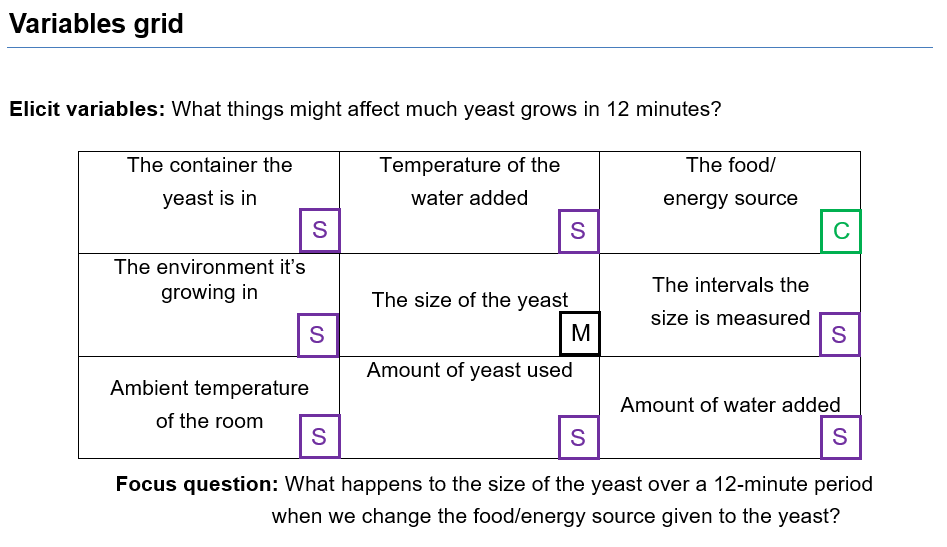
Show students the completed variables grid on Variables grid yeast food Resource sheet, or make your own variables grid which includes all of the variables from the previous investigation.
Highlight that in the next investigation the independent variable will be the yeast’s food/energy source.
If necessary, discuss the need to follow fair testing procedures.
- Why is it important that we only change one thing in our yeast experiment?
- What could happen if we changed more than one thing at a time?
- What might happen if one group used warm water and another used cold water?
- This will be investigated in the following lesson.
- How would it affect our results if one group used more yeast than another? Or if we added different amounts of food?
- Changing more than one variable means that we cannot identify which variable affected the result.
- We wouldn't be able to accurately compare each group’s results.
- How does keeping the same amount of yeast, water, and food help make the test fair?
- It helps us to know if it was only the type of food that made a difference, not anything else.
- How do fair tests help us trust the results we get from an experiment?
Brainstorm a list of potential foods that could be added to the yeast instead of sugar.
Show students the prepared new ingredients available for their investigation (such as cornflour, powdered milk, flour, honey, apple juice).
Pose the question: Which food will help the yeast grow best?
Clarify that in this instance “best” means the yeast that has grown and produced the most gas at the end of the 12-minute timeframe.
In teams, allow time for students to use Part 2 of the Yeast feast Resource sheet to:
- record the variables for the investigation, including the food source they have selected as their independent variable.
- make a prediction about what they think will happen to the growth of the yeast with this new food source.
- complete any further planning for the investigation.
- carry out the investigation, recording the 12 minutes of data collection with the new yeast sample.
Too much sugar
How much sugar is too much sugar for yeast?

High amounts of sugar can slow down yeast growth because it makes it harder for the yeast cells to stay properly hydrated and function normally.
Yeast needs a balanced amount of water inside and outside its cells to grow and reproduce. When there is a lot of sugar in the mixture, water moves out of the yeast cells into the surrounding liquid (due to osmosis). This leaves the cells a bit “dried out”, which makes them work less efficiently.
As a result, the yeast grows more slowly and produces less gas. In very sugary conditions, the yeast may become inactive or stop growing altogether. This is why recipes usually use only moderate amounts of sugar—enough to feed the yeast, but not so much that it slows them down.
High amounts of sugar can slow down yeast growth because it makes it harder for the yeast cells to stay properly hydrated and function normally.
Yeast needs a balanced amount of water inside and outside its cells to grow and reproduce. When there is a lot of sugar in the mixture, water moves out of the yeast cells into the surrounding liquid (due to osmosis). This leaves the cells a bit “dried out”, which makes them work less efficiently.
As a result, the yeast grows more slowly and produces less gas. In very sugary conditions, the yeast may become inactive or stop growing altogether. This is why recipes usually use only moderate amounts of sugar—enough to feed the yeast, but not so much that it slows them down.
The Inquire phase allows students to cycle progressively and with increasing complexity through the key science ideas related to the core concepts. Each Inquire cycle is divided into three teaching and learning routines that allow students to systematically build their knowledge and skills in science and incorporate this into their current understanding of the world.
When designing a teaching sequence, it is important to consider the knowledge and skills that students will need in the final Act phase. Consider what the students already know and identify the steps that need to be taken to reach the level required. How could you facilitate students’ understanding at each step? What investigations could be designed to build the skills at each step?
Read more about using the LIA FrameworkFollowing an investigation, the Integrate routine provides time and space for data to be evaluated and insights to be synthesized. It reveals new insights, consolidates and refines representations, generalises context and broadens students’ perspectives. It allows student thinking to become visible and opens formative feedback opportunities. It may also lead to further questions being asked, allowing the Inquire phase to start again.
When designing a teaching sequence, consider the diagnostic assessment that was undertaken during the Launch phase. Consider if alternative conceptions could be used as a jumping off point to discussions. How could students represent their learning in a way that would support formative feedback opportunities? Could small summative assessment occur at different stages in the teaching sequence?
Read more about using the LIA FrameworkCollating the data
In the following Integrate routine, students are guided to link their experiences and observations on a micro level about growing yeast to the science concept on a macro level, that is, that changing the conditions an organism exists in can affect its rate of growth and chance of successful survival. Through questioning and discussion, students should come to a consensus that:
|
Teams share their data and add it to the class results section of the demonstration copy of the Yeast feast Resource sheet. Add as many rows as you have groups to the class results table.
Refer students to the previous lesson and how to draw a column or line graph. As a class or individually, use the class results data to graph the growth of each culture, using a different line colour for each food type.
Compare the class yeast growth results to the predictions made by students. Discuss the accuracy of the predictions that were made.
Compare the data collected on all of the different foods and determine if sugar was the most effective, or if some other food source was better or as good. Invite students to use evidence from their investigation to make a claim about the best food that helps yeast to grow.
Pose the question: Why do some foods help the yeast grow better than others?
Determine with students what they have learned on a micro level (plants, animals and fungi all need different types of food), and how it might apply from a macro perspective (all living things have preferred nutrients and sunlight to survive). Record these in the class science journal. See the step purpose section at the beginning of this step for details that might guide your discussion.
Optional: Explore yeast further:
- Discuss how bread makes yeast rise.
- View videos to explore how yeast makes bread rise, such as:
- Discuss how students could use their investigation to write an improved recipe for bread. As a class or individually, write a school bread recipe that provides the best conditions for yeast growth.
Reflect on the lesson
You might:
- add to the class word wall or glossary any relevant words and images related to yeast growth and suitable food sources to support growth.
- add to the L and H sections of the TWLH chart.
- discuss how the learning from this lesson relates to conditions affecting yeast growth in nature and food manufacturing.